Search This Blog

Friday, November 22, 2013

Review: Bad Monkey by Carl Hiaasen

Bad MonkeyBad Monkey by Carl Hiaasen
My rating: 4 of 5 stars

I'd call myself a fan of Carl Hiaasen. I enjoy his offbeat characters, his plots revolving around corruption and illegal acts that skate in under the radar, and his insight into how Florida runs. (Hint: it's badly.)

So of course I had to pick up his latest book soon after it came out. I picked it up on audio, because I seem to get around to audio books much more quickly. I think I would've enjoyed a paper version more, but I also wouldn't be reviewing it until sometime next summer.

Bad Monkey starts with a tourist on a fishing trip catching a disembodied human arm. The arm makes it to our hero, Andrew Yancy, a soon-to-be-ex-cop, who shoved a hand vac up a man's rectum for insulting Yancy's girlfriend at the time. The man was his girlfriend's husband, and a well-respected doctor. The matter is settled out of court, but it takes Yancy off the force and puts him in a job inspecting restaurants for health code violations. This makes him suspicious of even food cooked in his own kitchen, and he thinks he sees roaches everywhere.

In hopes of returning to his position as a cop, Yancy looks into the mystery of the severed arm, and becomes convinced the wife did it. When several witnesses are murdered and someone comes after him, he starts to think he's onto something. His investigation takes him to the Bahamas, where the suspect widow is funding a condo by the ocean. That's where the titular monkey comes in. Driggs is a capuchin monkey with a skin condition and a fondness for fried food. His owner, Neville, was told he's the monkey from the Pirates of the Caribbean movies, and the book does delve into Driggs's back story to confirm that. The monkey's behavior, though, indicates it's a lie. He's anything but tame, and brings Neville only grief. In trying to rid himself of the monkey, though, he unwittingly helps Dr. Rosa Campesino, Yancy's girlfriend and helper in the murder investigation, get free of kidnappers.

The plot is fairly convoluted, though still easy to follow. Perhaps it's the reliance on Hiaasen standbys. Yancy is the jaded but well-loved authority figure, capable of plenty of mischief. Rosa is the slightly unbalanced love interest, there are two evil developers, and dumb mooks abound. As always, in the end, the bad guys are punished, though the comeuppance comes well after the book's climax.

The ending felt rather padded, actually. We know the bad guys are doomed long before we find out their final fate. There are a lot of plot threads to wrap up, and a lot of characters to account for. It makes for an entertaining complexity, but it also made me feel like the book is too scattered, and would've been better told as a novella.

My only other complaint is that most of Rosa Campesino's quirkiness rests on the fact that she has some kinks. I don't find that particularly odd. But then, I'm well aware that what a person gets off to is no reflection on that person's sanity. Having kinks is not a sign of mental damage. The minor character who develops an auto-erotic asphyxiation fetish off-screen supports the notion that Hiaasen thinks something has to be wrong with someone who doesn't want vanilla sex, which is demonstrably false, and a damaging notion to promote.

The narrator for this audio book has a heavy New York accent, which, in a book about people in Florida, seemed a little off. I was distracted from the story anytime he had to pronounce a word with "hu" in it (yooge, yoomungous, yoomorous). He frequently sounded annoyed, like the book was a pain to have to read aloud, and he'd lower his voice in the middle of sentences. His emphasis was also off, making familiar words sound foreign. Needless to say, the narrator detracted from my enjoyment of this book.

Overall, I did like Bad Monkey, though its flaws became more glaring, read aloud by this narrator. If you're thinking of reading it, I recommend something you can read for yourself, instead of having to listen to this guy.


View all my reviews

Thursday, November 21, 2013

Review: Doppelganster (Esther Diamond #2) by Laura Resnick

Doppelgangster (Esther Diamond, #2)Doppelgangster by Laura Resnick
My rating: 4 of 5 stars

This is the second book in the Esther Diamond series. It's an improvement over the last book, though there are some indications the series might fall into some tropes I dislike.

In the previous book, Esther, a struggling stage actress, found out that magic exists, and stopped a sorcerer who wanted to sacrifice leading ladies to a powerful demon. In this book, her familiarity with magic serves her well, as it's the only explanation for the bizarre deaths taking place at her day job at an Italian restaurant. People with mod connections are seeing perfect doubles of themselves, and then dying within hours. A hit man asks Esther for help finding the killer. Meanwhile, Detective Lopez has been moved to the department that investigates the Mafia, and he'd very much like for Esther to stay out of it before his conflict of interest gets them both in trouble.

The title probably would've been funnier if it hadn't been adopted as the name for what's killing mobsters, and repeated throughout the text. Still, it's apt, and eye-catching enough to make someone want to pick this up, if it's the sort of thing they'd like.

This book never pretends to be anything it isn't. It's silly, fluffy urban fantasy, and Esther well knows how ridiculous it sounds. In case she forgets, other characters are more than willing to laugh or disbelieve. That made me feel this book is more grounded in reality than most urban fantasy, despite its humor trappings.

There were times, though, when it seemed the humor might rely on the absurdity a little too much. I worried future books might start to string together wacky hijinks, for lack of any better ideas. It gave me flashbacks to the Stephanie Plum series, which I've give up on.

For now, though, I do plan to read the next book. We'll see if it lays the above fears to rest, and continues to give me the fun melding of murder mystery and magic that I enjoy in these books. I also hope we see more Detective Lopez. Not because I particularly like him, but I like how Esther plays off him.


View all my reviews

Tuesday, November 19, 2013

Review: The Historian by Elizabeth Kostova

The HistorianThe Historian by Elizabeth Kostova
My rating: 4 of 5 stars

I've had a copy of this book sitting on my shelf practically since the paperback release. It had all the elements of a book I might enjoy, but I was worried the book in my head was more interesting than what was on the pages. That's why this book was on my 2013 TBR Challenge. And, while it wasn't the book I imagined, it wasn't as terrible as I feared.

The Historian may, on the back cover blurb, be about a search for Dracula. Anyone going into it with the expectation that we meet Dracula and he's as sexy and fascinating as the modern zeitgeist would have you believe will be disappointed, though. This Dracula is secretive and hidden, and requires lots and lots of digging to find. The book tells three generations' worth of searching: the narrator's (she is never given a name), her father's, and his mentor's, Professor Rossi. There are three different love stories, too, each with a different ending. Love, according to this book, is best kindled in the midst of chaos, and fanned from afar.

The story opens when the narrator finds a strange book in her father's library, blank except for a woodcut dragon in the very middle. He reluctantly starts to tell her what the meaning of the book is, but cuts his story short when the unsolved mystery pulls him away unexpectedly. While she tracks him down, she reads his letters containing the rest of his tale, and where he relates that of Professor Rossi. Her father, Paul, once went in search of Rossi, helped along by the daughter Rossi refused to acknowledge, who also has ties to the Dracula legend. There are strong hints Rossi may have been kidnapped by Dracula, or by one of his agents.

The narrator receives the least attention, though it isn't until the close of her story that the narrative threads are tied up. She's telling her story from the 1970s, while Paul is traveling a postwar (and semi-Communist) Europe. Rossi, in the 1930s, finds the borders more open, but resources more elusive.

I know little of European history, even from this century, so the information within this book was all new to me, and fascinating. I have no idea how many liberties Kostova may have taken with true events, but I was able to follow her version of history, for the most part. The various political squabbles, the Ottoman influence, and the minutiae of history may have been a bit painstaking, but they were broken up enough that I felt they didn't kill the narrative tension. Rather, they added to it.

There is one aspect with which I know the author took liberties. She has "Gypsy" characters show up in the narrative. They're there to make dire proclamations about matters they could only discern magically. While the stereotypes of Roma as magical fortune tellers is a positive stereotype, it's no less ridiculous than the ones painting them as thieves, liars and child stealers. I was thrown out of the book by the appearance of these characters-as-set-dressing, and I wish Kostova had found a better way to bring mysticism into it, without reinforcing damaging stereotypes.

Overall, I was glad for a reason to stop putting this book off. Now I know, for myself, what kind of story it contains. Though it isn't the one I would've written (just thinking of all of that historical research makes me tired), it's a good story, and an excellent addition to the Dracula mythos.


View all my reviews

Monday, October 28, 2013

Review: Indexing by Seanan McGuire

IndexingIndexing by Seanan McGuire
My rating: 4 of 5 stars

Indexing is a Kindle Serial, released in installments through an Amazon-exclusive publishing deal that gave us twelve tantalizing installments, spread out throughout six months. The episodes each had to function as a whole story, make the reader eager for the next one, and contribute to the overall plot. It was a tall order, but I think it was one that Seanan McGuire manages, for the most part.

The story is set in a modern equivalent where the last thing you want is a fairy tale ending. In this world, fairy tales can rise up to swallow entire cities. A Sleeping Beauty equivalent might be carrying an airborne plague, a Pied Piper can turn the happy woodland creatures against you, and a Wicked Stepsister might decide to stop fighting against her murderous impulses. The ATI is a secret police force that stops these fairy tales and mitigates the damage they might cause. The index of the title refers to the Aarne-Thompson Index, a classification grouping fairy tales and their elements. Correctly identifying a fairy tale appearance is essential to shutting it down.

Henrietta Marchen (Henry to her colleagues) runs a task force in the ATI, consisting of only one person whose life hasn't been directly touched by what they refer to as incursions. Henry's mother was a Sleeping Beauty, and she, herself, has all the hallmarks of becoming a Snow White. When the story opens, bluebirds are beating themselves to death against her closed window, desperate to bask in her sweetness. In order to keep her story at bay, Henry has to resist everything that tries to draw her in.

Sloane is the most memorable in her team. She had the potential to become a Wicked Stepsister, and only just sidestepped it. Sloane is prickly, snarky, and irreverent. She's also the oldest member of the team, and the only one who's been inside a narrative and lived to tell the tale. Therefore, she's attuned to the narrative, and can easily identify elements.

Demi is the next most memorable, as the confused rookie. One day, she was a college student; the next, she was recruited into the ATI ranks. She's an active Pied Piper, and her skills of persuasion come in handy.

I kept mixing up Jeff and Andy, because they're mostly background. Jeff's role as a former shoe elf makes him super organized, and well equipped to research pertinent details. Andy is untouched by the narrative, though he's seen what it can do. He also seems to be the only one with a social life; he has a husband and the best sense of the mundane parts of the city. He keeps the rest grounded in reality.

Andy isn't the only gay character to appear within the story. Some of the stories are gender-flipped to accommodate a gay central character. There's also a trans* person who serves an important role in the story. I felt his character was handled with dignity, and fleshed out just as well as the central cast. There are also heterosexual relationships and nuclear families, so you know it's not a side effect of the fairy tales leaking over into the "real world."

Most of the episodes are a case apiece, though some end on cliffhangers. Toward the end, there are more and more loose ends at the close of each episode. The ending doesn't wrap them all up neatly, though it does address the major conflicts in a satisfying way. Seanan McGuire has said on record that there are no plans to publish a season two at this time, but that it's up to her publisher. I take that to mean that it depends on the success of season one, which is why I'm pestering everyone I know to pick it up.

It's hard to tell if some of my sense of detachment from this book, in the end, comes because I had to read it in small chunks, or if the story, itself, was disjointed. I know there were several points where I found myself lost by a plot point because I'd forgotten what had happened before. Not that I'd ask for recaps or for frequent narrative hints; they would quickly become repetitive, especially if one were to read the entire story start to finish.

I do think the medium limited this story, and that it would be more enjoyable to read all at once. By the same token, though, I'm interested to see what creativity can come of limits. As an experiment, I would call Indexing a success. I enjoyed the story, the characters, and the world. I hope to read more about Henry, the ATI, and her team.

I am curious, though, how different an experience it would be to read the entire story at once.


View all my reviews

Tuesday, October 22, 2013

Review: Under the Dome by Stephen King

Under the DomeUnder the Dome by Stephen King
My rating: 5 of 5 stars

I'd been meaning to read this book for quite some time, but its length intimidated me. I imagined a lot of sagging narrative and droning passages. After I picked it up on audio, the length was less apparent, and I listened to it happily. I was surprised to find a tight narrative with very little breathing room in the 34 ½ hours of listening time.

The story is straightforward: Chester's Mill is a small town in Maine that's suddenly, inexplicably blocked off by an impenetrable dome. While the US government scrambles to destroy it, a selectman in the town makes a power grab, recruiting young people to the police force to back him up, while a small handful of residents try to get rid of the dome from inside.

But that doesn't cover all of the story. This is a story of James "Big Jim" Rennie, the evil selectman running Chester's Mill, and of Dale "Barbie" Barbara, who's tasked with saving the town. It's also about Eric "Rusty" Everett and his wife and kids, the Dinsmore family on the edge of town, Phil and Samantha Bushey and their son Little Walter, Julia Shumway and her corgi Horace, Jackie Wettington and Carter Thibodeau and Peter Randolph and Andy Sanders and Rose Twitchell and Andrea Grinnell. The cast is even larger than that, but suffice it to say that there are a lot of people who appear in this book. The town has a population of about 2000 people, and few are strangers by the end of the book.

It's also a story steeped in metaphor. The dome is a commentary on 9/11, and the loss of liberty thereafter. It's a manifestation of the gravitational pull small towns exert on their residents. It's an indictment of the Katrina response (someone even tells Rennie he's doing a heckuva job). And it's the worst thing to happen to Chester's Mill and its 2000 residents.

The book's approach echoes 9/11 closely. It's no accident that a lot of the rhetoric and fear is the same as that following 9/11, and the weather changes bring to mind the eerie calm in the sky after the US was declared a no-fly zone. The body count in Chester's Mill is lower than on 9/11, but we feel the pain of every death. We learn that liking a character doesn't save him or her, in the end. We also see the helplessness of those outside, and the horrible choice faced by those who can either kill themselves (as many did on 9/11 by jumping from windows as the building burned) or await a fiery death.

The horror element is mostly human in Under the Dome. While the cause of the dome is supernatural, it's Rennie's and his cronies' response to it that turns the situation deadly. Rennie deliberately incites fear to tighten his stranglehold, and shows no remorse when people die or are seriously wounded as a result.

For all his evil, though, Rennie is human. He doesn't want to see how he's hurting everyone with his choices, and so he doesn't. I've known people like Rennie, ones who luckily didn't have his power. They stick to their poor choices, refusing to examine their motives, or the consequences of their choices. I've seen others react the way Pete Randolph and Junior and his friends do, too, mistaking stupid stubbornness for strength and integrity. If Rennie knows the harm he's caused the town, he never acknowledges it.

I'm glad Stephen King wrote this book. Sometimes, the scariest monsters are the ones walking among us. The best way to fight them is by learning to recognize them for what they are, and robbing them of their power before they get it. I hope that message sinks into the book's many, many readers. We're the ones with the power to stop people like Rennie.

As I mentioned, I listened to this book on audio, narrated by Raul Esparza. For the most part, I enjoyed his delivery. Because of the large cast of characters, though, he often had to vary accents to make each character sound distinctive. I couldn't figure out why people from the same Maine small town would have such different accents. Rennie had a Texan drawl that went with his lines just fine, but that drove me to distraction, wondering what a good ol' boy was doing in Maine. Had he a Maine accent like everyone else, though, he likely would've been hard to tell apart. At least Esparza's Maine accent was passable.


View all my reviews

Sunday, October 20, 2013

Advance Review: Parasite (Parasitology #1) by Mira Grant

Parasite (Parasitology, #1)Parasite by Mira Grant
My rating: 4 of 5 stars

I received an eARC of Parasite through NetGalley. It will be released on Tuesday, October 29th.

Sally Mitchell is brain dead following a car accident when, just as her family is about to pull the plug, she wakes up. SymboGen, a company devoted to genetically engineering parasites for personal health, takes credit for her miraculous recovery. Sally had an "implant," which is what they euphemistically call these personalized tapeworms. The tapeworms excrete needed medication and bolster an immune system that would otherwise be near-paralyzed with allergies. (For more information about why these are scientifically viable concepts, read up on the hygiene hypothesis.)

Several years later, Sally is mostly back on her feet. She has no memory of her life before the crash, and it's been a long recovery process. She can speak and interact, but colloquialisms elude her. SymboGen has been taking care of her, and she has regular check-ups at their facilities in exchange for their taking care of her medical bills. She's never relearned how to drive, and is extremely cautious of other people's driving. She's dating Dr. Nathan Kim, a parasitologist at a San Francisco hospital, and one of the few people to opt out of an Intestinal Bodyguard.

Suddenly, people are acting strangely. It looks like sleepwalking, though the sufferers are awake and fine just moments before the onset. Sally witnesses two of these events, and they leave her deeply troubled. One of them winds up with a dog in her care, a well-behaved black lab named Beverly whose former owner scared her half to death when he came down with what is soon called the sleeping sickness.

The mystery deepens, and Sally soon finds herself in the middle of several conspiracies and coverups. Her father works for the government, and thinks she's the key to curing the sleeping sickness. SymboGen might have something to do with it. And Nathan's mother seems to have the most information of anyone.

If you have a sensitive stomach, you won't want to read this book after you've eaten. Some of the discussions of parasites might bother you. I was fine, but I find parasites more fascinating than gross. I did, however, read the most terrifying scene I've read since House of Leaves. When Beverly starts barking at the backyard fence, you might want to turn on a few more lights before you continue reading.

Parasite is the first of two books in the Parasitology series by Mira Grant. It shares the meticulous research, the near-future crisis, and the snappy dialogue of the NewsFlesh trilogy, but the similarities end there. This is an entirely different world, and an entirely different problem.

I'm intrigued to see where it goes from here.

I recommend this book if you like your medical thrillers well researched, and you need more plausible science fiction in your life. Parasite takes place in 2027, and most of it seems like a logical extension of current health problems. Mira Grant knows her stuff, and she writes well, while she's at it.


View all my reviews

Saturday, October 19, 2013

Review: Nine Princes in Amber (Chronicles of Amber #1) by Roger Zelazny

Nine Princes in Amber (Amber Chronicles, #1)Nine Princes in Amber by Roger Zelazny
My rating: 3 of 5 stars

I picked up the audiobook of Nine Princes in Amber because it was an Audible daily deal, and I've been meaning to read the Amber books for years. I thought it would give me a nice start.

It is, indeed, a start. It actually reads like a prequel novel: all setup, very little payoff.

The story starts with our hero waking in a hospital bed, and taking out the orderly who's come to medicate him. Using just his wits and a kind of supernatural strength, he soon confronts a doctor, steals enough money to go visit the person who's paid for his hospital stay, gets some real clothes, and goes to meet his sister.

Gradually, his memories start to return, and we finally get a name. He's called Corwin, and he's part of a magical family destined to rule Amber, the greatest city in the world. To do that, he has to depose his brother Eric, who may be the most powerful of them. He recovers his memory, finds some of his brothers, drums up an army, and makes his way toward Amber.

The method of travel to Amber is explained in excruciating detail, yet I never fully understood it. Nor did I understand what was so hard about walking the maze he uses to recover his memories. It's supposed to be so difficult that only a Prince of Amber can walk it, but its difficulty eluded me.

In the end, Corwin winds up set back even farther than where we started. The point, apparently, was to introduce the reader to Amber and its magic systems. By the end, we don't even know what magical quest Corwin will have to complete in order to go up against his brother with better odds.

The oddest thing about this book was the language. It's a curious mix of archaic language mixed with modern (for the 1970s) slang. It led to some truly excruciating exchanges among the characters.

I'll probably read the next book, mostly because these are such quick reads, and to see if it gets any better. The narrator, who read in a noir, rapid-fire patter, may have detracted from my enjoyment of this book, though I have no other complaints about his delivery. It seemed true to what was written.


View all my reviews

Tuesday, October 15, 2013

Review: Partials (Partials Sequence #1) by Dan Wells

PartialsPartials by Dan Wells
My rating: 4 of 5 stars

I thought I'd rate this book more harshly than I did. The opening was a bit shaky, and it was my impression that it was padded. But, as the story wore on, the issues dropped off, and the pacing picked up. I also got a fuller picture of the intricacy of the future dystopia Dan Wells has written. I started off unimpressed, and am glad I gave the book a chance to change my mind.

Partials is the first in a trilogy about a future where humanity's remains huddle on Long Island, hoping for a cure for the disease that wiped almost everyone out. In the meantime, they try to overwhelm it with numbers, by legislating that young women must give birth as often as possible, in hopes that one of the newborns will have a natural immunity. They blame the disease's existence on the Partials, human-appearing superbeings who went to war with humanity after they were created to win a different war.

Kira Walker, 16, believes the key to curing the disease is in Partial biology, and sets out to capture one to run tests, despite having been forbidden by all of the adults she mentions it to. This wouldn't be a dystopia without her discovering all kinds of secrets about the world she thinks she understands along the way.

Unlike with most trilogies or series, she does solve the initial problem, at least partly, by the end of this book. There's no frustrating cliffhanger, no sense of narrative waste. What drives us on to the next book is the new complexity she's discovered, and the hundreds of questions that raises.

The book starts off slow, establishing the world Kira knows before we can see how different the rest of it is and where the cracks lie. It's a logical evolution, and the issues are understandable, though not always predictable.

There were two flaws early on in the book. First is the question of why Kira asks for a sample of Marcus's blood to test for RN. She doesn't even think of using her own. Her physiology turns out to have plot relevance, leading me to wonder even more why it never even crossed her mind. She could've saved herself some time.

The second issue is when Kira and her friends are discussing plans to go capture a Partial. Jayden tells her it'll take some time to set up, then she goes off to discuss it with someone else. Suddenly, she's talking about "tomorrow" as if that's when they plan to leave. I think the later conversation was initially written as having taken place the night before she left, but some shoddy editing missed the timeline issues. It was a relatively minor error, but it was jarring, and stuck in my mind when I thought of what to mention in my review.

Overall, I found Partials to be entertaining, and the worldbuilding to be far more complex than it appears. There are at least four opposing elements by the end of the book, each with a plan to save the world that makes sense to that group. I thought I'd be unimpressed, when I reached the halfway point, but I finished it looking forward to the next book.

I listened to this on audio, narrated by Julia Whelan. She's also the voice of Amy in Gone Girl, so it took me a while to settle down and start trusting the narrator, which may have colored my perception of this book. Her narration is clear, and she captures Kira's emotional range nicely.


View all my reviews

Monday, October 14, 2013

Review: Jennifer Government by Max Barry

Jennifer GovernmentJennifer Government by Max Barry
My rating: 4 of 5 stars

I reread this for a book club recently. I'd first read it soon after it came out, and all I remembered clearly was that I liked it. So, I refreshed my memory.

Jennifer Government is set in an alternate Earth where corporations have the run of the place. People's names are derived from where they work, or which corporation owns their school. The government is an entity like any other, the biggest difference being that it's not as well-funded as the rest. The NRA has a strong corporate presence, and its members are often tapped for hired killings.

The story begins with Hack Nike, a weak-willed peon, tasked with creating buzz for sneakers by having kids who bought them murdered. When he goes to the police to report this illegal activity, they assume he's contracting them for the killing, and draw up a contract. Skip to the scene of one of the murders, of which the titular character has heard and is trying to prevent. In the process of chasing down the shooter, she damages a brand new car, and on top of all of her other paperwork is being sued for those damages.

The book follows several perspectives, though I found myself easily able to follow whose section was whose. Each character has very different drives and morals, and it shows. All are told in a snappy, quick pace that was often funny. Jennifer's sections are the most sardonic, and I found myself reminded why I liked her enough to want to reread this book.

My complaints are minor. The first, and this isn't the book's fault, is that it's dated. Jennifer Government came out in 2004, and it has references to VCRs, talks about cell phones like they're exotic and special, and the networking capabilities in the book are hilariously outdated. It served as a solid reminder that the book was meant to be alterate-Earth, not near-future.

Second, Hack starts out so clueless about how his world works. I suppose if he understood better, we wouldn't have had much of a plot. It's possible that he was deliberately kept ignorant, too, as this world doesn't have much room for coddling. I would've liked to have seen more evidence for that, though.

Third, the book relies heavily on coincidence. The cast of characters shifts about to three different continents, yet it's often the same players affecting events. There's some amusement value in their shifting alliances and changes in outlook, but there were too many coincidences tying these characters together.

Overall, I was glad to be given a chance to reread this book. It was an entertaining read, and it fits a lot of my own deep suspicions about those who profit in today's economy. It's absolutely stuffed with hyperbole, but, as it's hyperbole I can get behind, I didn't mind one little bit.

If you're looking for some anti-capitalist commentary with your zany adventures, you could do a lot worse than Jennifer Government.


View all my reviews

Thursday, October 10, 2013

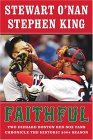
Faithful by Stephen King and Stewart O'Nan

Faithful: Two Diehard Boston Red Sox Fans Chronicle the Historic 2004 SeasonFaithful: Two Diehard Boston Red Sox Fans Chronicle the Historic 2004 Season by Stewart O'Nan
My rating: 3 of 5 stars

This is the ninth book in my 2013 TBR Pile Challenge, and the only nonfiction. I'd been meaning to read it since it came out in 2005, but I just hadn't been able to make room on my reading list until I signed up for the challenge.

Faithful is written as a series of email exchanges, diary entries, and just plain narratives of the 2004 baseball season, following the Boston Red Sox. Stephen King grew up a fan, but Stewart O'Nan came to it later in life, though he's no less avid for being a Red Sox Nation transplant. He wasn't born a Sox fan, but he got here as quick as he could.

Their sections are easy to tell apart, even without the font changes. Stewart has his superstitions, and an entire family rallying around his project, while Stephen's family is mostly grown up and his wife is spoken of little, except as a tolerant bystander. Stewart likes to relate the play-by-plays, while Stephen's passages are, more often, general musings on baseball fandom, the team itself, and his own agony as a lifelong Sox fan.

I rarely follow baseball minutiae, so a lot of the jargon went over my head. The nicknames for players, the slang or abbreviations for plays, and the references to past rivalries were all lost on me. These details certainly filled the pages and ramped up tension for a baseball season whose ending I already knew, but they weren't illuminating in the least. Had I been less of a Red Sox fan, I would've given up on this book.

I like to think I picked up a couple of things, though, and that what I picked up made me a better fan.

After all the painstaking detail and speculation of the earlier sections, the final parts about the pennant win against the hated Yankees, and then their World Series victory, seemed almost cursory. I didn't feel the excitement of the earlier chapters, and the tension seemed to have been used up. I remember I was ecstatic at the Game 4 pennant win, and my elation only grew with each subsequent victory. I felt little of that from either writer, which was disappointing. Surely they could've captured some excitement, instead of focusing most of their narrative on the tragedies at the Boston celebrations.

If you're a Boston Red Sox fan, and you understand baseball jargon, I think you'd love this book. Because I only fit one of the two criteria, I found it acceptably entertaining, if a bit dry in places.

If I ever decide to reread this, I'll make sure I read Baseball for Dummies or the equivalent, first.


View all my reviews

Wednesday, October 9, 2013

Review: MaddAddam (MaddAddam #3) by Margaret Atwood

MaddAddamMaddAddam by Margaret Atwood
My rating: 5 of 5 stars

This is the conclusion to the MaddAddam trilogy, a book I anticipated so highly I bought it in hardcover (signed!) and on audio. It concludes the science fictional series about a world so corrupt, it deserved to be wiped out by its own tools.

MaddAddam starts right where The Year of the Flood left off, which Ren, Toby, Amanda and Jimmy in the woods with the Crakers and the Painballers. They go back to their refuge and attempt to treat Jimmy's high fever and severely infected foot, while Toby quietly pines for Zeb, and the rest of humanity that remains tries to find purpose.

The story is told through Toby's perspective, with interjections from Zeb, as related to Toby. These sections often echoed techniques from The Blind Assassin, and effectively so. We're never told how the characters are interacting, but we get a good look into what's going on by the dialogue framing them.

There are also some sections, toward the end, narrated by one of the Crakers. Blackbeard (and the irony of Crakers' never growing body hair is noted by Toby) spends a lot of time with the humans, picking up some of their quirks and becoming a translator, both figuratively and literally. Only the Crakers can understand the pigouns who invade the humans' settlement, and so Blackbeard is called upon to serve as their bridge. Meanwhile, it is he who inherits the important task of telling a story and shushing the singing until the right moment. It lends a fascinating perspective to the human themes within the book.

The book's pace is meandering, reflecting the lethargy of the humans who have found themselves on the winning side and made no plans for what happens afterwards. The conflict is far removed until the last few chapters. Even then, the most exciting part is reflected upon by Blackbeard, who doesn't even fully understand violence or anger. His detached, euphemistic narration is perfect for those final sections, though, as he transitions the reader to the new world created by Crake.

That is not to say the pacing is boring, though. There's plenty to keep a reader entertained along the way. If the poetic writing doesn't grab you, there's the mystery of Zeb, perhaps the most enigmatic of characters in the trilogy. There's the question of what's going to happen to humanity, and what the humans are going to eat when their supplies run out. There's humor within the narrative, most of it Zeb's dry wit or Toby's reactions to the Crakers. There are some new mysteries, and leftover ones from the previous two books. There's the hope of Jimmy's recovery, even if he does represent everything the God's Gardeners hoped wouldn't survive the waterless flood.

As the book wound itself up, I could feel only grief. The ending was perfect: melancholy yet hopeful, and in keeping with the tone of the books. But finishing it meant I didn't have any more of it to read. I can always reread, but I can never discover those words again for the first time.

I listened to MaddAddam on audio. Toby's narrator was the same as in The Year of the Flood, with new narrators for Zeb and Blackbeard. They all narrated crisply, though Zeb's narrator often sounded annoyed when he had no reason to be. Blackbeard's did a good job of capturing the boy's wide-eyed innocence and the competence inherent to his species.


View all my reviews

Review: Because I Said So! by Ken Jennings

Because I Said So!: The Truth Behind the Myths, Tales, and Warnings Every Generation Passes Down to Its KidsBecause I Said So!: The Truth Behind the Myths, Tales, and Warnings Every Generation Passes Down to Its Kids by Ken Jennings
My rating: 4 of 5 stars

I'd first heard of Ken Jennings from my mother, an avid Jeopardy! watcher. She's the only person I know who records old Jeopardy! episodes on her DVR when she's away, and then actually watches them.

But I digress.

I know he's a smart guy, and the episodes I saw with him up against Watson, the computer opponent, were entertaining. Jennings struck me as the sort of person who has a wealth of knowledge just simmering under the surface, but who doesn't use it as a bludgeon.

It was with these assumptions I picked up his book, Because I Said So! It's an examination of all of the things parents tell their kids, and the factual basis (or lack thereof) behind them. He tackles such diverse warnings as, "Your face will freeze that way," and "There are starving children in Africa!" (That was the location given when my parents chided me, but a number of places have been picked as an example.) Jennings often goes into the origin of parents' sayings, then expounds on the scientific truths behind them. The book is a study in risk assessment, reassuring helicopter parents, and enlightening those who pass things along because it was something their parents said. It's like the joke about the new bride's pot roast, which I'll tell at the end of the review.

The style of the book is light and funny, with quips and one-liners sprinkled throughout. Some of the jokes fell flat, but most got a chuckle out of me. Though the book has a fragmented style, it is grouped by general subject matter, and each section is headed by the parental wisdom he addresses. The final chapter is on sex and relationships, which were interesting, though Jennings doesn't come across as professorial enough to keep away the creepy factor. Hearing him discuss my private parts was a bit like a dinner conversation gone terribly wrong.

My other complaint about the book has to do with its presentation. Unfortunately, repeating myths, even to debunk them, often has the unintended consequence of reinforcing them. The verdict needed to be delivered in a way that undid the damage, instead of the short explanations given.

Overall, though, I found this book both entertaining and informative, and am thinking about who I might want to give it to as a Christmas present. I do know a lot of parents.

I listened to the audio edition, which was narrated by Ken Jennings. He does an excellent job reading his words, and his delivery made me laugh at some jokes that would've fallen flat on the page.

The New Bride
A couple marries and moves in together. Soon, the husband notices that, every time his new wife prepares roast beef on Sundays, she cuts off both ends before she puts it into the oven. He wonders if this makes it more flavorful, or helps it cook more evenly, or what, and finally asks. She tells him she doesn't know; that her mother always did it, so that was how she learned. The next time he speaks to his mother-in-law, he asks her why she cut the ends off her roast beef. She says she doesn't know, but that her mother always did. This is fortuitous, because the grandmother is due to visit the very next week.

Over Sunday dinner, as they're sitting around the table and chatting, waiting for the roast to cook, he asks his wife's grandmother why she cut the ends off her roast, and explains how it's survived the generations. The grandmother blushes, then laughs so hard she can't breathe. Her granddaughter jumps up to get her a glass of water, and the husband stays behind to make sure she isn't choking.

After she's had a big gulp of water, still giggling, the grandmother says, "That was the only way I could get it to fit in the oven!"


View all my reviews

Sunday, September 29, 2013

Review: Shadow and Bone (Grisha #1) by Leigh Bardugo

Shadow and Bone (The Grisha, #1)Shadow and Bone by Leigh Bardugo
My rating: 3 of 5 stars

I'd been reading rave reviews of this book. I thought I'd learned my lesson about that by now. Apparently not. While it was a perfectly readable book, there was nothing to distinguish it from a slew of other YA paranormals.

This book was like YA Mad Libs. (Girl's name) lives in the magical land of (made-up place), where the elites can (magical thing). (Same girl's name) doesn't fit in and isn't pretty, and is in love with (boy's name). Then she finds out she's (same magical thing), only special. She's whisked off to (place name) to learn how to use (same magical thing), but it's hard and nobody likes her, except for (another boy's name). Then she's torn between (boy #1) and (boy #2).

It's pure YA paint-by-numbers. While not all YA books follow this plot, it was close enough that I felt like the variations had been pulled from a hat.

In this book, the action is set in Ravka, a fantasy version of Russia, and the girl is Alina Starkov, an orphan. She discovers she's not only a Grisha (magical user), but one who might be able to heal the rift of darkness bisecting her country. The Darkling, the most powerful Grisha in the country, is suddenly paying her special attention, while most of the others are jealous, or They Just Don't Understand Alina's Pain.

The frustrating part of the book is that most of the conflict is internal. Alina needs to figure out how to use her power, how to control it, and how to amplify it. But the answers are all a matter of her figuring things out, or conveniently remembering certain events. Outside conflict stays on the back burner for about 80% of the story, while Alina whines and tries to figure out what's wrong with her. When the plot relies on a character figuring things out, some outside impetus can help. Otherwise, the reader is often left with the distinct impression the narrator is an idiot. She's not, but I was frustrated with waiting for her to be whacked upside the head with a clue-by-four.

I listened to the book on audio, and Lauren Fortgang did a mostly acceptable job. Her Darkling sounded a little too flat for my tastes, but I suppose it was what the narrative called for. My biggest complaint is that, while she was usually able to handle most of the pronunciation, it was inconsistent, and her "typical Russian" accent sounded like Boris Badenov. If I were Russian, I would've been insulted.


View all my reviews

Monday, September 23, 2013

Review: Chimes at Midnight (October Daye #7) by Seanan McGuire

Chimes at Midnight (October Daye, #7)Chimes at Midnight by Seanan McGuire
My rating: 5 of 5 stars

This is the seventh book in a series I'm hopelessly in love with. Every time, I say they get better with each book, and every time, it continues to be true. Each book advances the worldbuilding, develops the characters, reveals plot lines that have been building all series, and thoroughly entertain me. This is how you write a series. Epic fantasy writers, take note.

This book has Toby getting to the bottom of the goblin fruit trade. She uncovers that it's killing changelings, and goes to the Queen to sort it out. Instead, she's banished. She has three days to pack up and go. This being Toby, she isn't about to meekly slink off. Instead, she uses the resources she's been building all series to research how to wriggle out of it. Along the way, she nearly dies several times (but what else is new?), finds new corners of the realm, visits the library, and gets hit in the face with an evil pie.

She also finds out who Quentin's parents are, so, if you've been looking forward to that revelation, it's in this book.

My favorite part of the book is finding out my cat is aptly named. About a year ago, I adopted a brown tabby, and I named him after Tybalt. He's vocal and loyal, and extremely affectionate. He's also distressed if I'm out of his sight for any period of time, and not a fan of dogs or car rides. The fictional Tybalt displays all of these characteristics (though his affection is of a different kind), and, every time he acted like my little Tybalt, it made me happy.

I'm also convinced that the dog park mentions (there are two in so many pages) are Night Vale references. I don't think Ms. McGuire started listening to the podcast until after the final edits were in on this book, but, if nothing else, it might add to her personal amusement. It certainly enhanced mine.

Much is changed of Toby's world in this book, and we get some hints about where this might be leading, or what might have led up to the current situation. I could speculate, but I'd much rather just wait until the next book comes out in a year, and be surprised.

I love this series.


View all my reviews

Monday, September 16, 2013

Review: Metatropolis by Jay Lake, Tobias S. Buckell, Elizabeth Bear, John Scalzi, and Karl Schroeder

MetatropolisMetatropolis by Jay Lake
My rating: 3 of 5 stars

This was a promotion on Audible, and the premise seemed halfway interesting, so I picked it up. Sadly, it shares a lot of the same problem of most anthologies: inconsistency. It had its high points and its low points, leaving it to average out to "meh."

Metatropolis is a shared-world anthology, meaning that all of the writers set their stories in a near-future dystopia they developed collaboratively. This near future is violent, corporate-owned, and clannish. The police force is run by Edgewater Corporation, and its representatives are nicknamed "Eddies." Cities are independent enclaves, scrabbling for survival, and most jobs are picked up on the equivalent of Craigslist, in a process called turking. They're fleeting, and a person may never meet his or her employer. Technology is a few steps ahead, except where people are too busy figuring out the whole survival thing to mess around with wires and shiny toys. John Scalzi provides interim narration, explaining the concept behind the anthology and introducing each story.

The first story is "In the Forests of Night," a military SF-esque tale of the fall of Cascadiaopolis. That's a crunchy granola settlement in the Cascades, and, for reasons that are never entirely clear to me, some corporation owner needs to break in. The story is told through several different perspectives, and introduces several characters. As it's a short story, this was a poor choice, and I wound up confused and annoyed. If this had been a later story, I might've been able to follow it better, but later stories seem to hinge on this city serving as a warning to the others.

"Stochasti-City" by Tobias Buckell is the second, and it takes place in Detroit. Our hero, Reginald, is turked out for a job, and it screws him over. When he goes for payback, they hire him to cripple the city without turning it into a war zone. Reginald is clever on his feet, and the patter he uses to address the reader is almost musical. It was a vast improvement over the first story, and I finally started to get a handle on the world. The message in the story is rather anvilicious, though; they didn't need Reginald to agree with their message to agree to work with them, so why all the persuading?

"The Red in the Sky is Our Blood" by Elizabeth Bear is also set in Detroit, perhaps a few months after the events of the previous story. We see its marks in the city Katy, our no-nonsense narrator, rides her bike around. She gets an offer of employment, too, but her instinct is to run from these well-organized idealists, who may be just trying to trap her for her Russian Mob ex-husband. Her caution is understandable, and her exhaustion at being alone in such a harsh landscape is palpable.

"Utere Nihil non Extra Quiritationem Sui" ("Use everything but the squeal") is John Scalzi's offering, and it's a third strong point in an anthology that had so much potential. He tells of regular city life in New St. Louis (same as the old St. Louis, but for some energy conservation and socialist values). The story is told through the eyes of a young man getting his first job, and getting himself tangled up in an attempted insurrection. Benjamin starts off as a jerk, as the narrative points out to us, but his breezy attitude is easy to latch onto, and he's certainly more likable than the guy kidnapping the girl he likes.

The last story is "To Hie from Far Cilinea" by Karl Schroeder, which involves augmented reality, 3D games, the next generation of Google Glasses, and radioactive material, on top of the above trappings. It adds layers of complexity to a world that's already alien, and I felt like the author was doing it just to mess with me. The story is told through Gennady Malianov, a Ukranian agent who retrieves radioactive material. This job involves going through several layers of augmented reality, and we find out he's nearly crippled by social phobia, a factoid that may have been there to make Gennady more sympathetic, but that doesn't go anywhere. The ploy doesn't work, and I'm left swamped with bizarre details about an esoteric world, navigated by someone I don't particularly like. At least it was over quickly.

If all of the stories had been as strong as the first three, this would've earned a much higher rating. As the two others bookended this anthology (and Scalzi rhapsodized about how much I'd love Schroeder's world-building in his commentary), it gets a "meh."

The anthology is narrated by John Scalzi, with five different narrators for the five different stories. It worked well, and all the narrators knew what they were doing. I have no complaints about the audio quality.


View all my reviews