Search This Blog

Showing posts with label grammar. Show all posts

Friday, August 31, 2012

Recap for August 2012

Slight dip in blog hits this month, but that's okay. I'm still doing well for a writing/reviewing blog that's been around about a year.

I picked up an Audible Gold account this month, because I'm running out of audio books the library system has that I want to listen to. Also, there are audio books I want to own, and the account makes them more affordable.

Book Reviews
Chomp by Carl Hiaasen (YA humor/adventure; 4/5 stars; audio)—Wahoo Cray and his crazy father go into the Everglades with a "reality" wildlife show host. Hijinks ensue. Hiaasen seems to hit his stride with the YA elements in this one.

Persuasion by Jane Austen (Classic romantic lit; 5/5 stars; audio)—Anne Elliot verges on the edge of spinsterhood because she took her well-meaning friend's advice and rejected the only man she ever loved. He comes back into her life. Jane Austen's final published novel, at least in her lifetime, and it's a delightful read, especially for Jane Austen fans. I read this and several other Austen novels as part of a reading event.

No Need to Ask by Margo Candela (short romance; 4/5 stars; ebook)—Read this in May, but didn't get around to reviewing it until just now, after it was re-released with a pretty new cover. Jillian Winters is a set designer for a hit show, but feels stuck in a rut. Then she meets Ethan Marshall, who hires her to decorate his loft, and who she falls for, hard. From what I've read of Candela, her stuff is good if you don't like explicit sex scenes.

An Artificial Night by Seanan McGuire (urban fantasy with fae; 5/5 stars; October Daye #3; audio)—A reread to hold me over until the next book comes out in September. Toby Daye tracks down the Firstborn who kidnaps children from their beds to use in his Hunt. Decidedly dark, with several visible influences throughout.

Home Improvement: Undead Edition edited by Charlaine Harris and Toni L.P. Kelner (urban fantasy anthology; 3/5 stars)—Picked this up because I like some of the authors. Liked their stories, for the most part, but found an awful lot of them lacking in quality. Overall unimpressed.

Sense and Sensibility by Jane Austen (classic romantic fiction; 4/5 stars; audio)—The Dashwood sisters have moved down in the world, but they make the most of their new cottage home, and its handsome (and rich) locals. My opinion of the book's quality may have been colored by a narrator I didn't like.

Death Masks by Jim Butcher (urban fantasy detective wizard; Dresden Files #5; 2/5 stars; audio)—I only listen for James Marsters' voice, and even that's wearing thin. In this installment, Harry evangelizes to a holy warrior, fights a duel, watches other people slice up demons, and recovers a stolen Shroud of Turin. If I detected any hint of character growth or changing his mind about the sexism, I might warm to these. I'm not going to gross myself out, in the meantime.

The Hollow City by Dan Wells (psychological mind screw/science fiction; 5/5 stars)—Michael Shipman has schizophrenia, but all he sees may not be hallucination. Excellently crafted in a way that makes it clear what's real and what isn't, even when what's real is implausible.

No Dress Required by Cari Quinn (romance; 4/5 stars; ebook)—Noelle and Jake are alone together on New Year's Eve, and ready to see if their not-platonic feelings should be consummated. A fun, light read, it cleansed my reading palate after the last two.

Mansfield Park by Jane Austen (classic romantic fiction; 5/5 stars; audio)—Fanny Price goes to live with her rich cousins, where she's looked down on and treated like a servant, until the charismatic Henry Crawford falls in love with her. Her protection against his charm is that she's already in love with someone else. A lot of elements in this appear in modern rom-coms.

Lady Susan by Jane Austen (epistolary novel published posthumously; 4/5 stars; audio)—Lady Susan Vernon is selfish, vain, and manipulative, and the only relief at the end is that she doesn't ruin everyone's lives. An excellent study in perspective in Austen.

Moon Called by Patricia Briggs (urban fantasy with werewolves; Mercedes Thompson #1; 3/5 stars)—Mercy Thompson helps out a werewolf who's new to the whole shifting thing, and winds up hip-deep in it. The writing isn't excellent, but I can see glimmers of potential, so I'll keep reading.

The Strange Case of Dr. Jekyll and Mr. Hyde by Robert Louis Stevenson (Victorian horror; 4/5 stars; audio)—An incredibly quick read, and worth it to get at the original story. Lots of differences between this and the version that's survived in pop culture.
Most Popular Posts in August
The first two most popular are the hyphen post and my 11/22/63 readalong post, neither of which were posted in August. Moving right along . . .

The Importance of Good Grammar explains why the rules are important to learn, which was recently substantiated in an article in the Harvard Business Review. Even if you're not a writer, you need to learn how to grammar.

A Pantster on Top Ten Tuesday lists the ten posts that give you the fullest picture of who I am. Considering I shy away from making this a personal blog, it was an easy list to compile. The hard part was picking which ones to weed out.

Good Stuff: Seanan McGuire's Toby Daye Series is borne of an impatience to read the next October Daye book, and it discusses why I love the series as much as I do, and why I think you should give it a try.

Throwing Out the Rules gives you permission to ignore everything I've written about the craft of writing on this blog, and just write. Helpful for those who feel overwhelmed by all the things they're trying to remember, and who just want to write a freakin' story, okay?
Bending Tropes discusses one of my narrative kinks, and how to accomplish it. I give some examples of tropes, and ways I've seen them subverted that I liked.

Setting Your Story talks about the pitfalls with using a real place, and with making up your own. Both have their pros and cons, and I can't tell you which you want to use. I can give you information about how to choose, though.

Speaking of choices, Editing vs. Rewriting explains why you don't want to toss out your whole story just because you have to make a few changes, and I tell you how I approach rewrites, when I do them.

Honorable Mention
I also wanted to point out that I did a guest post for Roof Beam Reader's Austen in August event, about using Jane Austen's dialogue to teach you how to write it more effectively. I've already mentioned it once before, but it bears repeating. I do like how it came out, and I get a warm fuzzy every time I look at all the nice comments.

Everyone, have a wonderful Labor Day weekend, whether you're at Dragon*Con, Worldcon, PAX, or hanging out on your couch catching up on some reading. I'll see you in September.

Sunday, August 26, 2012

Throwing Out the Rules

Photo obtained from Free Stock Photos.biz
Every week, I read the PostSecret blog when it updates. It's partly because it gives me story seeds and character traits, and because the speculation and back-and-forth on the LJ community devoted to it gives me some outside perspective. Mostly, though, it's because I'm fascinated with people's secrets, and I like to know what people aren't telling those around them.

This week, the last secret was a picture of a bear, with the text, "When you tried to teach me the technicalities, You killed my love for photography." The secret, itself, didn't stand out in my mind, but then a thread cropped up comparing the sentiment with that toward writing. One person noted feeling bogged down by all the rules, and others wrote of writing technicalities killing their love of writing, or hampering their creativity.

I didn't address it there, because I don't like to be confrontational, and I don't think I could've gotten it across without the context of my blog. I talk mechanics here. I talk technicalities. I talk grammar. I talk building blocks. Obviously, I think these things are important.

And I think it's essential that a story be written well. There should be a cohesive theme. The dialogue should ring true. The story's tone should remain consistent. The characters should be fleshed out and believable. There should be research put into your story. And so on.

Knowing all that doesn't negate that you have permission to suck, though. Getting your first draft down is a lot more important than that it's perfect the first time around. It'll never be perfect on your first try. That's why I have my sometime series on editing.

As you get more familiar with what you have to edit in, you'll write it correctly the first time, but there will always be something to fix the next time around. You'll realize you have to research something that'll take some digging, or you haven't yet figured out the ending to know what to foreshadow.

There are several ways of marking your text to go back to later. Some people put remarks in double brackets [[like this]], then do a Ctrl+F for the double bracket to find the remarks. This works just as well with any mark of punctuation you wouldn't expect to see doubled up. Others jot notes in their document. I use Open Office on my computer, but Word also has this capability; Scrivener does not.

Technical aspects of writing are important. Yes, writing is creative, and creativity can be stifled by too many rules and restrictions. Thousands of authors have managed, though, while following those rules and mechanics. If it's truly getting in your way, you have my permission to ignore every last rule. Misspell every other word in your first draft. Refuse to use punctuation. Throw words out onto the page as they occur to you, if that's what makes you finish that draft.

You're the one who has to edit it when you're done.

Tuesday, August 7, 2012

A Pantster on Top Ten Tuesday

I decided, on the spur of the moment, to participate in The Broke and the Bookish's Top Ten Tuesday. Being a pantster, when else would I decide to participate? I'd glanced at topics before, but struggled to come up with more than two or three responses, which makes for a weak top 10. I feel like I'm cheating a bit, because my blog isn't exclusively reviews. Ah, well.

The topic is, Top Ten Posts I Think Give You the Best Glimpse of Me

1. Plotting by the Seat of Your Pants explains the blog title better than any of my earlier posts on the topic. I write by the seat of my pants, and that post explains why that's my approach, in the face of lots of writers who'll tell you an outline is necessary.

2. Turning Negatives Into Positives wrapped up an impromptu series about my weak points as a writer. So, not only can you read about the things that get in my way, you can read the links to see how I deal with them.

3. Rules to Review by lists the standards I hold myself to with my reviews, and therefore what people can expect from them. It's a short list, but I've been consistent on those points.

4. Reading for Pleasure is my reaction to being told there are books that are good for me, and that I should, therefore, read. If it's not fun, I won't read it. There are books that are both good for you and a pleasant read (precisely why I'm taking part in Roof Beam Reader's Austen in August event), but talking about literary value isn't how you talk me into reading a book.

5. Bad Grammar Makes Me [Sic] discusses how I feel about grammar, and why I post about grammar mistakes or how to properly punctuate. I'm no Grammar Girl, but I don't think there's such a thing as overdoing information about how to use grammar correctly on the internet.

6. Narrative Kinks lists the things in stories that turn me on. If I see those elements in a story, movie, or TV show, I'm apt to love it, unless it does one of the other things very, very badly.

7. Care and Feeding of Authors is a how-to guide on approaching authors to spend time with them without leaving them with a bad impression of you. The post leads into the stories of the times I had dinner with Peter S. Beagle and Seanan McGuire. I love telling those stories. I get so warm and fuzzy thinking about them.

8. Perpetual Rewrites reveals how I got into a particular habit I have, and why it's made it easier to edit earlier drafts. It's a story of a younger, less intrepid pantster.

9. Learning to Write discusses the ways a young writer-in-training can learn how to be better. I talk about how I think college actually got in my way, and less expensive alternatives.

10. Insurmountable Obstacles to Writing is generally about recognizing when you're in over your head, but it reveals a major problem I struggle with. I have a manageable form of depression, but I have to watch for the signs and prioritize, sometimes. That's the most personal entry in my entire blog.

There. In ten posts, I think that's the most complete picture you'll have of me. Now you don't have to read the other 303 posts. (Though, feel free to poke around, and let me know if there's something you'd like to see me post about, or if there's a post label that would make some things easier to find.)

Thursday, August 2, 2012

The Importance of Good Grammar

Back in January, I posted about why I consider grammar to be important. Since then, I've learned that there's a term for me (well, a nicer one than the usual). I'm a grammar prescriptivist. That takes away the implication that I go around berating people about their grammar mistakes (I don't), while making me sound all smart and stuff.

There was a recent post on the Harvard Business Review, written by the CEO of iFixit. He won't hire people with poor grammar, and his reasoning is sound, to me. In today's employer's market, he could have any justification he wanted for refusing to hire the people he doesn't want working for him, within legally protected limits. But I can't find fault in his assumption that those who pay attention to grammar also pay attention to other small details. Detail-oriented people are the ones he wants working for him.

At work, I'm the detail person. I'm the one who proofreads emails and cover letters, looks over monthly billing for errors (which I used to do more formally), is in charge of the most exacting paperwork, and who people snag for some picky little error in one of the computer programs we have to use.

Outside of work, my detail orientation isn't appreciated. My family and friends throw up their hands in exasperation if I correct them, and I read regular screeds online about how "GRAMUR DUSNT MATER."

I do recognize the value of descriptivism (basically, the notion that it doesn't matter, so long as the intent was communicated). I also think attention to grammar and spelling show a level of respect I prefer in those I wish to communicate with. I don't expect my friends to speak in full, grammatically correct sentences, but I do expect their posts to contain the right version of "its" in enough of their posts that I know they know the difference (and they can blame autocorrect for the rest). If I think they don't, I'll try to gently point it out.

With writing, all you have is your words. You don't know my expression right now, or in what tone I'd speak this post, or how much sleep I got last night. (Not a lot; thanks for asking.) The words are devoid of context.  They're your only link to the person reading those words.

And call it snobbish, call it elitist, call me full of myself, but bad spelling and consistently poor grammar say a lot about your education and intelligence. If a person can see at a glance that you lack the ability to learn a set of rules and follow it, why should they trust anything you have to say?

The importance of grammar applies whether you're typing comments on a blog post or submitting to an agent's slush pile. If you honestly don't care how others perceive you, then you can feel free to ignore any and all rules. But, if you want to come across as well-educated or publishable, I recommend you read up on the rules.

Friday, July 20, 2012

Grammar Peeves: Filler

I thought I'd posted about all of the grammar sins that bother me, but my published friend retweeted a tweet from her editor that reminded me about another I'd meant to write about.

In a novel, it's rarely the case that every single word counts. You don't have the economy of a short story or poem. And yet, if you establish a pattern in wasting a reader's time throughout your novel, you'll lose them as effectively as if you'd written something offensive. While that usually comes about with long scenes that don't address the plot, it can also happen on a sentence level. Here are a few ways how.

  • Progression—A good sign you're delaying your sentences is if you talk about progressions on a task, rather than the task, itself. "Started to," "in the process of," "finished," "worked on," and similar phrases halt the action, rather than moving it forward.
  • Synonyms and Definitions—This is one I know I'm guilty of. I write something like, "Conciseness, or using just a few words to describe something, is a skill that doesn't come naturally." It wasn't necessary that I define the term, but I did it, anyway. I'll also start to list words that mean the same thing, when one would do.
  • Redundancy—"PIN" is an acronym for "personal identification number." Calling it a "PIN number" grates on my last nerve. "ATM" is "automatic teller machine," so if you call it an "ATM machine" within your text, I will question your intelligence. It's a great phrase to put in your character's mouth to show he's not all there, but, if you don't know any better, I have no sympathy for you. Similarly, empty words that add nothing to the sentence don't belong.
  • Qualifiers—If you've heard adverbs are evil, this is why. "Just," "only," "really," "mostly," "usually," "basically," serves to weaken a sentence, rather than help it. Similarly, if you describe how dialogue is delivered (flippantly, sarcastically, seriously, quietly), your dialogue is failing.
  • Fluffed-up Phrases—"The fact that," "The reality of it was," "The system of," "The mechanism that," "As we all know," indicate that the writer is going about this story the long way around. These phrases and similar have their uses, but overuse makes the story look like a NaNoWriMo gone awry.
It is possible to use any or all of the above without stalling your sentences in the middle. Filler words can contribute to the overall flow of a sentence, and they can be used in dialogue to show the character is a blowhard.

During your editing phase, note any of the above you find in your manuscript. Keep a file of them. If you notice they keep cropping up, start to pick and choose where they belong, and use ctrl+f (cmd f on a Mac) to find instances of filler.

Your writing is stronger when you don't fill it up with unnecessary words. Also, readers appreciate that you didn't make them wade through useless text to get to the good stuff.

Sunday, July 8, 2012

Grammar Peeves: Homonyms

A pair of pears
Until I run across something new, this is all I have in the queue for grammar peeves. If there's a grammar issue you struggle with, feel free to post about it in the comments, and I'll post about it at some future date.

Homonyms are more of a spelling issue than grammar, but they're just as distracting as poorly constructed sentences, and they do contribute to writing mechanics issues. Homonyms may also be called homophones. They're when words that sound the same are spelled differently, depending on meaning.

Here are a few commonly confused homonyms:
Affect = Verb, as in to affect the outcome
Effect = Noun, as in to have an effect
Buy = To purchase
By = A preposition, meaning "near"
Bye = Short for "goodbye" 
Cite = To quote
Sight = Vision
Site = A location

Hear = To perceive with the ear
Here = In this location 
Lose = Opposite of win
Loose = Opposite of tight 
Than = Used when comparing two things
Then = Used to indicate a point in time
They're = They are
Their = Belonging to them
There = At a point in space
To = Preposition, meaning "toward"
Too = Additionally
Two = The number 2
Whose = Belonging to who
Who's = Who is
Your = Belonging to you
You're = You are
I've already written about when to use an apostrophe, so, if that's all you need to stop using the wrong word, that post is there for your use. If you'd like a more comprehensive list, this is the longest list of homonyms I've ever seen.


I can't say I've never written the wrong word. Sometimes, I didn't even pick one that sounds similar, leaving me to puzzle over what I possibly might have been aiming for when I go back to edit. So I do know how this happens. You get caught up in how the words sound in your head, and, because your inner editor is off, you're not paying attention to whether they're correct.


In the first draft, that's perfectly normal, and to be expected. But if, in later drafts, you don't catch it, and your editor doesn't, either, you're going to look mighty foolish when the reviews come out.


And, if you don't know to look for these in the first place, you're going to have some difficulty ever leaving the slush pile. If you don't know if you're confusing any homonyms, let a picky friend read a few chapters of your manuscript, and he or she should give you a good idea.


Once you know which homophones to look out for, you can do a Ctrl+F (if you're using Windows—Mac is Cmd F), and check each usage to determine if you wrote the correct one. Taking homonyms out of context, or even reading your manuscript backwards will illuminate a lot of this problem, but only once you're aware of it.

Thursday, June 14, 2012

Grammar: Semicolons

There's an easy way to pick out the grammar prescriptivists in a room. They're the ones who, when you ask if people have a favorite mark of punctuation, perk up and give you an unhesitating answer.

For me, that mark is the semicolon. It's that thing you use on your computer to make a winking smiley. It shares a key with the colon ( : ), and it's what you get if you forget to hold down the shift key.

The semicolon's function is an emphatic comma. If you're writing out a list, and some of the things in the list need further separation, you use a semicolon to separate the main items.

For instance:
At the grocery store, she bought eggs; milk; butter; a salad with olives, spinach, and feta cheese; and some fresh fish for dinner.
 Its main purpose, though, is to connect sentences which would be run-ons or a comma splice without the semicolon. If you have two whole sentences which are related, you can join them with a semicolon:
I'm a night owl; I'm rarely in bed before 1 AM.
You also use it before however, moreover, thus, consequently, nevertheless, and therefore. Again, an example:
I rarely get enough sleep; consequently, I have quite the caffeine addiction. 
The thing about semicolons is, you can usually leave them out, except in complex lists, as outlined above. The purpose of a semicolon is entirely that of flow. Were I to write the above sentence as two, it might read as choppy or abrupt, but it would still be correct. The notion of a punctuation mark's primary purpose being to vary sentence lengths and aid the flow of the words appeals to me very much.

I distinctly remember never using semicolons until I learned them in high school, and then squashing them in wherever they would fit, once I had the hang of them. It was like the invention of the cordless phone: freeing and fun and overused for everyone but me.

I sprinkle them much more conservatively these days. You can overuse semicolons, and they're considered passé by some publishing circles. I'll continue to use them until an editor tells me to stop, but I'm not going to waste them on trivial sentences in the meantime.

Thursday, May 31, 2012

Recap for May 2012

This month, I signed up to participate in a giveaway hop (you won't see anything more about it until 6/23), I drove to Tennessee and back where I picked up the Tennessee Death Plague, and I moved to a Sunday, Tuesday, Thursday updating schedule.

Here are the specifics:

Book Reviews
Bait and Switch: The (Futile) Pursuit of the American Dream by Barbara Ehrenreich (4/5 stars; nonfiction investigative; audio book)—The author of Nickel and Dimed takes on corporate America, and never gets past the job hunt. One of the books contributing to the political climate that's produced the Occupy movement.

Rosemary and Rue by Seanan McGuire (4/5 stars; debut urban fantasy detective; reread; audio)—Introduces half-fae detective Toby Daye, who has to figure out a friend's killer before the curse her friend laid before dying takes Toby's life. It's a debut, but it's clear why this is the author who would become my favorite.

A Local Habitation by Seanan McGuire (4/5 stars; urban fantasy detective; reread; audio)—Second installment of Toby Daye's story. She's been ordered by her liege to investigate why he can't seem to get hold of his niece. Becomes a tightly-plotted locked-door mystery with a twist I didn't see coming the first time I read it.

Naked in Death by J. D. Robb (2/5 stars; near-future detective/romance/thriller)—Nora Roberts' incredibly popular alter ego's first installment about detective Eve Dallas, who lives in the year 2058. Lots of people love this series, so the fact that I won't touch it again puts me in the minority.

Write More Good: An Absolutely Phony Guide by The Bureau Chiefs (4/5 stars; humor)—A funny twitter feed about grammar standards in journalism in changing times expands into a very readable fake AP guide. Better to read if you have a journalism background, but the jokes aren't too far over the rest of our heads.

Winter Garden by Kristin Hannah (2/5 stars; contemporary; audio)—I usually like Hannah's books, so I'll forgive that her pairing of the atrocities of war with white whine only trivializes the war story. This time.

Leviathan by Scott Westerfeld (4/5 stars; YA alternate history with steampunk elements; audio)—A well-paced adventure about teenagers in an alternate-history WWI. Ends on a cliffhanger.

An Ice Cold Grave by Charlaine Harris (2/5 stars; paranormal mystery; audio)—With this installment of the Harper Connelly stories, I give up. Not-related-by-blood incest doesn't have to be gross, but in this book, it is.

Little, Big by John Crowley (2/5 stars; classic magical realism)—Was probably revolutionary in its day, but reads like a dusty old relic when compared with modern fast-paced urban fantasy. Too in love with its language to bother illuminating the reader.

Fed by Mira Grant (4/5 stars; alternate ending to dystopian horror novel; available online for free)—The alternate ending to Feed; clears up any notion you might have that Feed needed a different ending. No, the real ending was better. Yikes.

Most Popular Posts in May
Grammar: Hyphen Use was, predictably enough, how to correctly use hyphens. It's probably the most boring post I wrote all month, but apparently it proved useful to several dozen people.

I expected Writing About Rape to take the #1 slot. I guess I'm not that interesting a ranter. Ah, well. I'm still glad I wrote it. I feel better.

My Review of Let's Pretend This Never Happened is still pulling in a decent number of hits. Considering how well the book is selling (and that my husband and I have a waiting list for our copy), I'm unsurprised.

Lots of people want to know what happens next on So You Want to Be a Pantster. Either that, or they Googled for pictures of butts.

My April Recap post drew a number of views. Wait, more than a pet peeve post? Hunh.

Pet Peeves: Too Stupid to Live came in next on the list, so not a lot of people know about the dialogue I hold with books I don't like.

Theme vs. Message tackled the difference between having an idea in mind as you write, and beating the reader over the head with it. One of those is advisable, the other not. Guess which is which?

I wrote about the Unexpected Benefits of Pessimism as a writer. It's certainly come in handy for me.

I posted about how you can Read Backwards for your detail-level pass of edits. I tried it out before I went telling anyone it was useful. It works really well.

My post about Reading Comprehension and the fact that some readers have none was in direct reference to a comment thread I'd been reading. Not that I mentioned that in the post.

Last, my Grammar Peeve about Dangling Modifiers seems to have proved useful to a few people. At least, I hope so, because I'm tired of reading them.

It was hot last weekend. Poor, fluffy Risu.
This has nothing to do with the post. I just think she's cute.

Monday, May 21, 2012

Tenses

Image is a pun. Groan if you get it.
It's time for another grammar lesson. Because I say so. I'm done with my editing project, and I still have picky grammar things on my mind.

Tense is where, in time, a story takes place. Something can be past, present, or future tense. One doesn't run across a lot of fiction in future tense, but present tense is becoming more common, as writers often employ it to increase the sense of immediacy. It's the best way to create uncertainty about the main character's survival in a first-person narrative, for instance, because a person could be narrating as she goes along, then suddenly die.

The most common tense for stories is past tense. There are several forms of past tense (link goes to an outside blog), but most are the straightforward, simple, "This happened, then this, and while that happened, this happened."

I've read mixtures of tenses that have worked rather well. I've read a present-tense story with interjections of past-tense flashbacks. I've read past-tense narratives with sections showing character insight in present tense. I've read past-tense narratives that make it clear the character is looking back on something that happened decades ago, with insights into the action or motives interjected throughout. I've read past-tense narratives that are following the action closely, which created almost as much immediacy as the present-tense accounts.

Which tense you tell your story in is up to you, and it will depend on what story you're telling and how you want to tell it. I've played around with tenses in story drafts to see if it fixes issues with pacing, because I'm a pantster and making wholesale changes is nothing new.

The biggest pitfall with tenses is making sure you're consistent. If you're telling the story in past tense, don't suddenly jump into present. If you have a flashback within the story, make sure to separate out that flashback as having occurred at another point in time (usually by adding, "to have," properly conjugated, before each verb, which is called past perfect), so that the reader is back in time with you.

If you're new at this writing thing, very little will give you away faster than a tense shift in the middle of a sentence or a paragraph. If you're not new at writing, tense shifts will certainly make you look that way, or like your writing is generally sloppy and all over the place.

Lots of experienced writers can get away with jumping about in time throughout their narratives without losing their readers. As with all grammar rules, though, you earn your poetic license by first showing you can do it right.

Sunday, May 20, 2012

Grammar Peeves: Dangling Modifiers

My post on Writing About Rape generated quite a few views, especially for a Thursday night post. This is not teaching me to avoid blogging when annoyed.

In my online perusal today, I came across The Purdue OWL, which has all kinds of information about how to properly write English. Those of you who come here for my grammar posts can find a wealth of information on that link, including exercises on grammar and usage.

One of the sections that caught my eye was on dangling modifiers. It's one of the pitfalls of passive voice, in that you can wind up with a disembodied force driving action in your story, leaving the reader confused.

A correct modifier is something like:
Stepping through the door, she dropped her keys in the bowl and said, "Hello?"
Incorrect:
Stepping through the door, the keys fell in the bowl with a clank as a voice called, "Hello?"  
The keys aren't stepping through the door, and the fact that a person is present is only implied. Granted, the reader will figure out that the keys aren't stepping anywhere, thanks to context, but why make a reader do that work in the first place? It's rude and off-putting. You want your reader to feel challenged wondering, "What happens next?", not, "What did she mean?"

There is an entire series of books I gave up on reading because of missed modifiers. Actions happened, then an inanimate object or disembodied force took up the rest of the sentence. Worst, people would apparently glare at themselves before speaking. ("Giving her a stern look, she said to him, 'I think it's perfectly rational.'" Bleah.)

The best way to recognize these in your own writing is to pause at commas. Do you have this kind of compound sentence, where one thing logically follows another? If so, ask yourself, what's the subject of the sentence? You can have a sentence with a noun in it that isn't the subject: see my first example. Read the sentence again to determine who has a verb attached, and if that person (or object) is who you meant to be acting in the sentence. If it's incorrect, fix it. That's usually as easy as breaking it up into two sentences, combining them into one statement without the comma, or moving the subject in to appear sooner.

I don't run into a lot of professionally-published books with dangling modifiers, thank goodness. When I do, though, I find it off-putting enough to make me question the writing ability of the author, and whether there's anything else wrong with the narrative.

Monday, May 14, 2012

Grammar: Hypen Use

Because I'm back to editing, as I mentioned last night, I'm noticing more grammar rules I take for granted. I learned and absorbed them so long ago that, in order to outline what I know, I had to look it up all over again.

Hyphens have become second nature to me, to the point where I'll type out a multi-adjective sentence without thinking twice about whether to hyphenate, or where. I know you use a hyphen when there's more than one adjective, but I had no idea how to differentiate a comma and a hyphen, except just to do it.

So, after some perusing, here's how you tell the difference: if the adjectives are supposed to be joined into a single modifier, hyphenate. For instance, if a kid is three years old, and you want to differentiate him from his older sibling, you'll write "the three-year-old boy." The kid isn't year or old, and calling him "the three boy" would confuse your readers. Because the modifiers only make sense together, you hyphenate them.

There is an exception to the above, and that's when the first word ends in -ly. The newly painted wall doesn't get a hyphen, because the reader will be looking for the adjective "newly" modifies. However, the just-installed door in the wall does get a hyphen, because the door isn't just.

For another example, let's say your protagonist went on a number of dates, and uses one major feature to describe each to her friend over drinks. The well-dressed one may well have made the best initial impression, and less if he were merely "well" or "dressed," both of which are a minimum requirement for dates. The tall and skinny one needs no hyphen, because both of these features can exist on their own. The Shakespeare-quoting man is indeed quoting, but what? And he's certainly not Shakespeare, unless that's the story you're writing. But would you really want to give it away so soon?

Basically, if you can remove either adjective, and it would still make sense, the most you'll need to do is a comma. If it doesn't make sense with any of the words removed, hyphenate.

If you're using a hyphen to separate, though, you're doing it wrong. The mark of punctuation you want to show you're about to introduce a concept is a colon ( : ). If you want to separate out part of the sentence in an aside, use an em-dash ( — ), which most word programs will automatically format from two hyphens put together ( -- ). If you're using Windows, you can also hold down the Alt key and type 0151 on your number pad. When you lift your finger from the Alt key, an em-dash will appear.

I've put spaces before and after the colon and em-dash, above, to make their appearance clearer. But when you use an em-dash, you don't put a space before or after it. As an example:
One might assume—correctly so—that I use em-dashes fairly often, if I have Alt+0151 memorized.
I hope that cleared up a few things, and that I've managed to make hyphens not boring and easier to understand.

Sunday, May 13, 2012

Editing Tools: Read Backwards

I recently heard a new piece of advice for editing your writing from purely a grammar, sentence structure, and clarity perspective. I needed to try it out before I went ahead and passed it along, though.

Lucky for me, more detail editing work has come my way. I won't reveal anything about it, except that the fact that I did the first set of edits for the first publisher led to this job in a roundabout way. This is a much smaller job, and should go much faster, which is why I had room to try this new method.

Simply put, on this run-through, I started at the end of the manuscript, and am working my way forward. I'm trying to go sentence by sentence, but this writer's sentences are a different length than what I'm accustomed to. So, if I can manage paragraph by paragraph, that's what I'm doing.

What this technique does is it removes the context. I can't check for continuity, using this method, but that's not the level of edits I was hired to perform, anyway. I'm contracted to look for grammar and sentence structure issues, and that's precisely what reading backwards is revealing.

It also slows me down, and anything that halts the eye is good. When you read straight through a thing, whether you're a fast reader or not, you'll want to keep going. Therefore, your mind will fill in gaps, patch over bad syntax, and generally ignore that the words aren't perfect, in favor of the big picture. That's one of the advantages of reading aloud, too.

I can definitely say that I've spotted some errors I'd jumped over before, when I was reading chronologically, so this small tip has been a great help. I can't say for sure I wouldn't have picked them up on my third read-through, but I didn't pick them up on my first or second pass.

And so, having tried it, and found it useful, I'm passing this tip along. For sentence-level edits, read your piece starting from the last sentence, and going back to the start. You'll find things you wouldn't have, reading chronologically.

This method may also highlight repetitive conversations or if you've mentioned something more than once, but I wouldn't count on it for finding redundancy. Instead, I'll be using it on my own writing when I need to polish up the grammar to a high shine.

Because, yes, even I make errors in my writing. Shocking, I know.

Monday, April 30, 2012

Recap for April 2012

I've been recapping my blog at the end of every month, and it's useful for me, so I continue.

Book Reviews
Uncross Your Heart by Taryn Elliott (4/5 stars; debut romance, ebook only) — The book that showed me I don't hate all romance, just some of the tropes. Very enjoyable read, sizzling sexual tension. But maybe I'm biased; this is someone from my writing group.

The Night Circus by Erin Morgenstern (4/5 stars; steampunkish Victorian urban fantasy; audio book) — Much-hyped debut novel doesn't quite live up to the gushing praise, but manages to entertain with a well-crafted tale that shows it's a debut. Looking forward to this author's next few books, to see if she improves.

Enchanted Glass by Diana Wynne Jones (4/5 stars; YA urban fantasy with fae and magicians; audio book) — Magic dabbler inherits his grandfather's house and a load of responsibility he doesn't understand, but he soon has a young helper in sorting it out.

In the Blood by Nancy A. Collins (4/5 stars; Sonja Blue #2; horror/urban fantasy before it was a genre) — Sonja Blue, returns to face off against the monster who made her what she is. Less bleak and confusing than #1, though Sonja is still the rare modern vampire who's scary.

The Thirteen Clocks by James Thurber (3/5 stars; fairy tale spoof) — Humorous take on fairy tales loses something with an adult audience. Doesn't help that I've never been a fan of Thurber's.

Ready Player One by Ernest Cline (3/5 stars; futuristic science fiction heavy on the 1980s nostalgia; audio book) — Another overhyped debut, this time banking on 1980s and gaming nostalgia. Best thing about this was the narration by Wil Wheaton for the audio book.

No Place Like Home by Seanan McGuire (5/5 stars; InCryptid-related short story; Wild West monster hunting family) — Our first look inside the Price family home, an origin story, and a chance for the Aeslin mice to have a say in the plot. So much to recommend this quick tale, which is still free on the author's website.

On Mystic Lake by Kristin Hannah (4/5 stars; contemporary fiction with a romance flavor) — A woman questioning everything about her life goes back to her hometown, and finds what she needs. But can she keep it?

Pygmy by Chuck Palahniuk (4/5 stars; political and cultural satire; audio book) — A young terrorist infiltrates middle America and reports back on his mission status via status updates that are in turns hilarious and gross.

Goodnight Nobody by Jennifer Weiner (3/5 stars; chick lit with a mystery plot; audio book) — A bored stay-at-home mom investigates her neighbor's untimely demise. A book with a fun narrator dwindles to an unsatisfying conclusion.

Let's Pretend This Never Happened by Jenny Lawson (5/5 stars; hilarious blogger's memoir) — The Bloggess's book is even funnier than I expected, and also more poignant. And congratulations are in order for the book's debut at #1 on the NYT Nonfiction bestsellers.

Wicked Appetite by Janet Evanovich (2/5 stars; urban fantasy rehash of the Stephanie Plum series) — This was so hackneyed and derivative that I've sworn off anything Evanovich has written.

Tithe by Holly Black (3/5 stars; YA urban fantasy with fairies) — Well-paced tale about a girl discovering her ties to Faerie keeps the reader at arm's length by never giving insight into the characters or explaining anything.

Most Popular Posts in April
Good Stuff: The Chrestomanci Series generated a ton of links from a right-leaning political site. I have no idea, but I'll take the blog hits.

Apparently a lot of people found my Miscellania and Potentially Useful Links useful.

Lots of people wanted to know more about my Pet Peeve of Infodumping, which was what I disliked so much about Ready Player One.

My Grammar Peeve: Comma Splices drew some readers. I was going to make that sentence into a comma splice, but the idea made my teeth hurt.

My general post on Reading for Pleasure was about why I choose the books I do, and to heck with anyone who wants to dictate what I should read. I've been out of school for years, thankyouverymuch.

Speaking of school, I outline whether I think it's useful in Learning to Write, and some alternatives to spending tens of thousands of dollars and four years of your life.

I have a Pet Peeve of Low Stakes in the books I read, and I discuss that in some depth.

I also have a Pet Peeve of Clichés, and I discuss why to avoid them.

The most useful link of the month is also toward the bottom of the page hits, but I'm going to repost it here, anyway. Lots of writers have trouble Naming Characters, and so I offer some resources.

That about wraps it up. I'll see everyone in May*.

*As in tomorrow, yes. There will be a post expounding on theme.

Sunday, April 29, 2012

Learning to Write

I recently stumbled across some short stories I'd written in 2003, two years after I'd graduated from college with a degree in Creative Writing. The stories all had a Message, and happily beat the reader about the head for several pages with it. I skimmed through several old pieces to see if there was something I could reuse, then I finally closed the file when I found only embarrassment.

I've evolved significantly in the years since I wrote those short stories. I recognize what was wrong with them easily. While my style is still very much the same as it was when I wrote those stories, and my characterization was fine, my content is improved. When I have a theme, I'm able to pursue it with far more subtlety, and tie more aspects of the story to that theme.

I didn't learn this in college. If I had, I wouldn't have written those execrable short stories two years later. I don't remember reading anything explicit about how I shouldn't do that in the interim, nor have I discussed it in the writing group or attended any workshops. It's something I've managed to internalize in the last nine years.

So, what did that Creative Writing degree teach me, then? It didn't teach me the building blocks of writing; I learned those in elementary, middle and high school, in the school system I was lucky enough to attend. My voice was entrenched by the time I entered college. I'd already been finishing stories before I started college, and finding time to write.

Mostly, when I look back on college, I remember it as where I learned I'm sensitive to criticism. It was the first time my peers had read my words, and I felt like I'd been peeled apart and stabbed repeatedly after critiques. Mostly, I felt vindicated in my decision to keep my writing to myself.

It should come as no surprise, then, that I wouldn't advise that people go to school for writing degrees if they wish to be published authors. If you go to college, get a degree in something you'll get directly hired into a job that'll pay the bills.

On the other hand, I am just one person, and my perspective could be skewed. Still, college is awfully expensive to use as an experiment. If you can afford it, and you'll have a job in the publishing industry lined up at the end, by all means, major in Creative Writing. But for the high school students with a yearning to write, I say, just write. When you feel like you've gotten as good as you can, let another writer see it, and get an honest critique.

Your first critique will hurt. There's no getting around that. But it's growing pains. Once you've finished hurting, and you've had a chance to let it sink in, you'll see that your critique partner was right, and that you can fix the issues he or she brought up.

I think getting input from people you trust to steer you right is an important part of the process. The story will have to leave your hands, at some point, if it's going to be good enough to publish. Maybe you'll get to the submission process without ever getting an outside critique, but getting non-professional input, in my experience, is a good way of breaking bad habits and seeing glaring errors or issues before an editor bleeds red ink all over it.

Lots of writers have learned and improved a lot through various workshops, boot camps, and retreats, so I'm not going to knock those. I will say, though, that the best way to improve is by practice, and by breaking bad habits. Personally, I learned far more from reading a lot, writing a lot, and getting critiques from my writing group, than I did spending tens of thousands of dollars and four years of my life on college.

Sunday, April 8, 2012

Miscellania and Potentially Useful Links

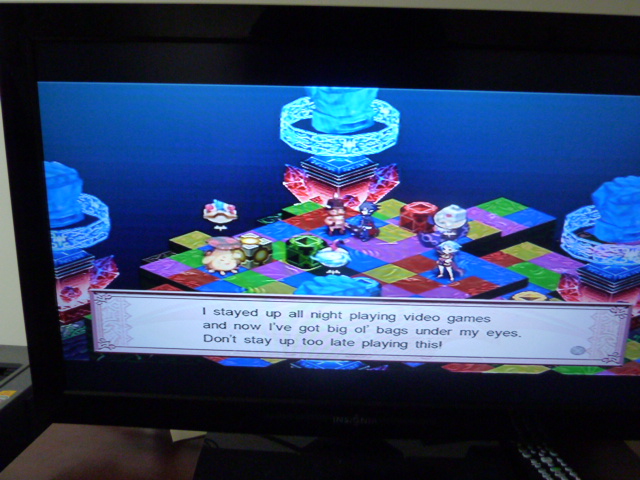
Text reads, "I stayed up all night playing video games,
and now I've got big ol' bags under my eyes. Don't stay up too late playing this!"
I managed to not check my blog stats all weekend. If you watch my Twitter, you know that's a momentous occasion. You also probably suspect I've been playing Disgaea, and you wouldn't be wrong. This post and some of the responses kept me reading until very late at night, too. Also, Josh and I did some cleaning for the writing group meeting, which we had at our place this time. As you know if you've read far back enough in my archives, I'm not big on prioritizing cleaning over writing. Not that a lot of writing was going on. 

Josh and I have another collaboration post coming up, this one about an aspect of world-building. Other than that, in true pantster fashion, I have no idea what's coming down the pipeline. We'll see what inspires me.

I wanted to share this chart of the most common grammar errors with you. It was shared on Twitter by Steve Umstead. Tweets only last so long, and they're frequently lost in the noise, so I wanted to make you were all able to see it.

Today's writing group was a critique for the one who was just published, and I, the delicate snowflake, may have been the most negative and critical. I ignored my own guidelines for critique. It sounds like it was still a useful critique session; whether in spite of or because of my very vocal contributions, I don't know.

My writing group went from expressing awe at my ability to be pure seat-of-the-pants to nodding knowingly when I confessed that the book I was currently working on waited until about halfway through to solidify into a plot. An awful lot of what I've written for that book is going to be scrapped, because they're irrelevant or they slow down the pacing or because they just don't add anything. Pantstering is not without its drawbacks.

I set a goal to finish this draft of what I'm working on by the next meeting, which is at the end of May. That should be easily doable, but we'll see how well I do at keeping away from my video game addiction.

Monday, April 2, 2012

Grammar Peeves: Comma Splices

How not to splice a tape courtesy of FSAudio
Commas are like sewage systems: you don't notice them until they've gone wrong. They help everything flow, and then, suddenly, there's a backup, and you're left wondering what that smell is.

They aren't second nature, and there are no hard-and-fast rules for how to use commas. You're supposed to use them in natural pauses in sentences, but different people will inflect their sentences differently. If you examine my above sentences, you'll see that I use commas to separate out independent clauses, but I learned to use commas long before I knew what an independent clause is.

The best way to learn how to use commas is to write, get it wrong, and learn. Someone will have to point out the commas in the wrong places, or that you don't use them enough, or that it sounds like Stevie from Malcolm in the Middle is narrating your words. You can try to spot your own comma issues by reading aloud, but, if you don't know the first thing about commas in the first place, it's unlikely to help you. If you exaggerate the pauses cued by commas as you read, you may find misplaced commas, but it's no guarantee.

The most preventable comma issue, and therefore the one you can learn without making mistakes first is that of comma splices. A comma splice is when two sentences are blended together using a comma instead of a period.

A basic sentence is composed of a subject and verb. Sentences can be joined together with a conjunction, and they're often much more complicated than a simple subject and verb. Further complicating the issue is gerunds, which is what you get from verbing a noun.

But, generally speaking, if a sentence has two verbs, it's a run-on. If those two distinct sentences are separated by a comma, the fix is as easy as changing the comma to a full-stop or adding a conjunction to blend the sentences seamlessly together.

I'd say that not having these down will get you rejected outright, but I'd be lying. I've read two professionally published books with comma splices lately. One of them may have been on purpose, but it still bothered me. Knowing what to do with commas, though, will allow editors to look at fixing other parts of your manuscript, instead of having to linger over your comma issues. You'll be doing yourself a favor.

Wednesday, March 14, 2012

The inner editor

I've talked about the inner editor before. It's the culprit behind writer's block. It's what you're thwarting if you want to try being tired to see if it makes you more creative. But the inner editor does serve a purpose.

In a first draft, you're basically tossing things out to see what sticks. You're generating ideas, trying out concepts, and seeing what works. At that stage, you don't want to listen to the voice in your head that tells you how much you suck. At that point, you want permission to suck. You can clean up all the random spew off the page in the editing phase.

It's in the later drafts that the inner editor finally serves a purpose. The inner editor is there to evaluate which plot threads and characters are important. It's there to slice off great swaths of dialogue, to sweep out all the scenes that don't serve the story, to kill your darlings (which is a post for a later time). It's there to keep the book grounded. It's there to make sure the sentences are strung together properly and in an order that makes sense.

If you don't have an inner editor, now would be a good time to get one. You need to read up on the grammar rules, take a writing workshop, and read some comments from publishers about why they didn't accept the books they didn't. A lack of an inner editor is why things like this happen, when an author goes off at length about how people's perceptions are wrong.

Granted, one can't anticipate all of people's criticisms, and one can't step outside one's own perspective to see it the way others will. But, without admitting there are flaws in the first place, when other people see them (and they will), you'll react poorly.

No one's writing is perfect. Some of the most-loved classics have one-star reviews online. (Despite the article writer's apparent belief that all of the reviewers are idiots, sometimes it gets down to taste and preference.) But one can't improve without seeing the flaws in what you're writing, and fixing it. Sometimes that means a writing group. Sometimes that means an editor. Most of the time, though, it means you have to look it over, yourself, find what's wrong, and eliminate it.

So, while the inner editor is the killer of productivity and the slayer of creativity, it does serve a purpose. Every writer needs to have one. It just needs to be tamed so it only comes out when you need it.

Tuesday, January 24, 2012

Grammar peeves: subject to ridicule

I don't see this in published works, luckily, but I do think it's an important grammar rule to have down. I didn't even learn about verb conjugation until I took French, so I think some people may need a remedial course in subject/verb agreement.

Basically, a verb changes based on what it's modifying. For the verb "to write," the conjugation looks like

I write                       We write
You write                  You (plural) write
He/She/It writes        They write

In the English language, it doesn't usually follow a neat, predictable pattern, and the conjugation changes from one verb to the next, which is why you can often tell someone isn't a native speaker by how they write verbs. Also, homonyms and silent letters and odd letter combinations are apt to trip them up. Don't judge them; we have a weird language, okay?

Where most native English speakers run into problems are when you're talking about a group. Though there are many members of a group, as a collective, they're treated as a singular entity. So, say you're talking about a high school football team. You might say, "The players write their papers on the bus whenever they have an away game." Talking about the whole team, though, you'd say, "The coach makes sure the team [it] writes its own homework."

It gets even more confusing when you have a word you're not modifying next to the verb. You'll usually find this to be the case in a prepositional phrase (one that begins with "with," "of," "from," or any of the words on this list.) As an example, let's see another sentence about the football team: "Every member of the team writes his own papers." The verb is modifying "every member," not "the team."

I also want to call your attention to the second half of that sentence, where I wrote, "his." You already know the subject is singular. I used "his" because I'm talking about an all-guy football team. Were this a coed team, though, I'd have to allow for the possibility of the female pronoun. I might write "his or her," which makes the sentence clunkier and more unwieldy.

Grammar rules say I can use "their," which I hate to do. English teachers and grammar experts alike are teaching people that it stands in as a gender-neutral singular pronoun when needed.

I refuse. I will rewrite the first part of the sentence to make it plural before I'll substitute "they" for a single person. I will use the unwieldy "his or her" or even "his/her" before I break out "they" to refer to a single person. I'll also use the already-singular, gender-neutral "one" or "one's," snotty as it makes me sound.

I hope someone finds this useful. High school and college English teachers, feel free to point your students this way.

Tuesday, January 3, 2012

Bad grammar makes me [sic]

Once upon a time, I worked on a college newspaper as copyeditor.  This position entailed writing an editorial for each issue to help fill the page.  I went to work, happily tearing down all the vices of consistently bad spelling, misused punctuation, and the dreaded they're/their/there problem.

The paper got a letter, from an education major who shall remain nameless (mainly because I can't remember, and am too lazy to look it up), riddled with spelling and grammar errors.  It accused me of elitism, scoffed at all the bile I was wasting railing about something so silly as how stupid people sounded when they didn't even try to string together a sentence, and then pointed out all of the errors she'd found in the paper over the last several issues.

The letter taught me something, but not what the letter writer intended.  It confirmed my suspicion that those most defensive that spelling and grammar don't matter are those who don't care they're bad at it.  It told me that presentation does matter - after all, the errors she'd noticed were supposed to reflect poorly on me.  And I learned that I was doing a good job; all of the errors the letter writer found were in sections I didn't proofread.

I'm more aware these days of the immense privilege I had in attending a school where some grammar basics were taught, where the teachers not only marked our papers in red ink but explained what was wrong with what we'd written.  I understand that bad grammar is not a sign of lacking intelligence, or laziness.

But I understood that then, too.  My point, which I still maintain, was that presentation matters.  What you say, how you say it, and how much effort you put into polishing it all matter, sometimes more than what you're saying (or writing).  This is true whether you're a writer or not.

As a writer, if you submit your draft for publication or for representation by an agent, and it's riddled with spelling errors, you're going to have a hard time selling that manuscript.  From what I've heard about the publishing world, new manuscripts aren't competing with a majority of poorly-written dreck.  Most submissions are cohesive, well-written, and polished.  Of two similarly well-written stories, one that obviously needs more work on the basic level (as in, spelling and grammar) is less likely to be picked up.  It's the same reason why they don't build houses on top of mounds of sand: the foundation has to be strong.

Grammar and spelling matter outside the publication world, as well.  If you misspell a job title or description on your résumé, you're going to have a hard time getting a good look from an employer who recognizes the need for a professional presentation. (In my limited experience of HR offices, that's most of them.)  Send an email riddled with sentence fragments and a bad grasp of apostrophes, and a business contact may go with someone who can put forth the effort to string sentences together properly, instead.  You won't see businessmen coming to blows over the minutiae of grammar, but it does affect one's business life and how people perceive you.

That is not to say you're doomed, if you haven't grasped it by now.  The beauty of the written language, and what I especially like about it, is that it can be edited.  You can't take back having said something stupid, but you can stop and take a few moments to look your emails over for common spelling errors.  You can have someone who knows these things proofread your résumé or cover letter.  You can spend a few minutes every day familiarizing yourself with the basics, and vow to stomp out one faux pas at a time.

To me, it's always been about the effort, not the errors themselves.  I'm not going to snark at every email I receive and make fun of every spelling error.  I'm not going to forward a poorly-written email to my co-workers or fellow grammar police to make fun of the person who wrote it.  I'm not going to correct a comment's spelling and grammar if I find it lacking.

If, on the other hand, I see a consistent pattern of someone making the same mistake again and again, and I know the person well enough, I'll try to correct the writer in a gentle and nonjudgmental way.  If that person has made it clear this approach is unwelcome, I'll leave it be.  I'll also correct my own errors, often loudly and blushing furiously as I do.

English is not an easy language.  I get it.  All I'm looking for in any written correspondence is that I'm worth the effort to attempt to communicate with effectively and meaningfully.  If you don't care about grammar, that's your prerogative, but at least try to think about the message it sends.

The title of the post, by the way, comes from a printed tank top my ex-husband got me for Christmas one year. I also have a "Grammar Police" mug.  Same source.

Tuesday, December 20, 2011

Comma abuse

I'm going to be on the road starting tomorrow, and unlikely to have the time or inclination to post until after Christmas.  I thought today could be another grammar gripe, to carry you through the week.


Commas are a useful piece of punctuation.  I use them daily, if not hourly.  When used properly, they aid in the flow of sentences and make for a seamless reading experience.  They clarify (see Lynn Truss's Eats, Shoots & Leaves for many examples on how), they separate, and allow for parenthetical asides without the intrusion of parentheses.  The oxford comma is hotly contested, and if you read the previous sentence carefully you'll see where I stand on that argument.

What commas do not do, however, is separate sentences.  You cannot take two whole sentences and splice them together with a comma.  Sometimes a semicolon is necessary, if the two sentences are closely related and interdependent, though I'm told they're discouraged by most modern publishers.

Those are, logically enough, called comma splices, and they sound, in my head, like the writer is out of breath.  While writing is difficult, it's rarely strenuous, and so I regard such passages warily.

A sentence is composed of a subject and a verb.  Rarely, though, are sentences mere subject and verb.  They're often fluffed up with adjectives, adverbs, prepositions and conjunctions.  I can't say a sentence with more than one verb is a comma splice, because I have several examples right in this post where they're not.  All of those verbs are separated out into their own separate pieces of the sentence, but it's difficult to articulate how without teaching you how to diagram sentences.

Incidentally, I learned how to do that in middle school, and I hated it.  But it did teach me about sentence structure and grammar rules and a grasp of the English language that I didn't previously have, so I'm grateful for the experience.

So, without all the strain and stress of diagramming your sentences, how do you learn to avoid comma splices?  By reading your sentences carefully.  If your thought is finished but the sentence is not, put a period.  If you really, really need to link two sentences, put a semicolon.  Ask what your commas are linking.  If it's adjectives, you're good.  If it's prepositions or lists, that's fine.  It's when you're linking thoughts that belong in different sentences that you have a problem.

Have a very happy holiday, no matter what you celebrate, and I'll see you all before New Year's to post a wrap-up post or two.  Meanwhile, feel free to request blog topics or share your thoughts in the comments.