Search This Blog

Showing posts with label Seanan McGuire. Show all posts

Thursday, October 2, 2014

Review: The Winter Long (October Daye #8) by Seanan McGuire

The Winter Long (October Daye, #8)The Winter Long by Seanan McGuire
My rating: 5 of 5 stars

This is the eighth book in Seanan McGuire's October Daye series. I think I say every time that they get better with each installation, but, well, it's true. McGuire does her homework, building intrigue and tension into earlier books that pay off handsomely with each new installment.

The Winter Long opens with the Winter Solstice ball, and Toby's official designation as the realm's hero. No sooner has she dropped into bed to recover from her long night of social obligations than she gets a visit from Simon Torquill, brother to Toby's liege and the one responsible for her spending 14 years as a fish. He wants to help her, only his definition of "help" is wanting to turn her into a tree for the next century so she can't be killed.

There are a number of reveals in this book that have been building for 7 books, and that I won't spoil if you haven't yet had the pleasure. Toby's nemesis is all the more formidable for blindsiding Toby. Alliances shift, relationships change, Toby empathizes with characters she had every reason to hate, and the Luidaeg gets to step outside her snarky-cryptic-adviser role to show off why she's the subject of parents' warnings and children's nightmares.

If a young writer asked me how to write foreshadowing, I would plunk down this series and say, "Get reading." All of the shocking reveals have been telegraphed from the start, yet they still blindside us, because Toby was (and we were) off investigating this shiny clue over here. As I posted elsewhere, McGuire was dropping breadcrumbs while we were following the shiny stones.

Everyone's favorite Cait Sidhe is here, backing Toby up and lending emergency transportation through the Shadow Roads, and providing much-needed levity. His role at the end of the book is probably the least surprising reveal, but it's a pleasant surprise.

The pacing of this book is lightning fast. The bulk of it takes place over a period of 24 hours. The only reason Toby stops is because she's unconscious. That's not a spoiler, because, of course she is. She tests the very limits of her magical abilities (and her body's blood capacity). She's far from the strongest magic user in Faerie, but she's probably the most determined.

There are hints of things to come in future books. I suspect we'll see some way of getting around Elf-shot, because Rayseline and her break with reality is too good to let lie. Er, no pun intended. And there's plenty stirred up by Simon's return that needs addressing. Lastly, the series can't come to a close without Toby having conversation or three with her mother, Amandine.

Beyond that, I won't make any predictions, because this series is too good to pick apart with speculation. It's best enjoyed when you trust McGuire to do what the story needs, and wait to see what that is. I'm still going to take note of clues I pick up along the way, because chances are good they'll pay off nicely, but I'm not going to cling to my predictions. I like how she handles them better every time.

If you're not reading this series yet, go pick up Rosemary and Rue, then
  A Local Habitation

, and so on until you're caught up. I'll wait. Because I need more people in my life I can talk to about my love for these books. They're so much fun. You don't hate fun, do you?

View all my reviews

Thursday, August 21, 2014

Review: Sparrow Hill Road (Ghost Stories #1) by Seanan McGuire

Sparrow Hill Road (Ghost Stories, #1)Sparrow Hill Road by Seanan McGuire
My rating: 5 of 5 stars

I picked this up when it first came out, but, unlike most Seanan McGuire books, I didn't immediately tear into it. I was familiar with Rose's story thanks to the serial fiction published in The Edge of Propinquity. It turns out the book is as far removed from the serial as the serial is from the original song that inspired it.

Rose Marshall is a road ghost. If you've ever heard the tale of the hitchhiking ghost who vanishes before reaching its destination, you know the other side of Rose's story. Rose is a benevolent ghost, but there are those who don't think so, and want her stopped. And then there's Bobby Cross, the reason she's been stuck at age 16 for the last 60 years. She lives in fear of being caught by him, at the same time as she rescues those who die on the road from his grasp.

The story doesn't entirely lose its serial-fiction roots. Rose repeats herself frequently and explains things the reader might already know. Each chapter could easily be read as a stand-alone story, though you'd lose the overall narrative arc. Rose warns the reader early on about the fluid nature of time to a ghost, and so it makes sense that she might go over things she's already said. She's not sure where the reader is jumping into the story.

Rose's voice is more lyrical and rich than Seanan McGuire's other first-person narrators. She speaks in metaphor and imagery, evoking the sort of rambling thoughts that can only come to mind when you're alone on a lonely stretch of road with nothing better to think about. That's not to say the book rambles. She often sets the mood with a few well-placed words. Her voice reads as a combination of road metaphors, 1950's slang, and trucker shorthand.

If you've read the serialized version of this story, you'll have the bare bones of the plot laid out, but you'll have missed out on a lot of details that tie the story together. I couldn't do a compare-and-contrast, because I can't be positive if I forgot certain details from the serialized story or if they weren't there. I do know that this version of Rose's story is the richer and more vibrant.

Rose's story takes place in the same universe as McGuire's InCryptid stories, which start with
  Discount Armageddon

. Rose refers several times to the Healy family and its creepy, possibly-haunted house in her hometown, though none of the family members make an appearance. Rose is seeing another side of that world. I can see where she might cross paths with a future InCryptid story, but there's no room for it in this tale.

Once upon a time, the "Sparrow Hill Road" short stories made me interested in looking up road ghost stories to learn more about the tales Rose refers to. Sparrow Hill Road in its polished form makes me nostalgic for a time I never lived through, and finishing it makes me miss a friend I've never met. Unlike in the short stories, this version leaves room for more of Rose's story. I look forward to visiting more of the second America Rose guides us through.

I've been recommending this book all over the place to friends interested in ghost stories and local tales and urban legends. It's an excellent compilation of those tales, at the same time as it gives them a face and their own voice. I can't overstate how highly I recommend this book.

View all my reviews

Monday, August 18, 2014

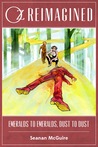
Review: Emeralds to Emeralds, Dust to Dust (Oz Reimagined) by Seanan McGuire

Emeralds to Emeralds, Dust to Dust (Oz Reimagined)Emeralds to Emeralds, Dust to Dust by Seanan McGuire
My rating: 4 of 5 stars

This is only one of the short stories in the Oz Reimagined anthology, but it was released as a standalone short story on ebook. I wish more anthologies would do this. I've read far too many anthologies I wish I'd just picked through for the reasons I bought the anthology lately. And, in this case, I don't think I'm enough of a fan of the Oz books to justify picking up the whole thing.

"Emeralds to Emeralds, Dust to Dust" posits an Oz beset by humans from our world, who crossed over the Deadly Desert and are now relegated to their very own Emerald City ghetto. Dorothy is all grown up, and is tasked with keeping humans in line, but they resent her for her status and for beating a path to a land that's less than magical to them. The story is a very short murder mystery. A body is found in the human sector of town, only it's clearly a plant to stir anti-human sentiment.

If you hold the Oz books as sacred or purely innocent, you're unlikely to enjoy this story. This takes a lot of the magic out of the world. Ozma is controlling and petty, and Dorothy is far more cynical than the young girl who was once horrified to accidentally kill two witches. Sand from the Deadly Desert is a drug, called Dust, that's potent and often lethal.

The alterations aren't without precedent. Considering what happens to wilderness not under federal protection, it's not a stretch to suggest that large numbers of human immigrants into a magical land may have a negative effect. And Dorothy couldn't possibly remain an innocent little girl forever. I'm not familiar with Ozma's role in the books, but power has, historically, gone to people's heads, and it sounds like Ozma has a lot of it.

If you're looking for a nostalgic stroll through the books you loved as a child, you may want to skip this. But if you're looking for a creative take on what may have been, I'd recommend giving this story a shot. It's a quick read, compellingly written, and easy for even those of us not as familiar with the Oz books to follow.


View all my reviews

Saturday, July 19, 2014

Review: The Midwich Cuckoos by John Wyndham

The Midwich CuckoosThe Midwich Cuckoos by John Wyndham
My rating: 4 of 5 stars

I realized after I picked up this book that it was abridged, and that the only unabridged audio is a performance. I have no idea what I missed, but I did listen to a compelling story, worth delving into the source material.

If you've heard of The Midwich Cuckoos, you've probably seen one of the Children of the Damned movies. I've heard of it through Seanan McGuire's InCryptid books. There's a race of cryptids called Cuckoos, and they're much like the creatures described in this book, with a greater variety in appearance. Sarah gets her last name from Gordon Zellaby, the layman who studies the strange children.

The book describes a small town in the English countryside, struck mysteriously by a sudden sleep that lasts a day and a half. Anyone passing into the radius immediately falls asleep, and wakes up when dragged back out, usually by a hook. Our narrator escapes the daylong sleep because he and his wife are away celebrating his birthday.

Soon after what everyone calls the Dayout, all of the women of childbearing age realize they're pregnant. Initially they make these discoveries separately, but, when they start risking their lives in ever more desperate measures, the town doctor talks Angela Zellaby into rallying them around for mutual support. When they're born, all of the children have a particular shade of blond hair, and golden eyes. And their mothers start to do their bidding, whether they want to or not. As the children grow older, at twice the rate of normal children, Gordon Zellaby starts to notice some other remarkable things about them.

Despite the book's overall patronizing tone (the women are "hysterical," and not in the funny way), it captures the crux of many pro-choice arguments. The women lament being used as a container, remark they feel used, and there's palpable tension as the due date grows near. Many of the women unsuccessfully try home abortion techniques, and risk their lives in the process. Surely even the most staunch abortion foes wouldn't argue the world was better off with these fictional children in it.

Mostly, Midwich Cuckoos evokes Cold War panic. The notion that the children are there to destroy society within is hard not to see as a parallel. The truly terrible events in the story are triggered by actions taken by the Soviets.

The book, then, is dated in some ways. It most shows its age when one of the characters remarks that, at least the children aren't black. I can only hope he wasn't meant to be an author mouthpiece.

The choice of narrator for this book is a curious one. The narrator participates in very little of the story, and serves only to tag along and observe the most interesting parts. He even has a convenient job in Canada that takes him away from the village for the 8 years where nothing much happens with the children, and he returns for a visit just in time for things to come to a head. He doesn't add any commentary or opinions that enhance the story.

This book is well worth a visit to the original material, despite how dated it is. If nothing else, it's a glimpse into how classic scifi/horror was crafted. The genre hasn't changed much in the intervening decades.

As mentioned above, I listened to this on audio. Despite the fact it was abridged, it was a pleasant listening experience. Jeremy Clyde's performance didn't detract from the story, and added to it in places. He was easy to understand with a consistent volume.


View all my reviews

Thursday, May 29, 2014

Review: Forbid the Sea (October Daye, #0.2) by Seanan McGuire

Forbid the Sea (October Daye, #0.2)Forbid the Sea by Seanan McGuire
My rating: 5 of 5 stars

I needed to scrub my brain after the last book I read. This seemed like a good bet. It's available for download free on Seanan McGuire's website.

"Forbid the Sea" takes place 10 years after the events of "Rat-Catcher." London's fae are only just returning to their homes. Everyone's favorite King of Cats, Tybalt, takes a boat ride down the Thames, where he meets a handsome young Selkie named Dylan. They become involved (yes, Tybalt, like many fae, is bisexual; you only don't notice in the present day because he's monogamous). Then Tybalt learns why Dylan's in London, and he has a choice to make between personal feelings and fae politics.

It's a fast read, though not because it's action-packed. It has the feel of a sweet summer romance throughout most of it, but there is that thread of menace running just under the surface. Tybalt is clearly lonely, and mourning the events that left his Court empty. This makes him overlook some aspects of Dylan he should've questioned. He's content to only dig into the first layer of secrets. And he shows Dylan (and therefore the reader) how much different he was when he was only Rand. There are hints of the Tybalt that appears to October Daye at sunrise in Rosemary and Rue, but he's changed through the centuries. By Chimes at Midnight, he's shown a lot more of the gentle tenderness we see in this story.

You don't need to have read "Rat-Catcher" to follow this story, though it does help with context. Even if you can't get your hands on the earlier story, I recommend reading this one if you're a fan of Tybalt. The download link is up at the top of the review, and it's author-hosted. So give it a read. It's chock full of insight into a fan-favorite character.

View all my reviews

Wednesday, February 5, 2014

Review: Half-Off Ragnarok (InCryptid #3) by Seanan McGuire

Half-Off Ragnarok (InCryptid, #3)Half-Off Ragnarok by Seanan McGuire
My rating: 5 of 5 stars

I won a copy of this book in a Goodreads First Reads giveaway. I was not compensated in any way for my review.

Can we just clone Seanan McGuire? Please? Because I want more InCryptid. I also want more October Daye. And sequels to Indexing. And more Mira Grant tales of science gone wrong. And short stories she keeps posting on her website. And I want her to be able to sleep and go to the Disney parks, because really, anyone who brings so much joy into the urban fantasy world deserves nice things. I'm not totally greedy.

It's not like she slacks off. Half-Off Ragnarok, which I was lucky enough to get as an ARC and will be buying in paperback when it comes out, is released on March 4. Sparrow Hill Road, which is in the InCryptid universe but addresses another aspect entirely, is due May 6. The Winter Long, Toby Daye's eighth book, is out in September. Symbiont is scheduled for a November release. I can't imagine the kind of productivity that lends itself to that release schedule.

But about Half-Off Ragnarok. This is the third InCryptid book, and the first to be narrated by Alexander Price, the oldest of the Price siblings and the only son. He's come to Ohio to mate a pair of basilisks, and, for his day job, works with reptiles at the zoo. He's dating Dr. Shelby Tanner, an Australian biologist who works with the big cats. He lives with his grandparents, on the Baker side of the family. He helps take care of his cousin, Sarah Zellaby, who's recovering from the events of Midnight Blue-Light Special.

Alex's busy life doesn't lend itself to much socialization. Or sleep, for that matter. Shelby is put off by his dozens of excuses about why he can't spend time with her, and seems on the verge of ending things. Then Alex finds the partially petrified corpse of one of his employees. He has to investigate which creature did it before the Covenant of St. George hears about it, without neglecting Shelby, pissing off the local gorgon population, or getting turned to stone, himself.

I did miss Verity, who makes a short cameo in a phone call, but Alex proves himself worthy of carrying this book on his own. The shift in perspective allows Alex to tell us things about the family Verity didn't find important or that didn't come up. We meet another colony of Aeslin mice, who are just as adorable as Verity's. We learn that, though they regard Alex as a deity (the God of Scales and Silence), he gets no additional perks from the position. He has to bribe the mice for privacy and participate in rituals just as Verity does.

We also see more aspects of the InCryptid world. Alex's focus is on non-sapient cryptids, so he can't reason with or threaten critters running amok. He has to trust his judgment on which ones are beyond redemption, and live with the consequences, whatever his decision. His focus is more on the biology than anthropology aspect.

Despite the shift in perspective, the tone of the series remains consistent. There's still lots of humor and levity, and I suspect the author had way too much fun writing Sarah's cryptic dialogue. It's not overdone, but it sure is random. The snark is perfectly intact, with plenty of snicker-worthy lines. Sarcasm appears to be genetic in the InCryptid universe.

I enjoyed this installment quite a lot, and will be eagerly awaiting the next. On the one hand, it's a whole year. On the other, it's only a year. There will be plenty of other books to read in the meantime.

View all my reviews

Saturday, January 25, 2014

A Fantasy Medley 2, edited by Yanni Kuznia

A Fantasy Medley 2A Fantasy Medley 2 by Yanni Kuznia
My rating: 4 of 5 stars

This is a short anthology, limited to four stories. All are a continuation of different stories in different worlds. It seems unfair to drop readers into three worlds they're unfamiliar with, but most of the writers managed to turn out something we could follow. I think. I knew the context of the one story I picked this anthology up to read, so I don't know how well it works out of context.

The first story is "Quartered" by Tanya Huff. It's set in a medieval fantasy world where the magic is wielded by bards, and used to control . . . spirits? Ghosts? Semi-incorporeal beings? And thus you see my problem with this story. Many terms are thrown about as if the reader already knows what they mean. By the time I had any grasp on who anyone was or what they were doing, the story was wrapping up. It could've been an excellent story about how a woman lost the use of her legs and how it doesn't slow her down. Instead, it's a near-inscrutable collection of political machinations and personal drama.

"Bone Garden" by Amanda Downum is easier to follow, at least. The perspective character, Gentian, finds his cousin, half-dead and starving, on the doorstep of the theatre where he performs and lives. He's drawn into her family struggles, and stands witness to how the family he turned his back on brings about their own downfall. I felt like the narrative made an about-face when the plot showed up, but otherwise it was an interesting introduction to the world.

"The Sergeant and the General" by Jasper Kent is set in post-Napoleonic France. It's about a lodger in the house of a man literally haunted by his part in the campaign against Russia. The second half of the story gives the context explaining the first half. And it is nicely creepy. It could pass for an ordinary ghost story, if not for its inclusion in a fantasy anthology.

"Rat-Catcher" is the reason I got the book from the library. It tells the story of everyone's favorite Cait Sidhe when he was Rand, a young Prince of Cats living in London in 1666. He watches Shakespeare performances from the rafters of his favorite theatre, and avoids his father as best he can. He's sent to the Divided Courts as an envoy, where he hears a Roane seer tell of a terrible fire coming. Tybalt's life has not been a pleasant, carefree one, and this story does a lot to explain why he's so protective of his subjects, how he learned to fight so viciously, and why he's reluctant to trust. It's a heartbreaking tale, chock full of little worldbuilding details.

Anthologies are tricky things. There are always stories you have to read to get to the one you wanted all along. In this case, there are only three of them, and two of them are rather enjoyable. If there were a way to read "Rat-Catcher" without this anthology, I'd be recommending that method. But, as it's packaged, it could be worse.


View all my reviews

Wednesday, January 1, 2014

2013: A Year in Reviews

I didn't do a lot of writing posts this year. But I did write up a review of each and every book I read in 2013, and I read a lot. Goodreads tells me it was 117 books, though I did cheat a little. Thirteen of those were The Human Division. The fact that I reviewed each and every installment has to count for something. I also won a reading challenge.

I think reviewing every single book has me reading a little differently, with more of an eye on technique and craft. I know formulating my thoughts about them has been helping me express myself better, though I do recognize they're not all masterpieces. At least you're getting your money's worth, right?

Last year, I recapped my favorites, and I enjoyed doing that. So, without further ado, below are my favorites of 2013. Please note that these are books I read in 2013, and many of them were published in previous years.

Favorite Debut: The Golem and the Jinni by Helene Wecker. It was funny, poignant, and topical. I cared
what happened to the title characters, the world was populated by what felt like real human beings, and it didn't end the way I expected. I wouldn't have guessed this was this author's first novel; she has the craft, level of detail, and research down pat. I look forward to her next book, whatever it may be.

Favorite Series Conclusion: MaddAddam by Margaret Atwood. A lovely, satisfying wrap-up to a series I can see myself rereading happily, despite my ever-looming to-read pile. Atwood has a background in poetry, but the prose is never mired in overly flowery descriptions. She understands what words are for, and uses the right ones.

Favorite Post-Apocalyptic: Swan Song by Robert R. McCammon. I admit, I was skeptical about all the love it was getting in reviews when I started out. It seemed dated and depressing. But all that atmosphere was building to a lovely and perfect conclusion. I loved all that stalling for leading me to that beautiful ending.

Favorite Reread: 1984 by George Orwell. I revisited it for a book club, because we were going to discuss it in the context of Brave New World, and I hadn't read it since high school. I didn't expect to like it as much; I thought it was one of those books I'd outgrow. But the politics and notions struck me all the more, now that I'm more of a participant in how the world works. I think it helped, also, to have read Margaret Atwood's perspective on it last year in In Other Worlds.

Favorite Audio Performance: The Importance of Being Earnest by Oscar Wilde barely edges out Macbeth by William Shakespeare, but only because we're talking about the performance, not the quality of the story. Oscar Wilde wins out for style. If it were up against a Shakespeare comedy, it wouldn't have stood a chance. If you check both reviews, though, you'll see the common element that made them both such tough contenders.

Favorite YA: The Absolutely True Diary of a Part-Time Indian by Sherman Alexie. Funny, revealing, universal yet illuminating. I wouldn't go so far as to make it required reading in schools, because that's how you make kids hate a book. But, I do think a lot of young people, especially misfits, artists, and ethnic minorities, might relate to the main character.

Favorite Fantasy: The Hundred Thousand Kingdoms by N.K. Jemisin. It was far better than it needed to be to hook me on the series. Personable, vulnerable gods and the best fantasy heroine I've ever read made this book positively addictive to me. This is one of those books that made me depressed I'd never write this well, then, when I got over it, determined to prove myself wrong.

Favorite Nonfiction: Let's Explore Diabetes with Owls by David Sedaris. Thoroughly entertaining, often funny, and expands on what we, as readers, know about Sedaris and his family. It also answers a number of questions I've wondered while reading other stories of his.

Favorite Serial Fiction: Indexing by Seanan McGuire. It'll be released as an entire volume in late January, but, to get the full experience, you'll have to put it down for two weeks after every chapter. (No; read it however you like. I'm curious how it stands up as a whole work, actually, and would appreciate comments letting me know what you think, if you discover it that way.)

Favorite Short Book: The Ocean at the End of the Lane by Neil Gaiman. It's been getting all kinds of critical acclaim, but, in this case, it's justified. This nostalgic tale about long-forgotten magic is lovely and poetic and a delightful read. And, it's just barely longer than a novella, so it's not like you've wasted a lot of reading time if you're not as enchanted as I was.

Favorite Doorstopper: Under the Dome by Stephen King. It justifies all that narrative space, but, whoo! It's a lot to find yourself faced with when you're already three books behind on your reading goal for the year.The themes resonated with me quite a bit, and it was deeper than I expected from Stephen King.

Favorite Concept: Lexicon by Max Barry. Control of the world through a few well-chosen words. Sounds like writing, true, but not the way it's presented here. I wasn't expecting to enjoy this book half as much as I did. And I don't pick up books with the expectation they'll be merely tolerable.

Favorite Kids' Book: Fortunately, the Milk by Neil Gaiman, illustrated by Skottie Young. A delightful tall tale about time traveling dinosaurs, redecorating aliens, and a scatterbrained dad. Don't wait for an excuse to read it to a kid. Read it for yourself.

Favorite Classic: The Idiot by Fyodor Dostoyevsky. An excellent book for those who like this kind of thing. Dostoyevky can be depressing, and rambling, and rather dark. That's what I like about his books. This one in particular manages to highlight some of the best parts of human nature, while condemning the worst. I didn't always understand character motivations, but I didn't care. The characters knew who they were and where they were going, and I wanted to follow them to see where they ended up.

Favorite Science Fiction: Redshirts by John Scalzi. A send-up of various science fiction tropes that serves as both homage and satire, which is a neat trick to pull. I still can't believe Scalzi did that*, and I'm a little mad he pulled it off so well.

Favorite Author remains Seanan McGuire. This year, in addition to numerous short stories published on her website, Seanan also published Midnight Blue-Light Special (InCryptid #2), Chimes at Midnight (October Daye #7), Parasite (writing as Mira Grant; first in a two-book series), Indexing (mentioned above), she had a story in The Mad Scientist's Guide to World Domination as well as several other anthologies, and she contributed to a Hugo-winning podcast. Just by sheer volume of my favorites of 2013, alone, she wins. But it's her consistency, her cheerful online presence, and her occasional posts about weighty, potentially controversial topics, that secures her the spot at the top of my author list for another year. The rest of her potential competition is running around in circles back at the start of the race.

So that's my 2013 in reading. How did yours fare?

I hope 2014 brings you some happy surprises, and many excellent books to read. Have a fun and safe New Year's.

* If you've read it, you know what that is. If you haven't, I'm not going to spoil the fun of finding out for yourself.

Monday, October 28, 2013

Review: Indexing by Seanan McGuire

IndexingIndexing by Seanan McGuire
My rating: 4 of 5 stars

Indexing is a Kindle Serial, released in installments through an Amazon-exclusive publishing deal that gave us twelve tantalizing installments, spread out throughout six months. The episodes each had to function as a whole story, make the reader eager for the next one, and contribute to the overall plot. It was a tall order, but I think it was one that Seanan McGuire manages, for the most part.

The story is set in a modern equivalent where the last thing you want is a fairy tale ending. In this world, fairy tales can rise up to swallow entire cities. A Sleeping Beauty equivalent might be carrying an airborne plague, a Pied Piper can turn the happy woodland creatures against you, and a Wicked Stepsister might decide to stop fighting against her murderous impulses. The ATI is a secret police force that stops these fairy tales and mitigates the damage they might cause. The index of the title refers to the Aarne-Thompson Index, a classification grouping fairy tales and their elements. Correctly identifying a fairy tale appearance is essential to shutting it down.

Henrietta Marchen (Henry to her colleagues) runs a task force in the ATI, consisting of only one person whose life hasn't been directly touched by what they refer to as incursions. Henry's mother was a Sleeping Beauty, and she, herself, has all the hallmarks of becoming a Snow White. When the story opens, bluebirds are beating themselves to death against her closed window, desperate to bask in her sweetness. In order to keep her story at bay, Henry has to resist everything that tries to draw her in.

Sloane is the most memorable in her team. She had the potential to become a Wicked Stepsister, and only just sidestepped it. Sloane is prickly, snarky, and irreverent. She's also the oldest member of the team, and the only one who's been inside a narrative and lived to tell the tale. Therefore, she's attuned to the narrative, and can easily identify elements.

Demi is the next most memorable, as the confused rookie. One day, she was a college student; the next, she was recruited into the ATI ranks. She's an active Pied Piper, and her skills of persuasion come in handy.

I kept mixing up Jeff and Andy, because they're mostly background. Jeff's role as a former shoe elf makes him super organized, and well equipped to research pertinent details. Andy is untouched by the narrative, though he's seen what it can do. He also seems to be the only one with a social life; he has a husband and the best sense of the mundane parts of the city. He keeps the rest grounded in reality.

Andy isn't the only gay character to appear within the story. Some of the stories are gender-flipped to accommodate a gay central character. There's also a trans* person who serves an important role in the story. I felt his character was handled with dignity, and fleshed out just as well as the central cast. There are also heterosexual relationships and nuclear families, so you know it's not a side effect of the fairy tales leaking over into the "real world."

Most of the episodes are a case apiece, though some end on cliffhangers. Toward the end, there are more and more loose ends at the close of each episode. The ending doesn't wrap them all up neatly, though it does address the major conflicts in a satisfying way. Seanan McGuire has said on record that there are no plans to publish a season two at this time, but that it's up to her publisher. I take that to mean that it depends on the success of season one, which is why I'm pestering everyone I know to pick it up.

It's hard to tell if some of my sense of detachment from this book, in the end, comes because I had to read it in small chunks, or if the story, itself, was disjointed. I know there were several points where I found myself lost by a plot point because I'd forgotten what had happened before. Not that I'd ask for recaps or for frequent narrative hints; they would quickly become repetitive, especially if one were to read the entire story start to finish.

I do think the medium limited this story, and that it would be more enjoyable to read all at once. By the same token, though, I'm interested to see what creativity can come of limits. As an experiment, I would call Indexing a success. I enjoyed the story, the characters, and the world. I hope to read more about Henry, the ATI, and her team.

I am curious, though, how different an experience it would be to read the entire story at once.


View all my reviews

Sunday, October 20, 2013

Advance Review: Parasite (Parasitology #1) by Mira Grant

Parasite (Parasitology, #1)Parasite by Mira Grant
My rating: 4 of 5 stars

I received an eARC of Parasite through NetGalley. It will be released on Tuesday, October 29th.

Sally Mitchell is brain dead following a car accident when, just as her family is about to pull the plug, she wakes up. SymboGen, a company devoted to genetically engineering parasites for personal health, takes credit for her miraculous recovery. Sally had an "implant," which is what they euphemistically call these personalized tapeworms. The tapeworms excrete needed medication and bolster an immune system that would otherwise be near-paralyzed with allergies. (For more information about why these are scientifically viable concepts, read up on the hygiene hypothesis.)

Several years later, Sally is mostly back on her feet. She has no memory of her life before the crash, and it's been a long recovery process. She can speak and interact, but colloquialisms elude her. SymboGen has been taking care of her, and she has regular check-ups at their facilities in exchange for their taking care of her medical bills. She's never relearned how to drive, and is extremely cautious of other people's driving. She's dating Dr. Nathan Kim, a parasitologist at a San Francisco hospital, and one of the few people to opt out of an Intestinal Bodyguard.

Suddenly, people are acting strangely. It looks like sleepwalking, though the sufferers are awake and fine just moments before the onset. Sally witnesses two of these events, and they leave her deeply troubled. One of them winds up with a dog in her care, a well-behaved black lab named Beverly whose former owner scared her half to death when he came down with what is soon called the sleeping sickness.

The mystery deepens, and Sally soon finds herself in the middle of several conspiracies and coverups. Her father works for the government, and thinks she's the key to curing the sleeping sickness. SymboGen might have something to do with it. And Nathan's mother seems to have the most information of anyone.

If you have a sensitive stomach, you won't want to read this book after you've eaten. Some of the discussions of parasites might bother you. I was fine, but I find parasites more fascinating than gross. I did, however, read the most terrifying scene I've read since House of Leaves. When Beverly starts barking at the backyard fence, you might want to turn on a few more lights before you continue reading.

Parasite is the first of two books in the Parasitology series by Mira Grant. It shares the meticulous research, the near-future crisis, and the snappy dialogue of the NewsFlesh trilogy, but the similarities end there. This is an entirely different world, and an entirely different problem.

I'm intrigued to see where it goes from here.

I recommend this book if you like your medical thrillers well researched, and you need more plausible science fiction in your life. Parasite takes place in 2027, and most of it seems like a logical extension of current health problems. Mira Grant knows her stuff, and she writes well, while she's at it.


View all my reviews

Monday, September 23, 2013

Review: Chimes at Midnight (October Daye #7) by Seanan McGuire

Chimes at Midnight (October Daye, #7)Chimes at Midnight by Seanan McGuire
My rating: 5 of 5 stars

This is the seventh book in a series I'm hopelessly in love with. Every time, I say they get better with each book, and every time, it continues to be true. Each book advances the worldbuilding, develops the characters, reveals plot lines that have been building all series, and thoroughly entertain me. This is how you write a series. Epic fantasy writers, take note.

This book has Toby getting to the bottom of the goblin fruit trade. She uncovers that it's killing changelings, and goes to the Queen to sort it out. Instead, she's banished. She has three days to pack up and go. This being Toby, she isn't about to meekly slink off. Instead, she uses the resources she's been building all series to research how to wriggle out of it. Along the way, she nearly dies several times (but what else is new?), finds new corners of the realm, visits the library, and gets hit in the face with an evil pie.

She also finds out who Quentin's parents are, so, if you've been looking forward to that revelation, it's in this book.

My favorite part of the book is finding out my cat is aptly named. About a year ago, I adopted a brown tabby, and I named him after Tybalt. He's vocal and loyal, and extremely affectionate. He's also distressed if I'm out of his sight for any period of time, and not a fan of dogs or car rides. The fictional Tybalt displays all of these characteristics (though his affection is of a different kind), and, every time he acted like my little Tybalt, it made me happy.

I'm also convinced that the dog park mentions (there are two in so many pages) are Night Vale references. I don't think Ms. McGuire started listening to the podcast until after the final edits were in on this book, but, if nothing else, it might add to her personal amusement. It certainly enhanced mine.

Much is changed of Toby's world in this book, and we get some hints about where this might be leading, or what might have led up to the current situation. I could speculate, but I'd much rather just wait until the next book comes out in a year, and be surprised.

I love this series.


View all my reviews

Monday, May 13, 2013

Review: Sweet Poison Wine (InCryptid #0.5) by Seanan McGuire.


Sweet Poison Wine (Incryptid, #0.5)Sweet Poison Wine by Seanan McGuire
My rating: 5 of 5 stars

This is another InCryptid prequel tale, the fifth in Frances (Brown) and Jonathan Healy's interesting life together. As with three of the previous stories, this is available for download free on the the author's website.

In this installment, Fran and Jonathan are happily married, and spending their honeymoon in Chicago. Because this is a world steeped in cryptid worldbuilding, though, leaving Jonathan's hometown doesn't mean there are no cryptids. The mice only put in a short appearance, but they're there in spirit. Jonathan and Fran's hotel is run by lesser gorgons, and they rescue a man from hungry freshwater sea hags. They're drawn into moonshine and liquor smuggling circles, and, as with all good trials, grow closer and learn things about one another.

As with previous installments, I felt like I was missing out on something, not having read "Flower of Arizona" in Westward Weird, which I plan to remedy as soon as my TBR pile will let me. But the entire story is there, and this is the most dynamic and interesting of the installments. It had the most opportunities for banter, and I felt like this best highlighted the relationship between the newlywed Healys.

One needn't have read the previous InCryptid books for this to make sense. It may save you the heartbreak, actually, of knowing their eventual fate. These stories are a lovely way to remember these characters.

Seanan McGuire has written on her blog that she'll write more InCryptid short stories, which is delightful news. I so enjoy these glimpses into the Price/Healy family past.


View all my reviews

Sunday, May 12, 2013

Review: Married in Green (InCryptid #0.4) by Seanan McGuire


Married in Green (InCryptid, #0.4)Married in Green by Seanan McGuire
My rating: 4 of 5 stars

This is the fourth InCryptid short story, available for free on the author's website. (The first is part of the Westward Weird anthology, and therefore unavailable.) The stories cover the courtship of Frances Brown and Jonathan Healy, the great-grandparents of the current generation of Price children, whose story is told in the InCryptid books. (So far, that comprises Discount Armageddon and Midnight Blue-Light Special, but there are more on the way.)

This is about Jonathan and Fran's wedding. Fran is very pregnant, and Jonathan has invited her circus family to attend and provide the facility in which they'll be married. But Fran's friend reads her cards, spelling a short life ahead if Fran goes ahead with it.

There's little question about whether she'll marry Jonathan. She's already made up her mind in "No Place Like Home," and any InCryptid reader knows what happens to these two. Still, it's fun to get a closer look at these characters and what went through their minds in their day-to-day living. And any excuse for the mice to celebrate and meet another outsider is a good one.

I'm glad these are available to read. I look forward to more.


View all my reviews

Sunday, May 5, 2013

Review: The Mad Scientist's Guide to World Domination: Original Short Fiction for the Modern Evil Genius, edited by John Joseph Adams


The Mad Scientist's Guide to World Domination: Original Short Fiction for the Modern Evil GeniusThe Mad Scientist's Guide to World Domination: Original Short Fiction for the Modern Evil Genius by John Joseph Adams
My rating: 4 of 5 stars

Once again, I've read an anthology, and come away with a mixed impression of the overall work. I loved the story I bought the anthology to read, and it was worth the cost of the book, but not all of the stories stacked up to that one. Here are my impressions of each, in the order they appear in the anthology:

"Professor Incognito Apologizes: an Itemized List" by Austin Grossman
I already knew Grossman could write mad geniuses, having loved his Soon I Will Be Invincible when I read it a couple of years ago. This is told in the form of a letter to the mad scientist's girlfriend, who has stumbled across his lair and discovered his secret identity. 5/5 stars.

"Father of the Groom" by Harry Turtledove
Mad scientist father turns the blushing bride into a literal bridezilla, wreaking havoc on the mall and surrounding suburbs. The men are clever, misunderstood geniuses, while the women are shallow airheads. Sigh. 2/5 stars.

"Laughter at the Academy" by Seanan McGuire
This is the story I bought the anthology for, and, as I said above, it was worth the cost of the book. I read it right before bed, though, which I don't recommend. I had bizarre and vivid dreams. In this, being a mad scientist is about whether one has a mental illness, and this latent tendency is being triggered all over the country by a very clever psychological scientist. 5/5 stars.

"Letter to the Editor" by David D. Levine
A mad scientist has a justification for his evil acts, and writes to tell the media. Creative take, and entertaining. 4/5 stars.

"Instead of a Loving Heart" by Jeremiah Tolbert
The AI trapped inside an ailing robot body has no choice but to do as his master instructs. Does it care what happens to the human race? Or does it have a soul? Typical of a sentient robot story, but I enjoyed it. 4/5 stars.

"The Executor" by Daniel H. Wilson
A mad scientist sets up an impossible test one has to solve before one can inherit his outrageous fortune. Generations later, the family is at one another's throats, still vying for the inheritance, which has grown. A man outside the family squabbles gives it a shot, so his infant daughter will live. Confusing narrative, but I liked the ending. 3/5 stars.

"The Angel of Death Has a Business Plan" by Heather Lindsley
An evil villain makes ends meet by coaching would-be supervillains on their monologues, costumes, and confidence. I liked how smart the character was, and the resolution had me grinning. 5/5 stars.

"Homo Perfectus" by David Farland
A scientist engineers himself to be the perfect man, and tries to find the perfect mate. His chosen candidate is dosed with pheromones, rohypnol, and some other inhibition-lowering substance, wherein she's reduced to a panting, begging animal, and he's too disgusted with her to take advantage. This story made my skin crawl. Creepy and gross. 1/5 stars.

"Ancient Equations" by L. A. Banks
A lonely mad scientist discovers where math and magic intersect, and summons an ancient goddess. Gets exactly what he bargained for. The dark-skinned goddess's use of ebonics wasn't appreciated, nor was her falling in line with the lusty, low-moral stereotype. I liked her attitude, but not the racial stereotypes. 3/5 stars.

"Rural Singularity" by Alan Dean Foster
A reporter goes to New Mexico to investigate a claim of a living two-headed chicken, and discovers a scarily precocious child. As he's planning how he might exploit his discovery, he makes one slip. Disturbing, in a good way. 4/5 stars.

"Captain Justice Saves the Day" by Genevieve Valentine
Tales of a mad scientist's assistant. At the end of the day, everyone has bills to pay. But one doesn't always have to perform one's job at 100%. Brenda's resourcefulness made me chuckle. 5/5 stars.

"The Space Between" by Diana Gabaldon
The longest selection in the anthology, and not worth the pages. If you're a fan of the Outlander series, you'll enjoy this one. I found it pointless, overwrought, and oversexed. 2/5 stars.

"Harry and Marlowe Meet the Founder of the Aetherian Revolution" by Carrie Vaughn
The spunky granddaughter of Queen Victoria investigates a steampunk mad scientist. It had all the elements of a story that should appeal, but it somehow fell flat. Maybe I was still mad about "The Space Between" when I read it. 3/5 stars.

"Blood and Stardust" by Laird Barron
A woman cobbled together by a mad scientist betrays her maker, for very good reason. She's clever, but the story didn't leave me with an overall positive impression. 3/5 stars.

"A More Perfect Union" by L. E. Modesitt, Jr.
Mad scientist specializing in political genius helps a promising candidate move up in the world. Forgettable story, and it felt significantly padded. 2/5 stars.

"Rocks Fall" by Naomi Novik
A lower-rung superhero meets an infamous supervillain, and they have a chat while waiting to be rescued. The mad scientist comes off as far more sympathetic than in any of the other stories in this anthology. Good characterization, and even a little touching. 5/5 stars.

"We Interrupt This Broadcast" by Mary Robinette Kowal
Post-WWII mad scientist is dying of TB, and is taking out Washington, DC before he goes using the primitive punchcard computers of his time. Doesn't want his lovely assistant to know he's dying, because he's in love with her. Bittersweet. 4/5 stars.

"The Last Dignity of Man" by Marjorie M. Liu
Alexander Luthor in a world without superheroes, who wants desperately to be the comic book villain so a Superman will emerge. The only story in this anthology with a gay protagonist, and he's sympathetic and redeemable, at that. Entertaining, but excessively gross in parts. 4/5 stars.

"Pittsburg Technology" by Jeffrey Ford
A disturbing little tale about signing up for one minor change in one's life to create a cascade effect that turns one's life around. But, if you're looking for that little change, you can ruin everything. Intriguing concept. 4/5 stars.

"Mofongo Knows" by Grady Hendrix
Supergenius ape foiled by his nemesis is a sideshow attraction in modern America. What happens when his nemesis is no longer around to keep him in check. Felt a bit padded. 3/5 stars.

"The Food Taster’s Boy" by Ben Winters
All-powerful despot sets up a young boy to become his nemesis, and spends the days until his return mentally mapping out how their final confrontation will go. Didn't like the dispassionate narration, and felt like the story was ultimately pointless. 2/5 stars.


View all my reviews

Monday, March 25, 2013

Review: Midnight Blue-Light Special (InCryptid #2) by Seanan McGuire


Midnight Blue-Light Special (InCryptid, #2)Midnight Blue-Light Special by Seanan McGuire
My rating: 5 of 5 stars

If this book were worse, I would be using this space to rail about how Seanan McGuire should spend her time focusing on Toby Daye's adventures so we'd have more of those. Alas, Verity's world is just as well-rounded as Toby's, her monsters and men just as interesting, her allies just as amusing. If you forced me to choose between Toby's stories and InCryptid, Toby would win just by virtue of volume. Luckily, I live in a world where both series exist to be read, and continue to come out once a year.

This is the second InCryptid book, the first being Discount Armageddon. There are currently five books sold under contract, but McGuire has said publicly she has more planned. (She did a reddit AMA the other day, and answered an awful lot of questions.)

This continues Verity Price's adventures in New York City. As her time away from home nears an end, her boyfriend tips her off that his fellow Covenant members are headed out to evaluate his work. She doesn't know if she wants to call him her boyfriend, especially considering he may betray her to the organization under which he's lived his whole life.

We get to see the reasons for Verity's paranoia, as we get a taste of just how nasty the Covenant of St. George can be. Stories about their wiping out all living dragons are one thing, but seeing their methods up close and personal really drives it home that the Price family has made a scary enemy.

Other characters get an expanded role. We see a lot more of Istas, the gothic-Lolita-wearing waheela with a taste for violence and very small hats. Her meeting the Aeslin mice is the most memorable scene I've read this year. The mice, themselves, get something to do besides comic relief. There are actually some very touching scenes featuring the mice, though my favorite moment is when they're trying various domains on Dominic. Verity's (and my) favorite is "the God of Absolutely Never Smiling, No, Not Ever."

There's a perspective switch in this book about 2/3rds of the way through, and it pained me to have to stop reading then to go to sleep. The perspective changes to make the reader question Verity's survival, and that question isn't answered satisfyingly until the very last chapter. Meanwhile, Verity's adopted Johrlac cousin, Sarah Zellaby, takes over the story. Her voice is so different from Verity's that it's clear there's something very wrong about the way she's put together, even without all of Verity's information from this book and the last. The terms in which she processes information, her bases for comparison, her priorities, all of it backs up everything Verity has told the reader about Sarah's (and her species') alien nature.

Overall, this book wraps up quickly, though not without a very real sense that someone might not make it to the end. It's neater than I'm accustomed to in the middle of a series, though there's still plenty of room left for more trouble when it's done. It felt like the season one finale of a show that's singlehandedly made me impatient for next fall.


View all my reviews

Friday, December 28, 2012

Review: The Girl Who Circumnavigated Fairyland in a Ship of Her Own Making by Catherynne M. Valente


The Girl Who Circumnavigated Fairyland in a Ship of Her Own MakingThe Girl Who Circumnavigated Fairyland in a Ship of Her Own Making by Catherynne M. Valente
My rating: 5 of 5 stars

I read this on audio, over the course of driving to and from my parents' for Christmas. I understand I missed out on a lot, not having the illustrations accompanying the text, but the story holds up just fine on its own.

The story follows September, a 12-year-old girl invited by the Green Wind to visit Fairyland. There, she gains a quest from a witch named Goodbye, meets the Marquess, the corrupt ruler of Fairyland, retrieves her mother's sword from the autumn woods, and then, as the title says, circumnavigates fairyland in a ship of her own making. Along the way, there are many whimsical characters and events, and the book is just packed with vivid and creative imagery. I suppose that's where the illustrations might help, but the descriptions can also stand on their own.

The book is told in a self-aware, almost meta way. The narrator frequently cuts in to interject something for the reader, whether it's foreshadowing or things September doesn't know or just a comment on storytelling or Fairyland in general. As the audio is narrated by the author, this seemed the most natural thing in the world, to me.

One thing that kept delighting me about this book is that Catherynne Valente is friends with Seanan McGuire, and she sprinkles several homages to McGuire's work throughout this book. September's name is compared to October, which is the heroine of McGuire's debut series. "I am not a toy," is a line toward the end of the book, which is straight from McGuire's song, "Wicked Girls." And September's favorite things being orange, fall, and Halloween are all traits she shares with McGuire, though the similarity does end there.

That's not to say there's nothing else to like about the book. Like I said, the imagery is creative and whimsical. I have no idea where Valente came up with some of this, though its inclusion in this version of Fairyland seems the most natural thing in the world. There are references that ground it to a fantastical world we know and love, but mostly, this Fairyland is populated with a slight twist on tired tropes, which is something I love to read. These elements are fused without seeming random or out of the blue, which is a tricky balancing act, one Valente pulls off without making it look difficult.

This would be an excellent book to read to a middle grade (age 7 and up) reader as a bedtime story. It's up there with The Hobbit for something adults can enjoy without being bored, while never talking down to the kids it's written for. I can see why people rave about this book, now. It's delightful.


View all my reviews

Thursday, September 27, 2012

Review: San Diego 2014: The Last Stand of the California Browncoats by Mira Grant


San Diego 2014: The Last Stand of the California Browncoats (Newsflesh Trilogy 0.6)San Diego 2014: The Last Stand of the California Browncoats by Mira Grant
My rating: 4 of 5 stars

This was far too heartbreaking to be a horror story.

In the Newsflesh universe, 2014 is the year the dead came back to life, and infected humans lost everything but a need to eat and to infect more people. This novella is set during the 2014 Comic-Con in San Diego, before the outbreak is common knowledge. The infected get onto the vendor floor on preview night, and are locked in with the uninfected. The living have an advantage, in that they're apt to believe it's a zombie outbreak, and to have seen the movies to know what to do about it.

There's a large cast of characters, which would've been a lot easier to follow if I'd read it in one sitting. As I didn't, I spent a couple of paragraphs sorting out who was who with each scene change. It made it difficult to connect with anyone except the two discussing the events in "present" day. I'm not counting that against the book, because that may have been the point.

I had pictured more of a "last stand," based on the title of the story. Sadly, there is no Serenity-Valley-type showdown here. There's no blaze of gunfire (which isn't a spoiler, as Comic-Con doesn't allow live weapons). Instead, there are good people succumbing, one by one, to inevitability. There are moments of heroism and bravery, and the trademark Mira Grant wit. It just felt like something was missing.

That something was not heart. I teared up at several points in the narrative, and I did connect with Lorelei, who's telling the story of what happened in that locked convention center during the Rising. I felt her pain and grief, even decades later.

If you really like the other Newsflesh books and need to read more, I think you'll like this a lot. If you're not especially a fan, though, it's not going to seriously alter your opinion on the series. There are no major revelations in this novella. It's there to fill in more of the picture, not to expand on it.


View all my reviews

Friday, September 7, 2012

Review: Ashes of Honor by Seanan McGuire


Ashes of Honor
Ashes of Honor by Seanan McGuire

My rating: 5 of 5 stars


I loved it.

This is the sixth book in the October Daye series, and there was a year between this one and the publication of the last book, One Salt Sea. I'd hate to say the wait was worth it, lest it encourage the publisher to torture us every time, but we already know The Chimes at Midnight doesn't come out for another year.

In this book, October (Toby) Daye is hired by Etienne, the knight who trained her, to find his changeling daughter. Chelsea is a teleporter, and Toby quickly realizes that her changeling blood means she doesn't have the limits of a pureblood Tuatha de Dannon. Translation: she's getting into parts of Faerie that have been locked away, and they were locked for a reason. If Toby doesn't find Chelsea, domains may start to collapse. And suddenly, it seems someone may be using her powers for their own gains.

We meet Duchess Riordan this book, who we'd heard about way back in book 2, A Local Habitation. For someone so imposing and aggressive, her initial introduction sure charmed me. But then her actions speak up, loud and clear, about why she deserves her reputation.

In addition to Chelsea, we also meet Bridget, her mother, a folklore professor at Berkeley. She's human, but no less imposing for her lack of magic. Her initial introduction has her threatening Toby with a cast iron frying pan. She's halfway panicked about losing her daughter, but still manages to show the intelligence and resourcefulness that would've made Etienne notice her in the first place. I found myself looking forward to reading more of her, and speculating if I'd get to.

We also meet Li Qin, widow of January O'Leary and luck manipulator. Her magic comes in handy, but it also becomes clear why she doesn't always use it.

Meanwhile, we learn more about Tybalt's past and his motivations, Toby tests the limits of her fast healing ability, we find out how delightfully snarky Jin (Sylvester's resident healer) can be, and things that have been building since book 1 come out in the open. I was most pleased with the resolution of one subplot that I know has been driving a lot of readers crazy. If you're one of the readers who cares about that subplot, I don't see you being able to put this down past page 200 painlessly.

I don't know how Seanan McGuire writes in a way that forces you to slow down during the slow build, and then paces it breathlessly for the last third so you can't imagine stopping, but I'm determined to find out, even if I have to read this book 20 times.

The book ends with a reference to an early scene in Rosemary and Rue, with Toby and Tybalt caught out at dawn together. It was a beautiful ending, and could've been a satisfying wrap-up to the entire series. Thank goodness it's not. I'm looking forward to the next book like crazy.

If you haven't picked these up from my prior recommendations, well, now you have to get through 5 other books before you can get to the awesome of this one. It's hardly punishment, but it will take time. And it's your own fault. I told you to read them.


View all my reviews

Wednesday, September 5, 2012

Review: In Sea-Salt Tears by Seanan McGuire


In Sea-Salt Tears
In Sea-Salt Tears by Seanan McGuire

My rating: 5 of 5 stars


This is a short story that expands on revelations from One Salt Sea in the October Daye series. If you haven't read that far in the series, there are minor spoilers.

Chronologically, this story is a prequel, with only a little of the timeline overlapping. None of the main characters show up in this. It is, instead, a story which gives insight into the Luidaeg, the grumpy sea witch Toby both fears and needs in her adventures.

She's less grumpy in this story. Here, she's Annie, the green-eyed cousin to skin-less Selkie, Liz. Without a skin, Liz is essentially human, with no powers, and a human life span. As she's watching her cousins and brother (Colin, who appears in A Local Habitation) go off to become full-fledged Selkies, she's falling in love with Annie. On the day her brother inherits his skin, she spends the night with Annie, and they soon move in together. But then Liz gets the call with the announcement she's been waiting for all her life, and, though Annie asks her not to, she accepts it.

This works as a tender, sad love story between women, as well as a story of a young woman coming into her own, and a further development of the world presented in the October Daye books.

Seanan McGuire never writes explicit sex in her books; most of it's fade-to-black. This story is no exception, though it does contain a bit more prompting about what the imagination should be filling in.

I enjoyed this story, though I'd imagine it wouldn't hold the same appeal to those who haven't read the rest of the October Daye books. I grabbed it free off the author's website, and, if you enjoy this series, I recommend you do the same.


View all my reviews

Tuesday, September 4, 2012

Review: Late Eclipses by Seanan McGuire


Late Eclipses
Late Eclipses by Seanan McGuire

My rating: 5 of 5 stars


I already read this, shortly before it came out, thanks to an ARC contest on the author's blog. But, with the next book coming out today, I wanted to refresh my memory, and see what bread crumbs I could pick up on by rereading the series. I've been picking them up on audio, because Mary Robinette Kowal's narration is lovely, and these are well-produced audio books.

This is the fourth book in the October Daye series. Toby is summoned to the court of the Queen of the Mists, who rules over the fae of California. The Queen is clearly plotting, but, before Toby can fully get to the bottom of it, she's whisked off to see to Lily of the Tea Gardens, who's fallen ill. Soon, everyone around her is getting sick or dying, and clues point to her losing hold on reality enough to have done it. The only other explanation is that it's Oleander de Merelands, the cruel pureblood responsible for Toby's 14-year stint as a goldfish.

The story marks a major turning point for Toby, for her and for the reader. She realizes that many of the things she's taken for granted all her life aren't true, which changes a lot more than just her outlook. She faces death several times in the book, and the presence of her Fetch, usually an omen of impending death, is explained.

But a lot more questions are raised in answering questions, most of which aren't answered in One Salt Sea. This is one of the major strengths of the series. The narrative tension doesn't make me want to scream about the wait for the next book, but it does make me speculate and hope.

Each book in the series has introduced someone new and interesting, and Late Eclipses is no exception. In this book, we meet Walter, the alchemist and chemistry teacher. We meet the imperious Dugan Harrow, who gives Toby plenty of reason to hate him. We also get a glimpse into the inner workings of Shadowed Hills, the duchy of Sylvester and Luna Torquill.

Though I knew the heart-wrenching scenes were coming up, they still hurt to read all over again. After the scene in the Court of Cats, I had to hug my own fuzzy beasts for comfort. Seanan McGuire can slice right through your defenses in a few well-chosen words.

She can also make you laugh with those few words, and, dark as Toby's world is, there are still moments to smile about. This book ends on a far more hopeful note than An Artificial Night did, though the world is no less complicated by the events in this book. If anything, Toby has even more reason for dread.

I'm going to have to skip over rereading One Salt Sea, because the next book is out now, and I don't want to wait to read it. Well, no longer than it takes for my husband to finish reading it, anyway.

I highly recommend you give this series a try. It's one of my favorites, by an author who's become my favorite.


View all my reviews