Search This Blog

Showing posts with label TBR challenge 2013. Show all posts

Wednesday, January 1, 2014

2013: A Year in Reviews

I didn't do a lot of writing posts this year. But I did write up a review of each and every book I read in 2013, and I read a lot. Goodreads tells me it was 117 books, though I did cheat a little. Thirteen of those were The Human Division. The fact that I reviewed each and every installment has to count for something. I also won a reading challenge.

I think reviewing every single book has me reading a little differently, with more of an eye on technique and craft. I know formulating my thoughts about them has been helping me express myself better, though I do recognize they're not all masterpieces. At least you're getting your money's worth, right?

Last year, I recapped my favorites, and I enjoyed doing that. So, without further ado, below are my favorites of 2013. Please note that these are books I read in 2013, and many of them were published in previous years.

Favorite Debut: The Golem and the Jinni by Helene Wecker. It was funny, poignant, and topical. I cared
what happened to the title characters, the world was populated by what felt like real human beings, and it didn't end the way I expected. I wouldn't have guessed this was this author's first novel; she has the craft, level of detail, and research down pat. I look forward to her next book, whatever it may be.

Favorite Series Conclusion: MaddAddam by Margaret Atwood. A lovely, satisfying wrap-up to a series I can see myself rereading happily, despite my ever-looming to-read pile. Atwood has a background in poetry, but the prose is never mired in overly flowery descriptions. She understands what words are for, and uses the right ones.

Favorite Post-Apocalyptic: Swan Song by Robert R. McCammon. I admit, I was skeptical about all the love it was getting in reviews when I started out. It seemed dated and depressing. But all that atmosphere was building to a lovely and perfect conclusion. I loved all that stalling for leading me to that beautiful ending.

Favorite Reread: 1984 by George Orwell. I revisited it for a book club, because we were going to discuss it in the context of Brave New World, and I hadn't read it since high school. I didn't expect to like it as much; I thought it was one of those books I'd outgrow. But the politics and notions struck me all the more, now that I'm more of a participant in how the world works. I think it helped, also, to have read Margaret Atwood's perspective on it last year in In Other Worlds.

Favorite Audio Performance: The Importance of Being Earnest by Oscar Wilde barely edges out Macbeth by William Shakespeare, but only because we're talking about the performance, not the quality of the story. Oscar Wilde wins out for style. If it were up against a Shakespeare comedy, it wouldn't have stood a chance. If you check both reviews, though, you'll see the common element that made them both such tough contenders.

Favorite YA: The Absolutely True Diary of a Part-Time Indian by Sherman Alexie. Funny, revealing, universal yet illuminating. I wouldn't go so far as to make it required reading in schools, because that's how you make kids hate a book. But, I do think a lot of young people, especially misfits, artists, and ethnic minorities, might relate to the main character.

Favorite Fantasy: The Hundred Thousand Kingdoms by N.K. Jemisin. It was far better than it needed to be to hook me on the series. Personable, vulnerable gods and the best fantasy heroine I've ever read made this book positively addictive to me. This is one of those books that made me depressed I'd never write this well, then, when I got over it, determined to prove myself wrong.

Favorite Nonfiction: Let's Explore Diabetes with Owls by David Sedaris. Thoroughly entertaining, often funny, and expands on what we, as readers, know about Sedaris and his family. It also answers a number of questions I've wondered while reading other stories of his.

Favorite Serial Fiction: Indexing by Seanan McGuire. It'll be released as an entire volume in late January, but, to get the full experience, you'll have to put it down for two weeks after every chapter. (No; read it however you like. I'm curious how it stands up as a whole work, actually, and would appreciate comments letting me know what you think, if you discover it that way.)

Favorite Short Book: The Ocean at the End of the Lane by Neil Gaiman. It's been getting all kinds of critical acclaim, but, in this case, it's justified. This nostalgic tale about long-forgotten magic is lovely and poetic and a delightful read. And, it's just barely longer than a novella, so it's not like you've wasted a lot of reading time if you're not as enchanted as I was.

Favorite Doorstopper: Under the Dome by Stephen King. It justifies all that narrative space, but, whoo! It's a lot to find yourself faced with when you're already three books behind on your reading goal for the year.The themes resonated with me quite a bit, and it was deeper than I expected from Stephen King.

Favorite Concept: Lexicon by Max Barry. Control of the world through a few well-chosen words. Sounds like writing, true, but not the way it's presented here. I wasn't expecting to enjoy this book half as much as I did. And I don't pick up books with the expectation they'll be merely tolerable.

Favorite Kids' Book: Fortunately, the Milk by Neil Gaiman, illustrated by Skottie Young. A delightful tall tale about time traveling dinosaurs, redecorating aliens, and a scatterbrained dad. Don't wait for an excuse to read it to a kid. Read it for yourself.

Favorite Classic: The Idiot by Fyodor Dostoyevsky. An excellent book for those who like this kind of thing. Dostoyevky can be depressing, and rambling, and rather dark. That's what I like about his books. This one in particular manages to highlight some of the best parts of human nature, while condemning the worst. I didn't always understand character motivations, but I didn't care. The characters knew who they were and where they were going, and I wanted to follow them to see where they ended up.

Favorite Science Fiction: Redshirts by John Scalzi. A send-up of various science fiction tropes that serves as both homage and satire, which is a neat trick to pull. I still can't believe Scalzi did that*, and I'm a little mad he pulled it off so well.

Favorite Author remains Seanan McGuire. This year, in addition to numerous short stories published on her website, Seanan also published Midnight Blue-Light Special (InCryptid #2), Chimes at Midnight (October Daye #7), Parasite (writing as Mira Grant; first in a two-book series), Indexing (mentioned above), she had a story in The Mad Scientist's Guide to World Domination as well as several other anthologies, and she contributed to a Hugo-winning podcast. Just by sheer volume of my favorites of 2013, alone, she wins. But it's her consistency, her cheerful online presence, and her occasional posts about weighty, potentially controversial topics, that secures her the spot at the top of my author list for another year. The rest of her potential competition is running around in circles back at the start of the race.

So that's my 2013 in reading. How did yours fare?

I hope 2014 brings you some happy surprises, and many excellent books to read. Have a fun and safe New Year's.

* If you've read it, you know what that is. If you haven't, I'm not going to spoil the fun of finding out for yourself.

Saturday, December 28, 2013

Review: The Road by Cormac McCarthy

The RoadThe Road by Cormac McCarthy
My rating: 3 of 5 stars

This was the twelfth and final book in my 2013 TBR Challenge, and I'm proud to have completed the challenge in plenty of time. As I still have lots more books that I haven't read, I'll be participating in 2014, as well.

I'd been putting off The Road because Cormac McCarthy isn't known for his bright, cheery writing. When I've spoken to people who've read this, the most frequent descriptors are "depressing," "dark," and "pointless." It's certainly those two former, but I disagree about the latter. There is a point, but it's not the point one might expect.

In a post-apocalyptic landscape, a father and his young son walk what remains of an old highway, seeking warmer climes. They scavenge what they can along the way, but other survivors have beaten them to most of it. The boy wants to trust and help others, but the father explains, time and time again, that others are bad guys who want to hurt them, and shows little mercy. Whether he's right or wrong, we never learn.

The prose is extraordinarily spare, skipping even many apostrophes, and all quotation marks. It makes it hard to follow conversations, sometimes, especially because all the rest of the book goes along at a nice clip. For all its bleak outlook, the book is a quick, easy read. Though, if you're not paying attention, you may stumble over some of the language. Big, seldom-used words are sprinkled throughout.

While the story is bare-bones, where it works is as an extended metaphor. The father has a plan for himself and his son. He refuses to deviate from it, often to their detriment. He tells his son to be good-hearted and generous, but his own actions are deeply suspicious, and he defaults to violence. He sets up the notion of "good guys" and "bad guys," then defines them so narrowly that all strangers are suspect. It's only when the son is allowed to decide that he's saved from his father's path to destruction. Certainly the above could apply to a lot of children of bigoted, hateful, myopic parents.

The book serves as a character study of the father. The apocalyptic aspect, little-explored as it is, mostly serves to strip away distractions so the father's true nature comes to the forefront. He's blinded by the love of his son, who's all he has left of a world he hasn't entirely let go of. The cold, ashy landscape is all the son has ever known, though, and the father's attempts to shield the boy's innocence are simultaneously depressing and touching.

Overall, I found The Road to be neither as pointless and boring as I'd feared, nor was it worth the hype. But then, few books are.


View all my reviews

Wednesday, December 11, 2013

Review: Boy's Life by Robert R. McCammon

Boy's LifeBoy's Life by Robert R. McCammon
My rating: 4 of 5 stars

This is the eleventh of twelve books I pledged to read in 2013, because it had been on my shelf for far too long. I have no reason for putting this book off as long as I did, except that it just wasn't a priority. Once again, I find myself grateful for the excuse to have bumped it up in my to-read queue.

The story is told by Cory Mackenson, an adult looking back on his twelfth year growing up in Zephyr, Alabama. He muses about the magic of childhood, which, in this book, isn't entirely metaphorical. The happenings of that summer can only be fully explained by the existence of supernatural phenomena.

The seed of the story is a murder mystery. Cory and his father are delivering milk one cool spring morning when they see a car go off a cliff into the town's deep, dark lake. Cory's father jumps in to rescue the driver, but finds the stranger is already dead, and handcuffed to the wheel. The memory of it comes to haunt Tom Mackenson.

But the story, really, is about the fictional town of Zephyr, its residents, and the changes sweeping through it. Some are good changes: the local source of most crime is stopped, and a museum dedicated to the history of slavery opens in the town, while racism is confronted and reduced. Some are neutral: the supermarket that opens is convenient for Zephyr's residents, though it also makes Cory's father's job obsolete, and the Mackenson family struggles with finances. Some are bad: the town discovers it's been harboring a murderer, a flood damages much of the poor (and, not coincidentally, black) part of town, and local members of the KKK make their presence known.

Cory starts out his year believing in magic. He collects tokens for their magical value, and wholeheartedly believes in the mystical power of The Lady, a black woman with some spiritual influence in town. He describes his first day of summer with his friends as their wings bursting forth, and relates an impossible story of soaring through the sky. He also encounters a prehistoric beast who occupies the river, and receives heaps of scorn when he tells his more cynical friends how he thwarted it.

The magical elements are there throughout, but Cory believes in them less and less as the story goes on. Toward the end of the book, he's justifying, hedging, and explaining why something might appear to be magic, but it isn't. He never disbelieves entirely, but it's easy to see it's wearing off as young Cory is forced to grow up.

Within the book, there's a reference to another murder mystery, written by the local eccentric, Vernon Thaxter. Cory's mother has read it, and remarks that the mystery seems tacked on. Cory later finds out that the mystery was tacked on. Vernon was pressured by his editor to make the story exciting, when all he wanted to do was pay homage to his lovely hometown. It's both a parallel and a contrast to Boy's Life, itself. The magic and mystery are blended nicely into the small-town anecdotes in this book. It also works on a meta level to explain why Robert R. McCammon chose this setting for his story.

The book contains several Bradbury-esque elements, too. The fall carnival seems a direct homage to Something Wicked This Way Comes, and the tone of Boy's Life is often similar to Dandelion Wine. There's also the quiet menace of some of Bradbury's creepier short stories. McCammon makes it clear that this, too, is no accident, when Cory gets a short story collection by Bradbury as a gift. McCammon lists several more inspirations at the back of the book, but Bradbury seemed the strongest one, to me.

Though Zephyr is a fun and fascinating place to visit, though, sometimes the chapters seemed too anecdotal. There were times when it seemed more like a series of short stories set in the fictional Alabama small town than a coherent narrative. The last few chapters dispel that notion, but it did make it difficult to read more than a chapter or two at a time. I had an easy time setting it aside.

When I picked up Boy's Life, I had fretted that other readers' enjoyment of this book stemmed from the nostalgia factor. While a love of the time period may well enhance one's enjoyment of this book, it stands well on its own merit. Provided you like stories that unfold slowly and subtly, I recommend you give this one a try. Of the McCammon books I've read so far, it's the least scary.


View all my reviews

Tuesday, November 19, 2013

Review: The Historian by Elizabeth Kostova

The HistorianThe Historian by Elizabeth Kostova
My rating: 4 of 5 stars

I've had a copy of this book sitting on my shelf practically since the paperback release. It had all the elements of a book I might enjoy, but I was worried the book in my head was more interesting than what was on the pages. That's why this book was on my 2013 TBR Challenge. And, while it wasn't the book I imagined, it wasn't as terrible as I feared.

The Historian may, on the back cover blurb, be about a search for Dracula. Anyone going into it with the expectation that we meet Dracula and he's as sexy and fascinating as the modern zeitgeist would have you believe will be disappointed, though. This Dracula is secretive and hidden, and requires lots and lots of digging to find. The book tells three generations' worth of searching: the narrator's (she is never given a name), her father's, and his mentor's, Professor Rossi. There are three different love stories, too, each with a different ending. Love, according to this book, is best kindled in the midst of chaos, and fanned from afar.

The story opens when the narrator finds a strange book in her father's library, blank except for a woodcut dragon in the very middle. He reluctantly starts to tell her what the meaning of the book is, but cuts his story short when the unsolved mystery pulls him away unexpectedly. While she tracks him down, she reads his letters containing the rest of his tale, and where he relates that of Professor Rossi. Her father, Paul, once went in search of Rossi, helped along by the daughter Rossi refused to acknowledge, who also has ties to the Dracula legend. There are strong hints Rossi may have been kidnapped by Dracula, or by one of his agents.

The narrator receives the least attention, though it isn't until the close of her story that the narrative threads are tied up. She's telling her story from the 1970s, while Paul is traveling a postwar (and semi-Communist) Europe. Rossi, in the 1930s, finds the borders more open, but resources more elusive.

I know little of European history, even from this century, so the information within this book was all new to me, and fascinating. I have no idea how many liberties Kostova may have taken with true events, but I was able to follow her version of history, for the most part. The various political squabbles, the Ottoman influence, and the minutiae of history may have been a bit painstaking, but they were broken up enough that I felt they didn't kill the narrative tension. Rather, they added to it.

There is one aspect with which I know the author took liberties. She has "Gypsy" characters show up in the narrative. They're there to make dire proclamations about matters they could only discern magically. While the stereotypes of Roma as magical fortune tellers is a positive stereotype, it's no less ridiculous than the ones painting them as thieves, liars and child stealers. I was thrown out of the book by the appearance of these characters-as-set-dressing, and I wish Kostova had found a better way to bring mysticism into it, without reinforcing damaging stereotypes.

Overall, I was glad for a reason to stop putting this book off. Now I know, for myself, what kind of story it contains. Though it isn't the one I would've written (just thinking of all of that historical research makes me tired), it's a good story, and an excellent addition to the Dracula mythos.


View all my reviews

Thursday, October 10, 2013

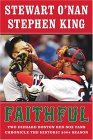
Faithful by Stephen King and Stewart O'Nan

Faithful: Two Diehard Boston Red Sox Fans Chronicle the Historic 2004 SeasonFaithful: Two Diehard Boston Red Sox Fans Chronicle the Historic 2004 Season by Stewart O'Nan
My rating: 3 of 5 stars

This is the ninth book in my 2013 TBR Pile Challenge, and the only nonfiction. I'd been meaning to read it since it came out in 2005, but I just hadn't been able to make room on my reading list until I signed up for the challenge.

Faithful is written as a series of email exchanges, diary entries, and just plain narratives of the 2004 baseball season, following the Boston Red Sox. Stephen King grew up a fan, but Stewart O'Nan came to it later in life, though he's no less avid for being a Red Sox Nation transplant. He wasn't born a Sox fan, but he got here as quick as he could.

Their sections are easy to tell apart, even without the font changes. Stewart has his superstitions, and an entire family rallying around his project, while Stephen's family is mostly grown up and his wife is spoken of little, except as a tolerant bystander. Stewart likes to relate the play-by-plays, while Stephen's passages are, more often, general musings on baseball fandom, the team itself, and his own agony as a lifelong Sox fan.

I rarely follow baseball minutiae, so a lot of the jargon went over my head. The nicknames for players, the slang or abbreviations for plays, and the references to past rivalries were all lost on me. These details certainly filled the pages and ramped up tension for a baseball season whose ending I already knew, but they weren't illuminating in the least. Had I been less of a Red Sox fan, I would've given up on this book.

I like to think I picked up a couple of things, though, and that what I picked up made me a better fan.

After all the painstaking detail and speculation of the earlier sections, the final parts about the pennant win against the hated Yankees, and then their World Series victory, seemed almost cursory. I didn't feel the excitement of the earlier chapters, and the tension seemed to have been used up. I remember I was ecstatic at the Game 4 pennant win, and my elation only grew with each subsequent victory. I felt little of that from either writer, which was disappointing. Surely they could've captured some excitement, instead of focusing most of their narrative on the tragedies at the Boston celebrations.

If you're a Boston Red Sox fan, and you understand baseball jargon, I think you'd love this book. Because I only fit one of the two criteria, I found it acceptably entertaining, if a bit dry in places.

If I ever decide to reread this, I'll make sure I read Baseball for Dummies or the equivalent, first.


View all my reviews

Tuesday, September 3, 2013

Review: The Way of Kings (The Stormlight Archive #1) by Brandon Sanderson

The Way of Kings (The Stormlight Archive, #1)The Way of Kings by Brandon Sanderson
My rating: 4 of 5 stars

This is the eighth book in my 2013 TBR Challenge, and it's the longest of them. It's also the first in a series of ten books about this world and these characters.

The world presented in The Way of Kings is harsher than most fantasy landscapes. Instead of dragons and gryphons and wizards, we're dealing with a world with very little magic wielded by people. The animals and even plant life have adapted to a world with harsh, violent storms. Somehow, these storms can produce a magical light, which can be harnessed into stones. From there, it's used for illumination, and to power magical items left behind by heroes who used to be able to wield magic, themselves.

Into this world we have Dalinar, brother to the deceased king and a powerful lord who holds honor above all. And maybe he's going crazy. Then there's Shallan, a young woman out to steal one of these magical devices from the king's daughter, an atheist. Last but not least is Kaladin, a soldier forced into slavery where he doubles as a pack mule and cannon fodder. He's determined to survive, and to help all those in his squad do so, too.

Kaladin's story was the most interesting, to me. He had the greatest struggles, and the greatest potential for growth. Shallan had some intriguing moments, as well, but she was so removed from the other two characters that it was difficult to see how she tied in. Dalinar's arc interested me the least, to the point where I felt relief, not tension, in the final scenes when all looks hopeless for him. I felt the continuing narrative would've been a lot more interesting carried by one of his two sons.

There are several minor characters, some of whom get their own perspective chapters, but all revolves around these three. It doesn't become obvious until the very end how Shallan is relevant to the rest of the story, and, it seems, her narrative may entwine with that of the assassin Szeth. That could be interesting.

A lot of this book is laying groundwork and showing how the world works, so the 1000-page epic does drag in places. It was hope of finding out what happened to Kaladin that kept me going through it. It's hard to believe Sanderson can sustain this for 10 books, but I guess we'll see. He did find a good place to wrap this one up, while leaving enough threads open that I really want to read the next one, now. (It comes out in March 2014.)

Overall, I recommend you don't start this book until you have some time to make your way through it. I have a feeling the portents are in the details, and you'll miss them if you quickly skim through to get to the good parts. This is a solidly built world, as you can expect from Brandon Sanderson. I just hope all of the characters are up to carrying this story.


View all my reviews

Sunday, August 4, 2013

Review: Things I Want My Daughters to Know by Elizabeth Noble

Things I Want My Daughters to KnowThings I Want My Daughters to Know by Elizabeth Noble
My rating: 4 of 5 stars

This is the seventh book I've read for my 2013 TBR Pile reading challenge. It puts me back on track for my book-a-month goal, as well as my enjoyment of books I'd been meaning to read for a while. I'd picked this book up years ago when I met the author, and have enjoyed everything else I'd read of hers. Why, then, did I hesitate to read this?

That answer is easy: it's about a mother of four daughters who dies of cancer. The last time I almost picked this book up to read, my own mother had been diagnosed with breast cancer, and I felt I would jinx her recovery if I read about a similar mother dying. (My mother has made a full recovery and is doing well. She's been cancer-free for two years.)

The girls' ages are far more spread than that of me and my sisters. The oldest in this book is in her 40's, while the youngest is still in high school. (The British equivalent thereof, anyway.) They're also a lot closer, both geographically and emotionally. They bemoan the distance between them, but they also consider it odd to have not spoken to one another for months, whereas my sisters and I catch up primarily on Facebook, and go years at a time without hearing one another's voices.

The story, itself, follows the four women in the aftermath of their mother's death. She left them letters, and a journal of her life and thoughts. She loved them dearly, but she also sheltered them from certain truths about her life while she was alive. The story lacks any major conflicts, but the sisters' relationships and personalities pull the reader through to the end. I never felt like the story dragged, despite the lack of a strong narrative thread.

The sisters are initially hard to tell apart. Their names are so generic and interchangeable that I had a hard time keeping track, and the omniscient narration didn't help. Perspectives shift from one paragraph to the next, in some passages. So, while each section may list a perspective character, it doesn't stick to that one character enough to solidify that person. By the end, I had them sorted out, but it took me nearly two thirds of the book.

Overall, I liked this book. It starts off bittersweet, but turns into a story about celebrating love and life, and making the most of what one has. I think I'm glad I didn't read it when I was worried for my own mother, though. The opening sections, immediately after the mother's death, would've been more than I could take.


View all my reviews

Monday, July 22, 2013

Review: In the Woods by Tana French

In the Woods (Dublin Murder Squad, #1)In the Woods by Tana French
My rating: 2 of 5 stars

This is another book in my 2013 TBR Pile Challenge, and it has the distinction of being the first book I'm not glad to have made myself read this year. I'd been looking forward to a taut, psychological thriller. Instead, I wound up tangled in a narrative mess.

In the 1980's, two children vanished in the woods in Knocknaree, Ireland. A third child was found with blood in his shoes, and no memory of what happened. Then, over 20 years later, a girl is found dead, and there's a sliver of physical evidence linking the crimes. And the boy, now Detective Robert Ryan and all grown up, is the one assigned to the case.

The premise is intriguing. The follow-through, not so much. We're treated to every false lead, every tedious detail, every single bit of evidence that doesn't pan out. In the end, it's Detective Ryan's sudden flash of insight that breaks the case, and then the book plods on for another 100 pages.

If the idea was to steer people away from wanting to be police detectives, well done, French. By the 100-page mark, I didn't even care about the dead little girl anymore. And it wasn't because I cared about Detective Ryan's angst more. The interpersonal drama takes the forefront in the book, and it's the kind that irritates me most. Detective Ryan's problems all seem to stem from his stupidity or stubbornness.

There's something of a twist in the plot at the end, one that Detective Ryan plays right into, while I read on wondering how this idiot ever made detective. He misses some very obvious signs that a person is manipulating him, fails to question several points, and, in the end, lets a dangerous person get away with it. I understand this happens in real cases all the time, but, if I wanted to be immersed in the reality of tedious and frustrating work, I'd go back to working retail. I read books to escape the tedium, not to be reminded of it and shown how things I didn't even know about it suck.

This is the second thriller I've read this year that's been highly praised, but that I've found tedious and uninteresting. It seems it's just not the genre for me.


View all my reviews

Saturday, July 6, 2013

Review: The Hundred Thousand Kingdoms (Inheritance Trilogy #1) by N.K. Jemisin

The Hundred Thousand Kingdoms (The Inheritance Trilogy, #1)The Hundred Thousand Kingdoms by N.K. Jemisin
My rating: 5 of 5 stars

This is another off the list of books I promised myself I'd read this year. When I signed up for the challenge, I had no idea how much of a favor I was doing myself. I have no idea why I'd put off reading this book, and I'm so glad I motivated myself to finally pick it up. I enjoyed it immensely.

N.K. Jemisin's debut is a fantasy novel with gods and political intrigue, told in first person. The teller is Yeine, a young woman raised in the Northern tribes to be a leader. Because of her father's "savage" blood and her dark skin, she finds little acceptance in her grandfather's court, though she quickly captures the interest of the royal family's "weapons." There are four gods in residence in Sky, all of whom are enslaved to the will of the royal family. The most dangerous of these is Nahadoth, the Nightlord who's human by day, sensual and powerful by night. Yeine is warned early that none of his human lovers have lived through the experience, but she's drawn to him despite—or perhaps because of—the danger.

Jemisin set out a large task for herself in this book. She has a fantasy world to build and establish, a mythology to work into the story without slamming the reader over the head with it, powerful characters to build as vulnerable and flawed, and a large cast of characters to develop. She proves equal to all of the above tasks. This world is full and lush, without a second of infodumping. There are confusing moments, but I trusted the author to make everything clear by the end, and she does.

I loved the style the book was written in, too. Yeine doubles back on her story, sprinkles pertinent mythology into the narrative, and even argues with herself in some sections. A lesser writer might've made the narrative seem fractured with such techniques, but, in this book, it made it flow even better. I felt more like I was in Yeine's head as the story unfolded.

The romance could've felt contrived, or Jemisin could've gone with the alpha male shortcut. She did no such thing. The development of the relationships are as key to the story as Yeine's quest to find out who killed her mother. I understood why the characters felt the way they did for one another, even if I wouldn't have felt the same way. For all his scary sensuality and potential to be an alpha male, I liked Nahadoth. Even the antagonists had reasons for their choices, though Yeine found those reasons distasteful and self-serving.

This book didn't read like a debut. There was no clumsy exposition, no dragging passages that didn't serve the story in any way. The story sucked me in from the start, and carried me through a fascinating, tension-filled ride. This book didn't need to be this good, but I'm glad it was.


View all my reviews

Sunday, April 14, 2013

Review: A Private Hotel for Gentle Ladies by Ellen Cooney


A Private Hotel for Gentle LadiesA Private Hotel for Gentle Ladies by Ellen Cooney
My rating: 4 of 5 stars

This is the fourth book I've read on my 2013 TBR Pile Challenge, which is comprised of books I've been meaning to read but hadn't gotten around to. Once again, I'm shaking my head at myself, wondering why I'd waited so long.

In this case, the answer is that, on its surface, this is another "cheating book." The action is sparked when Charlotte Heath, a headstrong young wife recovers from a long illness to discover her husband kissing another woman. She runs away to Boston, where she holes up in the Beechmont, which is not a fine hotel for upright citizens at all, but a place where the ladies' physical needs are serviced by male staff members.

Ellen Cooney taught Creative Writing one semester at the University of Maine at Farmington, and I was lucky enough to be in her class. She'd asked me to come read to her students at MIT, but I'd needed an operation during the week I would've taken her up on her invitation. My acquaintance with Ms. Cooney certainly makes me more tolerant of certain literary conventions I wouldn't put up with by other writers. But I also think I'd be missing out on some lovely writing.

Charlotte is far from the perfect narrator. She isn't an unreliable narrator, but she is unworldly, uninterested in current events, and indecisive. She keeps her secrets, even from the reader, and makes decisions based on fleeting emotions. She has an appreciation for Shakespeare beyond that of her stuffy in-laws, but she's no scholar, and she gets as caught up in the romanticism as any high school student.

A reader might get to the ending with no idea as to why she makes the decision she does. I know, but not in any way I can vocalize. It's in the spaces between, in the things she doesn't articulate. It's in what she values, and where she can get what she needs. I didn't need her explanation of why she decides what she does, but some readers might. Some readers might vehemently disagree with her decision, too. I doubt I'd've done the same, in her place, but then, I'm living over a century later, aren't I?

This is the sort of historical fiction that couldn't have taken place, but that might have. Not the details; I've never heard of a counterpart to the Beechmont, nor of the baby races detailed in one chapter late in the book. But Charlotte Heath may have existed, she may have fled her husband for the very reason she does in the book, and she may have stepped on a very similar path, once. The people inhabiting this book feel flawed and human and like they really could've existed in that time period.

I enjoyed this book, and, while I usually like to be in a perspective character's head a bit more, I thought it was used to good effect. I didn't expect the ending I got, and I can see where it turned off other readers. But, after I slept on it, it seemed like the ending this story required.


View all my reviews

Saturday, April 6, 2013

Review: Dumping Billy by Olivia Goldsmith


Dumping Billy Dumping Billy by Olivia Goldsmith
My rating: 4 of 5 stars

I'm a fan of Olivia Goldsmith's, which is why I put this book on my 2013 TBR Challenge pile. I don't know if this wasn't the best-written of her work, or if my tastes have changed, but I didn't enjoy this quite as much as her other books. I still enjoyed it, but I was also consciously aware of its flaws.

Despite the book's title and its jacket description, the Billy in question doesn't take up much of the story. Instead, the book is about Katherine (Kate) Jameson, who's escaped her bourgeoisie life in Brooklyn to become the sort of refined Manhattan woman who has a gay best friend, a job at a private school, and a serial problem with boyfriends. At the book's start, she's dating Michael, who's stable and dependable and who her best friend, Elliot, deems boring and not worthy of her. Then her Brooklyn friends, who's she's tried desperately to keep out of her Manhattan life, suddenly intrude in the form of Bina Horowitz, the best of her old friends. Bina's boyfriend was supposed to propose before he left for Hong Kong, but, instead, he dumps her for the prospect of sleeping around while abroad. Bina is heartbroken, until Kate's friends make the connection that a Brooklyn lothario seems to cause all of his ex-girlfriends to get married to the next man they date. They give her a makeover while Kate frets over the advisability of this plan.

Kate holds the strong belief that she's better than her friends, and the text never disavows her of her snobbishness. Her friends are, indeed, wrong to have used Billy to make Jack propose to Bina (though the makeover and distraction and confidence wasn't a bad idea). Her friends are wrong to warn Kate away from dating Billy, herself. Her friends are wrong that there's no substance to him, and of course Billy's problem all along is that no one took him seriously, like Kate does.

It's one thing to have insufferably snobbish heroines who learn humility, but to have Kate proved right repeatedly made her less sympathetic.

Oddly, I did still find myself sympathizing with her, and I felt myself tearing up at the scene where she learns the truth. I felt for her heartache, and I ached to tell her the truth I could so clearly see in those pages. I suppose her insufferable nature was watered down by the clues the reader parsed, but that she didn't.

There are a few introspective scenes that are rather more drawn out than they need to be, and a few recaps of scenes we already read (often recently) that were unnecessary. The book needed some tighter editing, and a little more depth to the non-Kate-and-Billy characters. The snappy Goldsmith dialogue was missing, too; it often felt forced and wooden.

Overall, I enjoyed this book, though it wasn't my favorite Olivia Goldsmith novel. After this, I find myself craving a reread of The Bestseller, as much to revisit what I liked as to check if I still like it as much as when I read it a decade ago.


View all my reviews

Tuesday, February 26, 2013

Review: The Tough Guide to Fantasyland by Diana Wynne Jones


The Tough Guide to FantasylandThe Tough Guide to Fantasyland by Diana Wynne Jones
My rating: 4 of 5 stars

This is the second book in my 2013 TBR Pile Challenge, and, again, I'm left wondering why I put off reading this book for so long. I found this an immensely entertaining and satirical book.

The Tough Guide to Fantasyland is written as a guidebook or encyclopedia to traveling in fantasy realms. It assumes the reader is from our world, or one like it, and has ported into this fantasy world, the one where most fantasy novels are set.

There is no narrative in this book. To get a whole story around the concept, you would have to read The Dark Lord of Derkholm, which Ms. Jones wrote after the Guide, having been inspired to carry the concept further. The Dark Lord of Derkholm is about the lives of fantasy world people and creatures, who have to set up an elaborate show of being beset by an evil Dark Lord so that tourists can come by and vanquish him.

This book, instead, is a series of satiric zingers, better enjoyed the more familiar with fantasy tropes you are. It reminded me of The Devil's Dictionary, with some worldbuilding built in. It pokes fun at the flimsy worlds most fantasy novels are set in, and the assumptions one must make to accept the worlds at face value.

I would recommend this book to anyone who enjoys fantasy but has found worldbuilding lacking, or is tired of the same old tropes. I would also recommend this to fantasy writers, so you know what to avoid.


View all my reviews

Sunday, February 17, 2013

Review: A Fine and Private Place by Peter S. Beagle


A Fine and Private PlaceA Fine and Private Place by Peter S. Beagle
My rating: 4 of 5 stars

This is the first book I've read for my 2013 TBR Reading Challenge, because I've been meaning to read it since I picked it up and got it signed by the author, several years ago. I find it astounding that this book was written when he was 19, though it does read like a debut.

A Fine and Private Place follows several characters' lives (and unlives) in a cemetery in New York City. Jonathan Rebeck is a hermit who lives in a mausoleum, and who comforts the dead as they forget who they are. Michael Morgan and Laura Durand are ghosts, people dead before their time. Campos is the night guard. His ethnicity is never directly given, but he sings in Spanish. Mrs. Gertrude Klapper is a widow who spots Mr. Rebeck, and learns that he lives in the cemetery.

The cemetery, being set apart from the world, proves a slow and easygoing setting. Most of the book involves musings on life and death and souls, musings that are far beyond anything I might've concluded about death at 19. They're far wiser than what I think of it now, even. The characters speak of death with a quiet acceptance and a willingness to move on I can't imagine a teenager able to grasp.

Having met Peter Beagle, it doesn't surprise me that he's always had such self-aware contemplation, but it still awed me.

The book still reads as a debut novel because the pacing is uneven. The main conflict stays on the back burner, as ghosts fall in love and Mr. Rebeck refuses to leave the cemetery and the raven (unnamed, and so not listed in the characters above) brings Mr. Rebeck his meals. There are several mentions of the trial of Michael Morgan's wife, but the repercussions don't arrive until the last 50 pages.

Along the way, the language is downright poetic, and so the meandering pace of the story didn't bother me. It's the jarring shift to tension that stood out, the sudden urgency to reunite the ghostly lovers.

After this book, Peter Beagle went on to write the classic The Last Unicorn, which is different in subject and pacing, but not in atmosphere. The language is all there, the potential to write everything he's written since.

As a debut novel, it's excellent, but overshadowed by his more popular work. Nonetheless, I would highly recommend it to those who wish to contemplate love and life and death.


View all my reviews

Sunday, November 25, 2012

Reading Challenge: 2013 TBR Pile

pile of books
I've decided to participate in a reading challenge in 2013. Generally, I avoid them, because I never know what I'll want to pick up next. But this one allows me enough freedom to read what I want, while nudging me to read things I've been meaning to.

The 2013 TBR Pile Challenge is to take 12 books from one's TBR (to-be-read) pile, with up to two backups. The book must have been there for at least one year, and I'm adding the "difficulty" that I must already own it. Further rules and tracking information is up at Roof Beam Reader.

Here's my list, alphabetical by author, which I'll update with links to reviews as I complete them:

  1. A Fine and Private Place by Peter S. Beagle
  2. A Private Hotel for Gentle Ladies by Ellen Cooney
  3. In the Woods by Tana French
  4. Dumping Billy by Olivia Goldsmith
  5. The Tough Guide to Fantasyland by Diana Wynne Jones
  6. The Hundred Thousand Kingdoms by N.K. Jemisin
  7. The Historian by Elizabeth Kostova
  8. Boy's Life by Robert R. McCammon
  9. The Road by Cormac McCarthy
  10. Things I Want My Daughters to Know by Elizabeth Noble
  11. Faithful by Stephen King and Stewart O'Nan
  12. The Way of Kings by Brandon Sanderson
And my backups are:
  1. Black and White by Jackie Kessler and Caitlin Kittredge
  2. To Say Nothing of the Dog by Connie Willis
That should give me a decent variety from which to choose.

If you want to challenge yourself to read 12 books that you've been meaning to read for longer than a year, visit Roof Beam Reader to sign up, and make sure to read the rules.

Hopefully I'll see you there!