Search This Blog

Showing posts with label TBR challenge 2014. Show all posts

Sunday, November 2, 2014

Review: Fire and Hemlock by Diana Wynne Jones

Fire and HemlockFire and Hemlock by Diana Wynne Jones
My rating: 4 of 5 stars

This is the tenth book in my 2014 TBR Pile Challenge. I always enjoy Diana Wynne Jones' writing, but, for some reason, I've been putting off reading more of her books. Can't imagine why.

Fire and Hemlock is a modern retelling of the Tam Lin tale, with some Thomas the Rhymer tossed in. Polly takes the role of Janet, who rescues Tam Lin with her love. Which, considering Polly is at least 15 years younger than Tom Lynn, and starts off a child, has some discomfiting implications. Polly starts off the story with no memory of Tom, but suddenly recovers them just in time to confront the powerful family who has Tom under its thrall.

The story is confusing in places. Part of it is because Polly doesn't understand, so, as the perspective character, she can't fill us in. But there are several aspects still left unexplained at the end of the story. The main points are covered, but why Laurel needs Tom, and later Tom's nephew, the charming Leslie, is never fully explained. Only those with a familiarity with the original tale will understand Laurel and Morton Leroy's ties to Faerie.

That does lead to far fewer info dumps, but it also makes things confusing in places. And some of the plot points seemed unnecessary. Like, if Tom's ability created the hardware store and the people populating it, why are they related to him? That whole plot point seemed needlessly complex.

I did think Nina's role was an interesting one, but that she was underused. There aren't a lot of overweight girls depicted as strong and desirable. That Polly wishes she could be more like her in the beginning is refreshing, though their later falling-outs were disappointing. I would've liked for Polly to have someone she could rely on, so she didn't have to bellybutton-gaze to reach all of her conclusions. I'm not sure why the story required that she was all alone in the world, except for Tom.

Despite my nitpicks, I did enjoy this story. Unlike many updates to classic tales, this didn't feel like it was shoehorning characters' actions to fit the plot. I understood Polly's motivations, and Tom's choices are understandable in retrospect. I liked it better than Pamela Dean's version. Though, that may have as much to do with the lack of enthusiastic recommendation as it does to the quality of Diana Wynne Jones's writing.


View all my reviews

Saturday, September 13, 2014

Review: The Wind-Up Bird Chronicle by Haruki Murakami

The Wind-Up Bird ChronicleThe Wind-Up Bird Chronicle by Haruki Murakami
My rating: 5 of 5 stars

This is the ninth book in my 2014 TBR Challenge. My sister gave it to me as a Christmas present years ago, but I set it aside for a time when I could get over the intimidation factor. Interestingly, I would not have appreciated it the way I do if I'd read it right away.

Toru Okada is unemployed by choice, living in a house that belongs to his uncle but would otherwise go empty, and has no idea what he wants out of the future. As the story opens, his cat is missing. The cat is named after his brother-in-law, who he dislikes. Then one day, his wife fails to come home from work. The aforementioned brother tells him she wants a divorce, but Okada is determined to find her and talk to her, himself, to get to the bottom of it. She writes him a letter explaining her actions and telling him to move on, but he remains unconvinced. His quest to find her becomes an inner journey, fueled by sensory deprivation inside an old, dried-up well, the mystical sisters Malta and Creta Kano, and his friendship with a flippant teenager who's stopped going to school.

Had I read this book years ago, Okada's passivity would've driven me up a wall. I would've been yelling at him to do something, instead of waiting for a solution to come to him. But two years ago, I found myself in similar circumstances. My husband left, with no hint to where he'd gone. He'd left only a note that explained nothing. Okada's and my stories diverge there; his wife, Kumiko, needs rescuing, and she's worth the effort, whereas my separation was an inevitability, and I'm better off now. Still, I can understand Okada's paralysis, his sense that the solution is out of his hands, his increasingly odd decisions. I didn't have any encounters with a prostitute of the mind, but I can relate to Okada's mental state. The story resonated with me.

The book is beautifully written. Even as a translation, the language is musical, full of vivid imagery. Haruki Mirakami works in impossibility alongside the mundane, and he makes good use of these elements. He has a parallel narrative about a Japanese soldier during WWII running throughout that even this historically illiterate reader can follow.

To call the narrative dreamlike is cheating, because dreams are such an essential part of the story. The story depends on the line between sleeping and waking being porous and blurry.

I was worried this book would feel like homework, or at least that it would be a slog to get through. I expected that I would need to paste a polite smile on my face when my sister asked what I thought. Instead, I find myself hoping she's read it, so we can talk about it. I owe her my thanks for this one. She didn't know it when she gave it to me, but I needed this book.


View all my reviews

Wednesday, August 20, 2014

Review: Her Fearful Symmetry by Audrey Niffenegger

Her Fearful SymmetryHer Fearful Symmetry by Audrey Niffenegger
My rating: 2 of 5 stars

This is the eighth book in my 2014 TBR Challenge, which puts me right on track for a book a month. I requested this as a gift on the strength of Audrey Niffenegger's debut, but delayed it because I suspected it couldn't stack up. What a good instinct I have.

Her Fearful Symmetry is about twins and isolation and death. It starts with the death of Elspeth Noblin following a long illness. Her twin, Edie (short for Edwina) Poole finds out when Elspeth's lawyer contacts Edie's twins, Julia and Valentina, telling them they've inherited her apartment and a tidy sum of money, with strings attached. The apartment is across from Highgate Cemetery, about which Robert Fanshawe, Elspeth's grieving lover, is writing his thesis. When the twins move in, Valentina and Robert start to fall in love, until Elspeth's ghost lets herself be known.

The first two-thirds of this book are compelling, and promise a build to a strong finish. Unfortunately, the book devolves in the last third to an object lesson in how bad it is to be selfish. All of the characters choose selfishly, to everyone's detriment, including their own. If I could remove one trope from the literary canon, it would be characters who screw themselves over. I read the last several chapters with a growing sick dread, and wanted to throw the book when it played out exactly how I feared. Unlike in The Time Traveler's Wife, the ending isn't hopeful. It's just bleak. One character is celebrating her fate at the end, but it feels tacked on.

The book has a lot of missed opportunities. I understand the appeal of a sad ending to make it seem more poetic, but I hate watching characters develop into worse people throughout the narrative when I started out liking, or, at least, understanding them. The more I learned about Elspeth, the more I questioned Robert's initial devotion and why he didn't see through her earlier. I started out feeling sorry for Valentina and Julia, and wound up feeling they deserved one another. Even Martin, the character I liked best, does something unforgivable, and the narrative lets us guess just how deep his betrayal runs.

I don't insist that all characters are likable in a book, but I hate watching the inevitable fate they deserve unfold. It makes me embarrassed for them that they couldn't learn any other way.

If you liked The Time Traveler's Wife, I can't recommend this one. It tries to capitalize on the elements that worked in the earlier book, and instead stumbles all over itself in a clumsy narrative about terrible people. This is one of those reads that made me angry with its wasted potential. It had such a compelling premise and promising setting. That this was the result infuriates me.


View all my reviews

Saturday, July 19, 2014

Review: The Time Traveler's Guide to Medieval England: A Handbook for Visitors to the Fourteenth Century by Ian Mortimer

The Time Traveler's Guide to Medieval England: A Handbook for Visitors to the Fourteenth CenturyThe Time Traveler's Guide to Medieval England: A Handbook for Visitors to the Fourteenth Century by Ian Mortimer
My rating: 4 of 5 stars

My interest in history is in the everyday. Random facts and dates and politics may tell me what shaped the world we have today, but I want to know what people were doing while all that went on. This book, then, was right up my alley. And it was in my 2014 TBR Challenge because otherwise, I was never going to get around to reading it.

The book is, as the title says, a guidebook for anyone wanting to visit England in the 1300's. It discusses customs, fashions, crime, justice, economic classes, conditions living in cities, food, travel, people's homes, and, briefly, the Black Death. It's the first history book I've read about the time period that doesn't dismiss research suggesting the Black Death was viral. But there are entire books devoted to that particular puzzle. In this, it's little more than a footnote, except to note how its effect on lifestyles and the population.

The book is absolutely packed with information. It covers any aspect a person visiting from our time period needs to know so they don't stick out. It presents the populace not as clueless rubes, but as people living their lives and worthy of respect despite their lowbrow humor.

Unfortunately, the Time Traveler's Guide isn't terribly readable. It's excellent as a resource to consult to get a good idea of the flavor of the time, but, as a cover-to-cover read, it's rather dry. That exhaustive research and thorough information doesn't take long to get tiresome. It's like that person at a party you were sorry to ask about their area of expertise when they're still going on about it an hour later.

Overall, this is a valuable resource for anyone who needs to get the flavor of everyday life during the time period. I recommend keeping it on hand to consult as needed, rather than reading all the way through at once. I'm going to keep it on hand, but I'm not going to read it as I did this time around again.


View all my reviews

Friday, June 20, 2014

Review: The Robber Bride by Margaret Atwood

The Robber BrideThe Robber Bride by Margaret Atwood
My rating: 5 of 5 stars

This is the sixth book in my 2014 TBR Pile Challenge. I always enjoy Margaret Atwood's books, but I can never make myself pick them up to read. The challenge seemed like as good an excuse as any.

The story is told through the perspectives of three women. Tony Fremont is a petite history professor, Charis (whose last name is never given, to my recollection) works in a spiritual gift shop and spouts New Agey nonsense, and Roz Andrews is wealthy and owns a women's magazine. All three have been betrayed by a woman named Zenia, and it's this shared experience that holds them together. Otherwise, they have very little in common. Tony is timid and lives inside her own head. Charis is evangelical about her respect for all life, and Roz is brash and bold. Roz is also the only one who identifies as a feminist, though all three exhibit different ideals of feminism. They believe Zenia to be dead, until, over lunch, they see her walk into the restaurant.

Zenia is less a character than a force of nature. She's a chameleon, changing her looks, personality, and approach just to best insinuate herself into these women's lives to wreck them from the inside. She tells each a different story about her childhood, one that echoes each woman's own childhood trauma or resonates in some way. She lies to all three of them about where she is in her life, and she plants seeds of doubt in their own competence, as well as in how well they can trust the men in their lives.

Zenia could be argued to represent a lot of things. She could be the voice of a society that wants to punish the three women for not performing femininity. She might embody mistrust and doubt, sure killers of a relationship. I was leaning in favor of Zenia being an aspect of each of the women whose lives she ruins. On the surface, though, she's manipulative and remorseless. I recognized women I've known in Zenia, though I wouldn't flatter any of them by comparing them to her. She's an amalgam of the evil women pitted against women can do.

The narrative delves deeply into each of the three women. We get series of flashbacks for each of them that show their childhoods, how they met Zenia, how Zenia wrecked their lives, and how their present situations came about.

Interestingly, each of the women winds up in a better place because of Zenia's interference. Charis's Billy and Roz's Mitch were toxic, and the women are better off without them. Charis's grief is the catalyst for her going after an inheritance she deserves. Roz's magazine takes off with Zenia's help, and Zenia gives Roz's son the reason he needs to open up to his mother. While Tony mistrusts West after he returns from being used up by Zenia, he's more devoted than ever after the events, and she buys a lovely house in the meantime to distract herself from her grief. Not that I would argue that Zenia set out to do them any favors. That they were all better off after Zenia tore through their lives was not her goal.

I had to admire Zenia, in a way. She lies with perfect conviction, manipulates everyone around her deftly, wriggles out of consequences without even mussing her hair, and always ends up on top. She's resourceful, and always has a backup plan. We learn very little about her, and what we do learn is unlikely to be true. But we do see a woman who knows what she wants and how to get it.

This book is written extraordinarily well. That's not to say it was an enjoyable read. I spent much of my reading trying not to compare my own troubles with Tony's, Charis's, or Roz's. I sympathized most strongly with Tony, though I'm quite certain my story won't end so neatly. The book did lend me some new perspectives I hadn't considered. Despite my discomfort, I'm glad I read it.


View all my reviews

Saturday, May 17, 2014

Review: The Ladies of Grace Adieu and Other Stories by Susanna Clarke

The Ladies of Grace Adieu and Other StoriesThe Ladies of Grace Adieu and Other Stories by Susanna Clarke
My rating: 4 of 5 stars

This is the fifth book in my 2014 TBR Pile Challenge. I've had it practically since it came out, so I thought now was a good time to get around to it.

This is a companion to Clarke's Jonathan Strange & Mr Norrell, but it's not necessary to have read the novel to appreciate these short stories. They're set in the same version of the world where magic is real and fairies walk among people. The stories read as if they were written in the same Victorian era.

The only story related to Jonathan Strange & Mr Norrell is "The Ladies of Grace Adieu," which explains a minor point from that book. It focuses mostly on the titular ladies. Johnathan Strange puts in an appearance, but as an antagonist. It tells of the friendship of three women, and how they magically protect one another.

The second story, "On Lickerish Hill," is similar to the story of Rumpelstiltskin most of us are familiar with. It tells of a young woman whose mother, in a fit of pique, tells her suitor she's capable of spinning a whole skein a flax in a day. After he marries her, he asks her to prove it, but she can't spin at all. A little man shows up who'll do it for her, and she'll get out of payment if she can guess his name.

"Mrs. Mabb" is your classic tale of fairy enchantment and entrapment, like Tam Lin. A young woman's handsome fiancé goes to visit the mysterious Mrs. Mabb, and doesn't leave again. So she makes it her mission to go to the house. But, every time, she goes into some kind of trance where she wanders for a long while, and doesn't remember the next day. Everything and everyone conspires against her seeing her fiancé again, but she's determined.

"The Duke of Wellington Misplaces His Horse" is set in Stardust's Wall, a border between fairy and human lands. The Duke of Wellington crosses the wall to go get his horse, and comes across a woman embroidering. As he watches, the things she's embroidering come true. The last scene is of a knight in chain mail coming along to kill him, then the woman leaves, and he has to think fast to save himself.

"Mr Simonelli or the Fairy Widower" tells a story through a letter and diary entries. A new parson comes to a poor village, where he meets an uncle he never knew he had. But that uncle is a fairy, and not a very nice one. He's kidnapped a young woman from the village to nurse his child. Mr. Simonelli frees her, and plots to stop his uncle from taking one of the pretty young ladies of the village for a wife.

The main characters in "Tom Brightwind" are a fairy who isn't quite so malicious and a Jewish man. They come across a sad little town, run by a man whose ambition is greater than his motivation. Tom agrees to build a bridge over the river dividing the town, and, being a fairy, has to do it extravagantly and dramatically.

"Antickes and Frets" is a fairy tale about Mary, Queen of Scots, and her attempts to use a friend's power with embroidery to undo the Queen who exiled her. But Mary isn't a very good friend, so her attempts backfire spectacularly.

"John Uskglass and the Cumbrian Charcoal Burner" is about the Raven King often mentioned Jonathan Strange & Mr Norrell. This doesn't showcase his power and might, though. It shows the dangers of hubris, and how no one can consider himself above reproach. While out hunting, Uskglass disturbs the camp of a charcoal burner, and changes his pig into a salmon. So the charcoal burner appeals to a succession of religious saints to teach Uskglass a lesson.

This is, overall, a creative collection, hinting at a deeper world in Jonathan Strange & Mr Norrell. Most of the stories are retellings of various fairy tales. Instead of a modern setting, though, it's in an alternate Victorian England. It can be enjoyed without having read that brick of a novel, but it did make me want to reread the book. The print edition of this book is illustrated by Charles Vess, which is always a treat.


View all my reviews

Friday, April 18, 2014

Review: If You Want to Write by Brenda Ueland

If You Want to Write: A Book about Art, Independence and SpiritIf You Want to Write: A Book about Art, Independence and Spirit by Brenda Ueland
My rating: 3 of 5 stars

This book was a gift from a college professor in 2001, the year I graduated. It's been on my to-read list a while, clearly. Hence its inclusion in my 2014 TBR Pile Challenge.

My professor warned me, as she handed it over, that it was far less useful for practical writing advice and more for inspiration. In that, she was absolutely correct. While there is some advice for how to get started and find one's voice as a writer, I found some of its advice counter intuitive, and sometimes contradictory of my process. The book is If You Want to Write, not If You Want to Be Published.

Brenda Ueland recommends an approach that ignores such words as "craft," "polish," and "honing." Her background is that of a teacher of nonwriters. She's drawn out the inner writer in her students, and the book's purpose is to do the same for its readers. She's interested in helping people find their voices as writers and finding what inspires them.

There are sections where she compares or contrasts pieces of writing, meant to illustrate her points about a looser, less critical approach to writing. At times, her point is well-made, when her students initially turn in stilted prose of the kind they feel they're supposed to write, and eventually write pieces that are flowing and natural. Other times, though, the "better" passages are purple, or just plain rambling. I understand at the time Ueland was writing, the longer, more descriptive passages were better valued, so some of my disconnect is a product of the shift in literary trends.

One of the major points in this book's favor is that it advocates pantstering, or discovery writing. It specifically recommends against outlining or planning out where the story will go. Ueland says, instead, to see where the story takes you. That's an approach I can get behind.

I wish I'd come across this book before I graduated high school. A lot of its lessons would've helped me in my early writing development. In this stage of my writing, though, it reads like a giant step backward. It tells me nothing about how to improve as a writer or how to edit what I've already written.

This book will not help you if you've already written a novel, or if you're ready to edit your pieces. Its main utility is giving a budding writer the confidence to find one's own voice. I'd recommend it to people considered NaNoWriMo; its lessons will help unclog you from the expectations holding back your word count.


View all my reviews

Monday, March 17, 2014

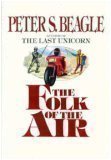
Review: The Folk of the Air by Peter S. Beagle

The Folk of the AirThe Folk of the Air by Peter S. Beagle
My rating: 3 of 5 stars

When people talk about the books Peter S. Beagle has written, this one usually winds up as a footnote. I ran across a copy at a used bookstore, though, and thought it sounded like something I'd like. Then it languished on my shelves, unread. Hence its inclusion in my 2014 TBR Challenge.

The book starts with Joe Farrell returning to his hometown of Avicenna, California. His best friend, Ben, is dating an older woman, and they have a spare bedroom he can borrow until he figures out what his next step is. Then he runs into Julie Tanakawa, an old flame. She introduces him to the League of Archaic Pleasures, a medieval reenactment society. He fits right in, but not before getting on the bad side of their resident sorceress, Aiffe, who can do real magic. Farrell feels sympathy for her when she summons a powerful being, Nicholas Bonner, who she can't control. She has no use for his sympathy, though, being convinced she's the one with the power. Her hubris leads her to confront Ben's lover, who is no mere human, herself.

This was written when urban fantasy was still very new, so it has the feel of trying on a few tropes and tones for size. I don't think Farrell was the right perspective character for the book; his flippancy lends itself to a sense of distance from the story, and he has nothing to do in the crisis point but observe. He's a fun character, and very typical of Peter Beagle's heroes, but I don't think this is his story.

There are several remarkable features to this book, though, which might make it worth the read. First, the language and imagery are lovely. Very evocative. As ever, Beagle conjures images with such turns of phrases that he makes it look easy.

Second is the diversity of the cast. Julie is of Japanese descent, and there are several other nonwhite people in Farrell's social group, many of whom get speaking roles. There's also a diversity of body types. Farrell notes there are a number of larger bodies at the League, and feels no need to share his opinion about their shapes. None of them are described as stuffing their faces, desperate for attention, or ungainly and unable to walk five steps without being out of breath, as fat people are often portrayed in modern media. The most desirable woman in the book is described as being in her 60s with a big belly. It astounded me, that anyone could even get into the mind set to write that with sincerity.

I need the people writing to the trend of fat heroines to look over this book, please. This is how it's done.

As much as I loved the writing and the characters, this book never spoke to me. It felt like a meandering, slice-of-life story with magic and people playing dress-up. The narrative thread was too thin, and, as I noted above, the conclusion described what Joe Farrell saw. He had nothing to contribute at the climax, no reason to be there except as an observer. I'm a lot more interested in the story this book seemed to be setting up at the end.


View all my reviews

Sunday, February 16, 2014

Review: The Wild Wood by Charles de Lint

The Wild WoodThe Wild Wood by Charles de Lint
My rating: 4 of 5 stars

This is the second book in my 2014 TBR Challenge. One would think I wouldn't need motivation to read anything by Charles de Lint, much such a short book. And yet, this has been languishing, unread, for ages on my shelves.

Eithnie is a painter who lives in the Canadian wilderness. Her paintings lately have been missing something; they're too remote and unconnected, though creative. She has a vision of seeing a woman in the forest holding a book, and, ever since, seems able to only paint fairies into her landscapes and scenery. It turns out the local faeries need her for something, something she needs just as badly, herself.

A lot of the book takes place with Eithnie in solitude, and it crosses a period of several months and spans the very different landscapes of Arizona and Canada forest. This leads to something of a sense of detachment from the book and its conflict. I felt like Eithnie wasn't as well-developed as other characters de Lint has written. Her inner struggle felt real enough, but it didn't feel genuine for it to have come to a crisis point only then. And her jump into intimacy when she was afraid to touch the leg of the guy she likes, before, seems abrupt.

Despite my complaints, I still found this a worthwhile read. It has its moments of beauty and fascinating otherworldly creatures drawn from mythology. It has a woman solving her problems by helping those in faerie. It has most of the elements I've come to expect in a Charles de Lint novel.


View all my reviews

Thursday, January 16, 2014

Review: Black and White (The Icarus Project #1) by Jackie Kessler and Caitlin Kittredge

Black and White (The Icarus Project, #1)Black and White by Jackie Kessler
My rating: 4 of 5 stars

This is the first book in my 2014 TBR challenge. The TBR challenge is hosted by Roof Beam Reader, and it's to clear books off your to-read list that have been there longer than a year. I add the "difficulty" that it has to have been taking up space on my shelves longer than that, too.

I actually found a signed copy of Black and White at my local Borders, which should tell you how long I've had it. Jackie Kessler is local to the Capital Region, and must've passed through signing their stock.

I did fret I wouldn't like this book, which is probably why I put off reading it for so long. I've met Jackie Kessler, and she's friends with one of my friends. While I don't consider writing ability a reflection on a person's worth, liking a person more than you like what they can do makes for awkward conversations.

Luckily, I needn't have worried, nor do I have to blame the parts I didn't like on Kessler's co-author. I enjoyed Black and White, and found myself unable to put it down around the 300-page mark. It reads quickly, with short chapters and a back story that matters as much as the present day. I really cared about what happened to Jet and Iridium, and I wanted to know what had driven them apart.

Black and White takes place in a near-future setting, where superhumans are well-known but not necessarily well-liked. The police resent them for showing them up at their jobs, the populace mistrusts them, and the corporation that trains and houses them keeps them on a short leash. One single slip-up with one's powers can get a superhero pronounced "rabid," and sentences them to life in Blackbird Prison. Most go full-on supervillain before they're caught, rebelling against the system that keeps a tight rein.

Jet has shadow powers, but is afraid of what they can do, after seeing her similarly-powered father snap and kill her mother with his power. Iridium has light powers, and her father went the supervillain route before winding up in prison. In a reverse of what one might expect, the shadow-powered one winds up the hero, and the light-powered one the villain. Something happens in their fifth year of training to drive a wedge between them, and, five years later, Jet is determined to bring in Iridium, while Iridium wants to show Jet she chose the wrong side, and get her back for betraying her, in the bargain.

When Jet fails to bring in Iridium, her PR is in trouble, and she embarks on a clandestine mission to fix it. While she does get back in the public's good graces (and almost dies, while she's at it), what she learns has her questioning the things she's always been told about the corporation she works for.

Iridium, meanwhile, works with a vigilante with electric powers to strike at the heart of CorpCo by shutting off the communications that keep the heroes marching to their beat, which will throw the city into chaos. Her plan takes her into Jet's path, where they both uncover something much bigger than their fundamental disagreement. Jet's sense of betrayal runs deep, while Iridium learns that thinking she understands what's going on is what got her where she is.

While it's difficult to capture the spirit of comics in an exclusively written medium, I think Kessler and Kittredge manage it well. The battles feel cinematic without becoming repetitive, and they paint an excellent view of the city of New Chicago and its filthy underbelly, as well as of Jet and Iridium. I expected to be able to tell which character's perspective was written by which writer, but they manage to blend their styles so well that there's no jarring shift from one section to the next.

I greatly enjoyed this collaborative project, and I wish there were more than two books. I'll be reading the second book as soon as I can get my hands on a copy (yes, despite my intimidating to-read pile). That, to me, speaks of a successful book, when the world and characters are so compelling you finish it wanting more.


View all my reviews

Saturday, December 28, 2013

Reading Challenge: 2014 TBR Pile

I succeeded at my 2013 TBR challenge. Not only that, I read 12 books that had been languishing on my shelves, unread, for years.

I have many more that are waiting to be read, though, so I'm also signing up for the 2014 challenge. The rules are, you can add any book you physically own, and have had for longer than a year. As you finish, link up your reviews, and post about them on Roof Beam Reader, where the challenge is hosted. Winners qualify for a prize drawing.

My list for 2014, in alphabetical order by author:
  1. The Robber Bride by Margaret Atwood
  2. The Folk of the Air by Peter S. Beagle
  3. The Ladies of Grace Adieu by Susanna Clarke
  4. The Wild Wood by Charles de Lint
  5. Fire and Hemlock by Diana Wynne Jones
  6. Black and White by Jackie Kessler and Caitlin Kittredge
  7. The Time Traveler's Guide to Medieval England by Ian Mortimer
  8. The Wind-Up Bird Chronicle by Haruki Murakami
  9. Her Fearful Symmetry by Audrey Niffenegger
  10. The Mote in God's Eye by Larry Niven and Jerry Pournelle
  11. If You Want to Write by Brenda Ueland
  12. Blackout by Connie Willis
My two backups are:
  1. Lisey's Story by Stephen King
  2. Animals Make Us Human by Temple Grandin
I'm looking forward to reading these. I leaned heavily on books people gave me as gifts, either because I asked for them or because they thought I'd like them. I'm looking forward to finding out if they were right.