Search This Blog

Showing posts with label nonfiction. Show all posts

Wednesday, September 16, 2015

Review: Mysteries of the Middle Ages by Thomas Cahill

Mysteries of the Middle Ages: The Rise of Feminism, Science and Art from the Cults of Catholic EuropeMysteries of the Middle Ages: The Rise of Feminism, Science and Art from the Cults of Catholic Europe by Thomas Cahill
My rating: 3 of 5 stars

It has been SO long since I've reviewed any books. I stalled on this one, so I thought I could start back up here, and chip away at them. And suddenly, I understand why I went on hiatus for so long.

Mysteries of the Middle Ages tells of an era of history shaped by the Catholic Church and its influences. Its premise is how the modern world owes so much of its culture to the Church. While it does put down some compelling evidence, I'm unconvinced that it's as positive as the author seems to think.

Cahill does go into a lot of history that textbooks leave out. He gives the past texture, gives historical figures motives and contributing factors that turns history into an actual story. The narrative is generally entertaining. This is one of those narrative non-fiction books that generally works. It feels factual and real, at the same time as it carries the reader along.

Well. Mostly factual. I'm no religious or historical scholar, but I'm fairly sure he misrepresents the Islam faith and its proponents. Badly. He gives a stereotyped, one-dimensional characterization that falls flat after he fleshes out so many other historical details. I also disagree with his assertion that the Catholic Church led to women's rights, because Virgin Mary. But then, he views female power as only happening within male power structures, rather than being its own entity.

There are also places where the book drags a bit, as Cahill goes into great detail about a person whose significance isn't apparent until the very end of the chapter. I would've had to be an art major, I suspect, to care about the level of detail put into the chapter about Giotto di Bondone, for instance. I would've liked to learn about his influence, rather than the nitpicky details about his life. The same holds true for Peter Abelard, whose love life is discussed in the same level of detail I'd expect from a soap opera.

Overall, this book is a good starting point for people looking for ways to approach the Middle Ages. Like many entertaining non-fiction books, it lacks depth and authority, but gives a reader some good places to start looking for more information. The book's strength is in its readability and in the texture the author gives the distant past. I would recommend this book to anyone studying the period, provided it wasn't their sole reference.


View all my reviews

Sunday, June 15, 2014

Review: The Nerdist Way by Chris Hardwick

The Nerdist WayThe Nerdist Way by Chris Hardwick
My rating: 4 of 5 stars

I only know Chris Hardwick from his hosting The Talking Dead on AMC. The premise of the book didn't seem terrible, so I thought I'd give it a shot.

The Nerdist Way is a self-help book written specifically toward self-identified nerds. It capitalizes on traits stereotypically associated with being a nerd, and advises ways of thinking about self-improvement that build on other knowledge, like tabletop gaming or chess. Hardwick is quick to point out that he's no expert, just a guy this stuff worked on. He discusses a lot of his journey toward self-improvement, and the obstacles standing in his way.

The book covers self-improvement in three stages: the mind, the body, and time. The first section deals with how a person might be getting in one's own way with implementing change. He specifically addresses anxiety and panic attacks, which he, himself, has had to manage. The second section focuses mostly on fitness, with a little lip service paid to diet. The third dilutes a lot of time management and priority advice into a practical set of guidelines for using the 24 hours allotted you.

I found the middle section to be the weakest. Hardwick conflates weight and health, and never clears up the misconception. He is coming from it from the angle that he was at his least healthy when he was overweight, but he later mentions that people were most concerned for his health after he'd lost the weight and was too skinny. It would be difficult for someone told by a doctor they need to lose 75+ pounds to relate to Hardwick, who reports a difference of 30 pounds between "doughy" and emaciated. While it is valuable to strive to be healthier, weight isn't an accurate measure, especially when you're comparing two people side-by-side.

While the book uses gender-neutral pronouns throughout, there are places where he invokes attitudes common to the male nerd that alienate women. He flirts with the "you deserve hot women" attitude several times, and depicts nerds as unilaterally liberal and open-minded, despite the historic blind spots the community has had in regards to women and minorities. I understand he's a guy writing this book, and therefore has a guy's perspective, but a little awareness of blind spots would've been nice.

All-in-all, though, Hardwick gives his advice in a self-deprecating, easygoing way that makes it sound realistic, and even desirable. He doesn't lay on guilt trips or make blanket judgments. He comes across as just a guy, chatting with friends non-judgmentally about what worked for him. He even hands out experience points for having finished sections of the book.

I listened to this book on audio, narrated by Chris Hardwick. It probably detracted from the middle section, because it's a lot harder to figure out how to correctly exercise when someone is telling you the specifics while you're doing something entirely different. For the most part, though, the narration was a plus. Hardwick has good comic delivery, and his self-effacing remarks are a lot more obvious when he says them aloud. I laughed while listening to this book quite a lot.


View all my reviews

Review: Hen Frigates by Joan Druett

Hen FrigatesHen Frigates by Joan Druett
My rating: 4 of 5 stars

I like to read women's stories throughout history. Princesses Behaving Badly told of women who should've been famous for their status, but who were often forgotten after the gossip died down. They Fought Like Demons tells of women who dressed up as men to fight in the American Civil War. Sea Queens is a YA take on lady pirates. Mrs. Robinson's Disgrace is an intimate look into a Victorian lady's private life. I picked up Hen Frigates on a recommendation that it would be along those lines.

And it was, indeed. This tells of the women who joined their husbands at sea in the 19th and early 20th centuries. Women played ambassador, tended to the sick, raised livestock, helped mend sails, struggled with seasickness and rough seas, gave birth to and raised children, and sometimes even helped crew the ship, all in restrictive, heavy skirts. (One woman in these accounts wore trousers; the rest went about the ship in fairly standard laundry day garb.) The stories are told in their own words, as many women kept a diary while on board.

The book is full of information about naval life in general during the 18- and early 1900's. It contains maps of sleeping quarters and ship layouts, guides on naval lingo, definitions of types of sails, illustrations of the various kinds of ships, and lots of information about the general life onboard, for hired sailors as well as the wives.

The book does acknowledge the superstition about women at sea; some wives fretted they would be blamed for storms or disease or other misfortunes. But it doesn't stop the women from accompanying their husbands. Some women die at sea, some from childbirth and some from disease, and one wastes away because she can't keep food down. Overall, there were enough women at sea that landing at a port became a series of social calls, visiting with old friends one had encountered before.

Though many of the women are writing during the Victorian period, and they all have at least enough education to write, none are the wilting flowers the time period is known for. They remark on troubles with little more than a sardonic remark, the gravity of which has to be gleaned from their husbands' accounts of the same events. The most common complaint is boredom; once they run out of embroidery thread or sewing, many of them resort to learning navigation or other useful aspects of ship life. They're strongly discouraged from mixing with the sailors, though.

The book recounts two instances of a woman taking over the ship. In one case, a daughter puts down a mutiny after her father dies at sea, and navigates home. Another woman is left in control when disease ravages the ship, and she has to navigate, crew, and tend the sick while she, herself, suffers the illness.

Unfortunately, I ran into the same problem with this book as with They Fought Like Demons. The book covers so many women, and in such a scattershot way, that it was hard to follow any one narrative. It gives glimpses of various aspects of these women's lives, without going into much depth. The various sections are by subject, which are only loosely organized, at that.

I learned a lot reading this book, though, and not just about women I'd never heard of before. I found out a lot about the daily lives of sailors during this time period, and what it was like to sail on one of the old sailing vessels, before steamboats halved the time it took to cross the Atlantic. Interestingly, it was the ushering in of steamboats that quashed the practice of women at sea. The owners of the ships claimed the wives were too much of a distraction, and banned them. The book wraps up with the observation that wives aren't a distraction in any other vocation of the time period.


View all my reviews

Wednesday, May 14, 2014

Review: Bait and Switch by Barbara Ehrenreich

Nickel and Dimed: On (Not) Getting by in AmericaNickel and Dimed: On (Not) Getting by in America by Barbara Ehrenreich
My rating: 4 of 5 stars

I've been meaning to read this book for years. My book club is reading it this month, which is as good an excuse as any.

Barbara Ehrenreich is fairly well-known in liberal circles for this book. I'd already read her
  Bait and Switch

, about the job hunt in today's market, and I found it an eye-opening look at the exploitative industry around getting one's foot in the door. I think that one may have been more informative. Or maybe it's because this book's main talking points have become such a part of the cultural knowledge. I didn't learn anything new, because I'd already heard most of the useful information from other sources who'd filtered it through their biases.

You don't have to move to a strange new city with two thousand dollars and the drive to find a minimum wage job to know that there's something off about people forced to work two or three jobs just to meet the basic cost of living. Reports like this one highlight the extreme discrepancy between minimum wage and rent, a gap that widens every time rent prices go up. Meanwhile, Seattle is gradually lifting its minimum wage to $15/hour, while Massachusetts settles on $10.50 or $11. These changes aren't a direct result of this book, but it did give a voice to those too exhausted from working absurd hours. The book illustrates a system of people too ground down to fight the common refrain that they're too lazy to pull themselves up by their bootstraps.

The book isn't perfect. Ehrenreich starts off with little empathy for those living on minimum wage, and often holds herself above them. She never acknowledges the opportunities and luck that allowed her to get an education and a job that paid well. She skims over the advantages in the color of her skin, but doesn't examine in any depth how much harder the struggle might be if she were a different race. The book is best viewed as the start of a conversation, not the entire answer.

The book's greatest strength is in asking for empathy for waitstaff, retail workers, and cleaners. Ehrenreich is consistently amazed at how her co-workers soldier on, despite worse living conditions than what she'll accept and awful nutrition. It never quite sinks in, for her, that this is their lives. They don't get to walk away from their jobs after a month of misery. They have to accept their lot, because they can't afford a few weeks of no income while they scrabble for something closer to home or that pays a little more.

Hopefully those points sink in with the reader. Anything that opens people's eyes to the reality they're asking their service industry workers to live with is a positive, in my view.

But then, when I lived this reality, it wasn't an experiment. I may have a job that uses my degree now, but I haven't forgotten how dehumanizing it was to work retail.

View all my reviews

Tuesday, May 13, 2014

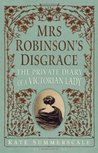
Review: Mrs. Robinson's Disgrace: The Private Diary of a Victorian Lady by Kate Summerscale

Mrs. Robinson's Disgrace: The Private Diary of a Victorian LadyMrs. Robinson's Disgrace: The Private Diary of a Victorian Lady by Kate Summerscale
My rating: 4 of 5 stars

I came across this book when I was looking with my book group for possible future books. I'm interested in the Victorian period, and in particular women's roles in it, so I decided to read this on my own to screen it for the group. While I don't think it has appeal for my book group, I did enjoy reading it.

Mrs. Robinson's Disgrace tells the story of a woman whose husband brought her to divorce court when such an institution was still new and the laws around it were being established. He'd found evidence in her diary that she'd had an affair with a close family friend and physician. It's a true story, and the book includes a lot of historical details to give context to the tale.

The legalities come down to how much of Mrs. Robinson's diary is true. The defense for Mrs. Robinson and her alleged lover argue that her diary is fantasy, for her later entertainment. The men deciding the case, meanwhile, have to read the whole thing. The author points out that this gives Mrs. Robinson a voice in her trial, possibly backfiring on her husband. He's not painted in a sympathetic light within the pages of the diary.

Mrs. Robinson's Disgrace never comes down on one side or another in the truth of Mrs. Robinson's diary. It presents the bare facts, and only the ones that can be substantiated by a reliable source. It takes great care to point out bias in anyone whose perspective it uses.

I found the book's greatest strength in its depiction of everyday Victorian life, especially aspects we don't normally get much exposure to. This depicts the roles of wives, the media, the rise of journals and diaries, the power imbalance between husband and wife, phrenology, the social lives of your average upper-middle-class family, property rights, and legal minutiae. The last is the least interesting, though the precedents set by this particular case might hold one's interest. The book falls flat where it tries to introduce the men hearing the case as characters in their own right, without all of the back story given all of the other people involved in the case. We get glimpses into personal lives or legal careers, and then the narrative talks about them like we're well acquainted.

The book also talks about phrenology like it's a valid science, and not a pseudoscience steeped in racism. It may have been a precursor to psychology, but it was specifically engineered to reinforce the notion of white male superiority. Features associated with white maleness were given positive traits, while those of other races were deemed inferior, and those of women named weak. The book completely ignores that phrenology is not only debunked, it's racist. It continually describes Mrs. Robinson in terms related to her phrenology reading like it's a valid character analysis.

For me, the most interesting thing was what the Victorian public considers salacious. There are details withheld from newspapers that none of us would even blink at. No, not even the sexually repressed among us. Even in the pages of her personal diary, Mrs. Robinson only implies a physical relationship.

I enjoyed this book. It gave me a lot of insight into the Victorian mind, and everyday details. I finished this book greatly relieved how much times have changed, and furious for the women who had to live through that repressive culture.


View all my reviews

Monday, May 12, 2014

Review: Sea Queens: Women Pirates Around the World by Jane Yolen

Sea Queens: Women Pirates Around the WorldSea Queens: Women Pirates Around the World by Jane Yolen
My rating: 4 of 5 stars

I came across this book in the midst of my "where the heck are women in history?" kick. This came up as a recommended resource on lady pirates, so I picked it up from my library.

The book is, indeed, full of information, much of which I didn't know or that I found out from someone who'd read it in this book. It discusses several women pirates, starting well before the time period we normally associate with piracy. Women escaped arranged marriages or lives of prostitution by taking to the sea, and they didn't all have to hide their genders.

The book covers a decent range of time periods and places, but it lacks depth. It's an introductory book for younger readers, not a primary reference. It definitely gets the point across that pirates weren't all male, nor did women pirates have to be a particular type of woman. But this book is a jumping-off point, not where your research should end.

I've always found Jane Yolen's style engaging and easy to follow without talking down to her younger readers. This book is no exception. Once I got past the large print and vivid illustrations, I lost my embarrassment at reading a "kid's book". It's written to be understood by an eight-year-old, and it softens some of the rougher realities of piracy for its younger intended audience. But it's not so childish that parents wanting to screen it for their younger readers would grow impatient with it.

I recommend this to any young readers interested in pirates, and who want to hear more of the story than what's commonly depicted.


View all my reviews

Friday, April 18, 2014

Review: If You Want to Write by Brenda Ueland

If You Want to Write: A Book about Art, Independence and SpiritIf You Want to Write: A Book about Art, Independence and Spirit by Brenda Ueland
My rating: 3 of 5 stars

This book was a gift from a college professor in 2001, the year I graduated. It's been on my to-read list a while, clearly. Hence its inclusion in my 2014 TBR Pile Challenge.

My professor warned me, as she handed it over, that it was far less useful for practical writing advice and more for inspiration. In that, she was absolutely correct. While there is some advice for how to get started and find one's voice as a writer, I found some of its advice counter intuitive, and sometimes contradictory of my process. The book is If You Want to Write, not If You Want to Be Published.

Brenda Ueland recommends an approach that ignores such words as "craft," "polish," and "honing." Her background is that of a teacher of nonwriters. She's drawn out the inner writer in her students, and the book's purpose is to do the same for its readers. She's interested in helping people find their voices as writers and finding what inspires them.

There are sections where she compares or contrasts pieces of writing, meant to illustrate her points about a looser, less critical approach to writing. At times, her point is well-made, when her students initially turn in stilted prose of the kind they feel they're supposed to write, and eventually write pieces that are flowing and natural. Other times, though, the "better" passages are purple, or just plain rambling. I understand at the time Ueland was writing, the longer, more descriptive passages were better valued, so some of my disconnect is a product of the shift in literary trends.

One of the major points in this book's favor is that it advocates pantstering, or discovery writing. It specifically recommends against outlining or planning out where the story will go. Ueland says, instead, to see where the story takes you. That's an approach I can get behind.

I wish I'd come across this book before I graduated high school. A lot of its lessons would've helped me in my early writing development. In this stage of my writing, though, it reads like a giant step backward. It tells me nothing about how to improve as a writer or how to edit what I've already written.

This book will not help you if you've already written a novel, or if you're ready to edit your pieces. Its main utility is giving a budding writer the confidence to find one's own voice. I'd recommend it to people considered NaNoWriMo; its lessons will help unclog you from the expectations holding back your word count.


View all my reviews

Thursday, March 13, 2014

Review: Nothing to Envy by Barbara Demick

Nothing to Envy: Ordinary Lives in North KoreaNothing to Envy: Ordinary Lives in North Korea by Barbara Demick
My rating: 4 of 5 stars

I read this with my book club. It's one of those books I wouldn't have picked up on my own, and I'm glad to have had it shoved in my face. It's far from perfect, and not what I'd call a pleasant read, but I did learn a lot.

The book follows the narrative of several people who escaped from North Korea, and their various reasons why they risked imprisonment to leave the only homes they'd ever known. The author calls them "defectors," which I suppose is accurate, but I saw them as refugees, escaping for better lives elsewhere.

I knew precious little about Korea, approaching this book. All I knew was that my sister is currently posted in Seoul, and her family lives there with her. I knew about the US military presence, and I had a vague idea it had something to do with communism.

Nothing to Envy certainly clarified why we're still there. North Korean forces staying on their side of the 38th Parallel is important. We do not want to risk the spread of conditions in North Korea.

The conditions described in the book are rather like
  1984

, down to the attitude that Russia has always been their enemy, after they'd been allies for decades. ("We have always been at war with Eurasia.") People are watched, their diaries read, and children are taught from a young age that they should turn in their neighbors and friends. The three-generation rule ensures that those who want to rebel keep it quiet, to keep their parents and children from suffering their punishment.

North Korea is so much worse, though. During the famine of the 1990s, various aid groups sent food to help the populace. Most of it went to those in power, or was sold at exorbitant cost on the black market. Conditions in the prisons are worse than bleak, hunger being the only force keeping prisoners from acting out even worse than here in the US. The book describes people stepping over those who've died of starvation in the streets. One woman, a doctor, escapes to China and finds a feast just lying in someone's front yard. It's only when she hears barking that she realizes dogs in China eat better than doctors in North Korea.

The book has a clear political slant, though. It's puzzling, how many pages are spent slamming communism. We already know how easy it is to exploit, and that it doesn't work in practice. The book really loses me, though, when it posits that capitalism has none of the problems of greed, corruption, and starvation, because we fixed it through regulation. I urge the author to take a look at our current political and financial climate, and talk to some recipients of school lunch programs.

The book also reads like a series of articles, loosely stitched together with very little editing. Passages are repeated, often word for word, while context is sometimes lacking. The narratives can be hard to keep track of. While they do all highlight different aspects of life in North Korea, it can be hard to tell within the context which person is being described at any given moment. There are sometimes hints, but not enough.

Overall, reading this book was an eye-opening experience. I learned a lot about North Korea, and about how powerful propaganda and cultural pressure can be in bringing people in line. I finished up this book a lot prouder of my sister for her role in South Korea, helping to maintain the military presence that keeps North Korean forces on their side of the border.

View all my reviews

Tuesday, December 24, 2013

Review: Hyperbole and a Half by Allie Brosh

Hyperbole and a Half: Unfortunate Situations, Flawed Coping Mechanisms, Mayhem, and Other Things That HappenedHyperbole and a Half: Unfortunate Situations, Flawed Coping Mechanisms, Mayhem, and Other Things That Happened by Allie Brosh
My rating: 4 of 5 stars

I didn't think I'd be able to review this book until next year, at the earliest. But a friend bought me some things off my Amazon wish list, and this was one of the things she sent me. As soon as I got over my astonishment and delight, I dug in.

The book's tone and content will be no surprise to Hyperbole and a Half readers. As with The Bloggess's book, this reuses some of the content of the blog. Though, having it in a full-color volume you can lend your friends is a definite plus, whereas with Jenny's book people might've been more irritated that you were making them read.

Allie Brosh has been open about her struggles with depression, and a chunk of the book is taken up by her famous posts about it. The book is far from depressing, though; she puts a creative spin on mental illness, explaining it in a way that both encapsulates the experience, and makes you laugh.

Another portion of the book is about her dogs. One of them is so stupid it's mind-boggling, while the other has no problems taking advantage of it, though she has neuroses of her own. The story of her cross-country move was on the blog, but she adds several anecdotes we haven't heard yet.

Another portion of the book is her strange childhood. I recognized the stories about dental surgery and a birthday party, her grandfather's cake, and about a dinosaur Halloween costume. Again, there are several new stories, as well.

Anyone wanting to read about what happened to the goose that got into her apartment will definitely want to pick this up. It's as hilarious as you imagined.

Overall, I think the book was 2/3rds stories that were already published on her blog, and a third new content. The stories aren't organized in any particular order, and the book isn't much of a cohesive whole. I was disappointed that the alot didn't make it in. But, it is vastly entertaining, and an excellent way to show your family and friends why you so enjoy a blog full of badly illustrated stories.

I am immensely grateful to my friend for getting me this as an early Christmas gift.


View all my reviews

Wednesday, October 9, 2013

Review: Because I Said So! by Ken Jennings

Because I Said So!: The Truth Behind the Myths, Tales, and Warnings Every Generation Passes Down to Its KidsBecause I Said So!: The Truth Behind the Myths, Tales, and Warnings Every Generation Passes Down to Its Kids by Ken Jennings
My rating: 4 of 5 stars

I'd first heard of Ken Jennings from my mother, an avid Jeopardy! watcher. She's the only person I know who records old Jeopardy! episodes on her DVR when she's away, and then actually watches them.

But I digress.

I know he's a smart guy, and the episodes I saw with him up against Watson, the computer opponent, were entertaining. Jennings struck me as the sort of person who has a wealth of knowledge just simmering under the surface, but who doesn't use it as a bludgeon.

It was with these assumptions I picked up his book, Because I Said So! It's an examination of all of the things parents tell their kids, and the factual basis (or lack thereof) behind them. He tackles such diverse warnings as, "Your face will freeze that way," and "There are starving children in Africa!" (That was the location given when my parents chided me, but a number of places have been picked as an example.) Jennings often goes into the origin of parents' sayings, then expounds on the scientific truths behind them. The book is a study in risk assessment, reassuring helicopter parents, and enlightening those who pass things along because it was something their parents said. It's like the joke about the new bride's pot roast, which I'll tell at the end of the review.

The style of the book is light and funny, with quips and one-liners sprinkled throughout. Some of the jokes fell flat, but most got a chuckle out of me. Though the book has a fragmented style, it is grouped by general subject matter, and each section is headed by the parental wisdom he addresses. The final chapter is on sex and relationships, which were interesting, though Jennings doesn't come across as professorial enough to keep away the creepy factor. Hearing him discuss my private parts was a bit like a dinner conversation gone terribly wrong.

My other complaint about the book has to do with its presentation. Unfortunately, repeating myths, even to debunk them, often has the unintended consequence of reinforcing them. The verdict needed to be delivered in a way that undid the damage, instead of the short explanations given.

Overall, though, I found this book both entertaining and informative, and am thinking about who I might want to give it to as a Christmas present. I do know a lot of parents.

I listened to the audio edition, which was narrated by Ken Jennings. He does an excellent job reading his words, and his delivery made me laugh at some jokes that would've fallen flat on the page.

The New Bride
A couple marries and moves in together. Soon, the husband notices that, every time his new wife prepares roast beef on Sundays, she cuts off both ends before she puts it into the oven. He wonders if this makes it more flavorful, or helps it cook more evenly, or what, and finally asks. She tells him she doesn't know; that her mother always did it, so that was how she learned. The next time he speaks to his mother-in-law, he asks her why she cut the ends off her roast beef. She says she doesn't know, but that her mother always did. This is fortuitous, because the grandmother is due to visit the very next week.

Over Sunday dinner, as they're sitting around the table and chatting, waiting for the roast to cook, he asks his wife's grandmother why she cut the ends off her roast, and explains how it's survived the generations. The grandmother blushes, then laughs so hard she can't breathe. Her granddaughter jumps up to get her a glass of water, and the husband stays behind to make sure she isn't choking.

After she's had a big gulp of water, still giggling, the grandmother says, "That was the only way I could get it to fit in the oven!"


View all my reviews

Sunday, July 14, 2013

Advance Review: Princesses Behaving Badly by Linda Rodriguez McRobbie

Princesses Behaving Badly: Real Stories from History Without the Fairy-Tale EndingsPrincesses Behaving Badly: Real Stories from History Without the Fairy-Tale Endings by Linda Rodriguez McRobbie
My rating: 4 of 5 stars

I won a copy of this book through a Goodreads First Reads giveaway. While Goodreads does ask for a review in exchange for the advance reader copy, I was in no way compensated for my review.

This is a collection of stories about real-life princesses throughout history who made their marks, in one way or another. Several make power grabs, while others are known for being the true power behind the throne, or for their madness. There are some warriors, all from non-European backgrounds. Many of the stories are about princesses in the last century or so, known for a certain wildness.

The book's strength is that it covers a lot of different cultures. There are princesses from every continent but Australia and South America. It could've stuck to just European royalty, but the variety fills in a lot of gaps of my own knowledge of history. Two North American princesses are discussed, in very different terms due to their very different approaches to the white conquerors.

While this does go a long way toward showing us where the women were in history, it's not without its faults. The book uses "gypsy" to describe people of Romani heritage, and doesn't question the stereotyped views thereof. It also takes a modern approach to beauty, scoffing at descriptions of plump princesses as attractive and describing all of the European princesses in terms of their looks. The Asian, African, and Native American, apparently, weren't worth considering. Last, it often presents the mythologized stories of these royals for several paragraphs before cutting in to say that's not true, that this is how it really happened.

This book was a decent way to make history interesting and relevant to me. It adds on to my high school courses about dead white guys. But, as a primary resource, it's lacking. I think it's a good jumping-off point for discovering about different people and cultures, but it's not detailed enough. It is a fun read, though the last third felt rather repetitive.

I would recommend this book to middle school and high school students who are bored to tears of their history courses, and want to hear about something other than dates and battles and borders. Budding feminists may also be pleased with the new ammunition about how women have been erased from history.

This book will be released November 19th.


View all my reviews

Monday, June 10, 2013

Review: Let's Explore Diabetes with Owls by David Sedaris

Let's Explore Diabetes with OwlsLet's Explore Diabetes with Owls by David Sedaris
My rating: 5 of 5 stars

I so enjoy David Sedaris's humorous essays. I snatched up his latest on audio, because his delivery often adds to the wry humor within. I thoroughly enjoyed his latest collection, though it leans toward slightly different themes than previous collections.

In Let's Explore Diabetes with Owls, Sedaris mentions in several essays that he's recently reached the age of 50. His mood is slightly more reflective, almost nostalgic in places, and he's not afraid to come off as an old coot with his "back in my day" ramblings.

His sense of humor is still intact. If anything, it's sharpened as he's grown older. I found myself gasping with laughter at the description of his new passport photo, and kept giggling as he narrated what should've been a grim, depressing story. There's a bit more potty humor, but it's tempered with his usual sardonic wit.

The story about owls ("Understanding Understanding Owls") comes out right off the gate, with Sedaris seeking a taxidermied owl as a Valentine's Day present for his longtime boyfriend, and being recognized by the taxidermist for the strange, morbid person he is. It turns into a poignant reflection on illusions in relationships.

Another favorite essay, "Author, Author," discusses his book tours, and the highlight that is the Q&A portion, when he can interact with fans. One woman in Boston answers a startling question with an offbeat reply, and Sedaris's delivery had me glad I'd pulled over to listen to that part. I would've gone off the road, if I'd laughed that hard while driving.

"Day In, Day Out" discusses his habit of keeping a diary, from which he culls his essays. Not only is it fascinating to learn the process that produces his bestselling books, it allows him to share observations that haven't made it into previous essays.

"Obama!!!" delves into politics, with Sedaris winding up disgusted at foreigners' apparent ownership of our election of a black man as US President. He reflects on the lack of candidates who support gay marriage, and hammers home (in a subtle, self-deprecating way) why that matters.

For those who enjoyed Me Talk Pretty One Day, Sedaris has some more musing about language in "Easy, Tiger," where he discusses learning from the Pimsleur audio program, which allows one to memorize phrases without learning the building blocks. A bonus feature on the audio includes a translation of phrases he would've found a lot more helpful on his journeys.

The weak point in the collection were the handful of fictional narratives in the back, included for students who have to memorize a short piece to perform. I'm not as fond of Sedaris's fiction, though it's often bitingly satirical. They're short, though, clocking in at about a third the size of the shortest nonfiction essay.

Overall, I enjoyed this collection. I wasn't disappointed to have bought it, as I can see myself revisiting several of these essays at some later time.

The audio includes some tracks recorded live, and others in a studio. The sound quality is excellent no matter the venue, and Sedaris's reading can be understood perfectly. If you're interested in reading anything by David Sedaris, I recommend picking it up on audio, because his delivery and timing really bring out the humor.


View all my reviews

Sunday, June 9, 2013

Review: Emergence: Labeled Autistic by Temple Grandin and Margaret M. Scariano

Emergence: Labeled AutisticEmergence: Labeled Autistic by Temple Grandin
My rating: 4 of 5 stars

I'd been reading a lot of nonfiction books this year, and I'd noticed that most of them left out the experiences of people with disabilities or mental illness. Over the last few weeks, I've been making a concerted effort to pick up more books about disabilities. So, somehow, this is the second book by Temple Grandin I've read in the last month.

Emergence: Labeled Autistic is a familiar story if you've seen the HBO movie with Claire Danes in the title role. It covers Temple's growing up with autism in a society that had no idea what that meant, her difficulties and adjustments, and how she learned to turn it to her advantage.

This book came out in 1996, so some of the terminology it uses has been phased out. Definitely a lot of the questions answered by her mother about her upbringing (included in an appendix) would no longer be asked today. The book also discusses Temple's having "recovered" from autism, which is no longer in use. Today, we acknowledge that a person with a particular diagnosis may still have a productive role in society, and that overcoming one's difficulties doesn't negate them.

A lot of the understanding we have today about autism and how it works is thanks to Temple Grandin's contributions, and so we have her to thank for the fact that autism isn't a life sentence of isolation and blame. While a lot of people still react negatively to those with autism, there's a movement toward inclusion that's benefiting entire communities.

The narrative has a much different focus than most memoirs I've read. Temple struggles with understanding other people and finding a balance in her life between her fear of overstimulation and the need for some unfamiliarity. She's able to verbalize a lot of her struggles in a way that I found easy to grasp.

While no two people with autism are exactly the same, I found it enlightening to read of Temple Grandin's upbringing and struggles in her own words, and to apply her observations to other people with autism I know. The book is a quick, accessible read, so I'd recommend that anyone, from neurotypical to on the autism spectrum, give it a try. It can't hurt to learn how others perceive the world.


View all my reviews

Monday, May 27, 2013

Review: Nothing about Us Without Us: Developing Innovative Technologies For, By, and with Disabled Persons by David Werner

Nothing about Us Without Us: Developing Innovative Technologies For, By, and with Disabled PersonsNothing about Us Without Us: Developing Innovative Technologies For, By, and with Disabled Persons by David Werner
My rating: 4 of 5 stars

In my search for books about people with disabilities, I came across this, which focuses on physical disabilities. I work with individuals who have intellectual disabilities, but I've heard the phrase this book is named after. I found this guide to have a lot of helpful things to say about the attitudes and approaches to disabilities, and a lot of insight into how different they are in other settings.

Nothing About Us Without Us is about a program in Mexico called PROJIMO, where assistive devices are made for people with physical disabilities. It discusses the various barriers to the use of devices for many of the people they serve, and how they address those issues. The devices are fitted carefully, both to make sure they're doing what they should, and to make sure they'll function in people's everyday lives. The author points out several times that refusal to use a device has many other reasons, other than that the person is simply being stubborn or proud, and addressing the real reason often leads to an improvement in the person's life.

Another lesson learned within the text is of the strength-based approach, where a rehabilitation worker focuses on what a person can do, rather than on the disability. Most of the workers who make items in the PROJIMO workshop are, themselves, disabled, which leads them to insight about why a tool may not be working as well as those who don't use it may want it to. It also helps the people being fitted for devices gain confidence, seeing others like them able to lead full and rich lives thanks to their innovations.

The last section of the book discusses how a disabled child's peers might help that child learn and grow and manage the disability. It discusses the home for young women with intellectual disabilities being tapped to provide daycare services for a severely understaffed state-run home for children with physical disabilities. It shows how young people often bond during their time at PROJIMO, and both benefit from their partnership. It gives an example of a young man feeling needed for the first time in his life because he has the strength to push people's wheelchairs. And it discusses children with no disabilities delightedly playing with their friends to help teach them games that will straighten their limbs or add muscle where they need it.

The book's terminology is sometimes outdated, and it doesn't consistently use people-first phrasing ("a person with a disability" as opposed to "a disabled person"). Some of the words chosen in the text may offend.

Overall, though, I found this an insightful guide into why First World solutions don't work in all settings, and of the unique problems with disabilities facing certain communities. After reading this book, I would strongly advocate that organizations who wish to help people in other settings with disabilities empower their communities to help, instead of stepping in to throw solutions at a problem they may not fully understand.


View all my reviews

Sunday, May 5, 2013

Review: Developing Talents: Careers for Individuals with Asperger Syndrome and High-Functioning Autism by Temple Grandin and Kate Duffy


Developing Talents: Careers for Individuals with Asperger Syndrome and High-Functioning AutismDeveloping Talents: Careers for Individuals with Asperger Syndrome and High-Functioning Autism by Temple Grandin
My rating: 4 of 5 stars

For my day job, I help people with disabilities maintain jobs in the community. Some of my co-workers, meanwhile, match people to jobs and try to get them those jobs. We serve a few people with an autism diagnosis, so I thought this might help as a resource. It contains a lot of perspectives I hadn't considered before, and is absolutely packed with vocational information, for such a short book.

Temple Grandin is best known for her autism diagnosis, either because you've seen her HBO-produced movie where she's played by Claire Danes, or because you've read about her in Oliver Sacks' Anthropologist on Mars. She's also a brilliant woman, and has served as something of a translator between the neurotypical and autistic brain.

This book is mostly addressed toward those with mild autism: questions to ask oneself about learning style, talents, and things to start thinking about. The book is divided into short sections about preparing oneself for the working world in various ways, and pointing out factors many neurotypicals take for granted. People with intellectual disabilities aren't prepped for a career the way neurotypicals are, or at least they weren't when Grandin was writing the book a decade ago.

The final section includes details about various professions, including the training and skills needed, how to prepare, and accommodations that may be necessary. Each career is explained through a person who works in that field. I was rather surprised to find that I knew one of the people discussed in that section, and not through my job, but from childhood.

This book seems like it might be useful, especially for kids with a mild autism diagnosis who are in middle school or just entering high school, or for their parents. It raises a lot of good questions to think about when preparing for the wider world, and anyone equipped with this information early on would have a greater shot at success. It discusses a lot of factors I've seen in my capacity as job coach, but it also brings up a lot of things I hadn't thought of. I was glad I read it.


View all my reviews

Saturday, April 27, 2013

Review: The Psychopath Test by Jon Ronson


The Psychopath Test: A Journey Through the Madness IndustryThe Psychopath Test: A Journey Through the Madness Industry by Jon Ronson
My rating: 4 of 5 stars

I read this book for a book club. It's not one I would've picked for myself, but I'm glad I read it. It's the most entertaining nonfiction non-memoir I've read in some time.

The Psychopath Test follows Jon Ronson through several interviews and meetings with people confirmed to be psychopaths, or who may well be. Along the way, he learns the twenty criterion from Bob Hare, interviews a notorious businessman known for firing people without remorse, sees a young man freed by Scientologists, and solves a mystery.

There is information within this book, but most of it serves as a darkly funny narrative about the dangers of misdiagnosis and the quirks of the psychological industry. Ronson never really gets into how a diagnosis requires that the disease interferes with everyday life or poses a threat to others, nor does he interview anyone for whom a diagnosis has helped. He also shows a lot of sympathy for Scientology and its claims about the total uselessness of psychology.

Still, the book gets points for its entertaining narrative, as opposed to the dry rendering in the last few nonfiction books I've read. The story is an amusing one, and it's easy to get through. I learned just as much about the narrator as I did about the subject at hand.

I listened to this book on audio, narrated by the author. Jon Ronson is British, which is always pleasant for this American to listen to. He speaks clearly and understandably, and his tone certainly adds to the humor of the story. If you decide to pick this up, I recommend the audio version.


View all my reviews

Sunday, April 14, 2013

Review: Quiet: The Power of Introverts in a World That Can't Stop Talking by Susan Cain


Quiet: The Power of Introverts in a World That Can't Stop TalkingQuiet: The Power of Introverts in a World That Can't Stop Talking by Susan Cain
My rating: 4 of 5 stars

What an enlightening book. I've known for years that I'm an introvert, but I've never seen it so thoroughly explained. I've often wondered what's wrong with other people, that they can't be alone with their own thoughts for a few minutes. I've wondered what's wrong with me, that I can't adjust to certain social expectations. But now, I know introversion and extroversion go all the way down to how our brains process information, and just how much it affects.

I didn't realize my vivid dreams were a matter of introversion, nor did it occur to me that my being bad at confrontation is another symptom. I'd learned recently about "performing extroversion," but I hadn't realized it varies based on whether one is a high social monitor or a low social monitor. Those with high social monitoring can fit in with extroverts better, but they strike many people, especially low social monitors, as fake, or sellouts. The book doesn't mention this, but it seems a high social monitor might burn out of social situations faster.

Another factor that goes into introversion is whether one is reward-seeking, or threat-avoidant. I scored rather high on the threat-avoidant scale, meaning new situations have me pausing to look for the catch, rather than jumping in to find out how much fun it might be.

Mostly, the book gave me words for things I experience, and some tips on raising an introverted child. It told me very little I don't already practice in my everyday life. I already do retreat on weekends so that I might recharge. I already carve quiet niches into my work life. My job is even so flexible that it's my co-workers who are expected to network and meet new people, while I deepen working relationships that are already there and use my strengths in the office.

The book discusses the link between anxiety or depression and introversion, as bad situations stick in an introvert's mind and continue to affect that person a lot longer. I've often been chided by extroverts about my clinging to negative experiences; now I know it's how I'm wired.

I'd be interested to know if the rise in depression and anxiety diagnoses correlates at all with the devaluation of introversion in our society. The book does get into the history of the current admiration for extroverted traits, but it falls short of discussing the impact this has had on the 1/3 to 1/2 of the world made up of introverts the author cites throughout the text.

If you're an extrovert, there is useful information for you within these pages. It will tell you how to better relate to your introverted friends, and how you might support your introverted co-workers. If you're an extrovert raising an introverted child, the chapter on raising introverted children is essential, so you know not only that your child isn't punishing you for bad parenting, but also how to best bring out your child's favorable traits.

Overall, I found this an excellent, friendly resource for anyone who wants to know about the role of introverts in modern society. I can see more introverts being drawn to it, because of the subject matter. Despite a few blind spots, it's a fairly comprehensive book that depicts that introverts are not better people than extroverts, but that it behooves us, as a society, to include them.

I listened to this book on audio. Kathe Mazur does a fine job with the narration. She reads clearly, and doesn't stumble over names or concepts. Her voice is pleasant to listen to.


View all my reviews

Monday, April 1, 2013

Review: If You Ask Me by Betty White


If You Ask Me: And of Course You Won'tIf You Ask Me: And of Course You Won't by Betty White
My rating: 4 of 5 stars

Betty White was 89 years old when she wrote If You Ask Me, and, some might argue, at the height of her popularity. Thanks to a Superbowl commercial and SNL appearance, she was appealing to a whole new generation who was only cursorily familiar with her as "the nice one" in Golden Girls.

And so, this book's purpose seems to be to familiarize a whole new generation to this funny lady, who's in on the joke a lot more than people may realize. She doesn't understand the appeal of the internet, and she answers what she does of her fan mail by hand, herself, but she's also a Hollywood and small-screen veteran, with a ton of fascinating stories.

Betty White is a class act, first and foremost. She has nothing but praise and love for everyone she's worked with, and she squeezes in stories about her love for animals whenever possible. When I was listening to the section where she talks about how cats are affectionate, and not standoffish at all, I had two cats curled up on or right next to my lap, and I had to smile.

There isn't much of a narrative structure to this book. Mostly, it's vignettes and short informational blurbs. Sometimes, she repeats herself within the narrative, but the context is often different. She speaks wistfully of growing old, losing friends, what she hopes Heaven will look like, as well as her family growing up, her life in show biz, her difficulty with public speaking, and, of course, about her animals.

I listened to this on audio, narrated by Ms. White. She chokes up a few times when she talks about animals who have passed on, but otherwise, her narration is warm and inviting. She has a vocal "catch" whenever she pronounces the letters "cl" together, but it's not terribly distracting.

This was an enjoyable, quick read, and I recommend it to anyone looking for heartwarming and lovable memoirs.


View all my reviews

Monday, March 25, 2013

Review: Sh*t My Dad Says by Justin Halpern


Sh*t My Dad SaysSh*t My Dad Says by Justin Halpern
My rating: 4 of 5 stars

This book stayed under my radar for a good, long while, until a co-worker lent it to me in return for loaning her
  Let's Pretend This Never Happened

. This doesn't quite contain Jenny Lawson's hilarity, but it is an amusing way to spend an hour or two.

The concept behind this book started out as a Twitter account. While working from home, living with his parents, Justin Halpern started tweeting the funniest things his dad said, thinking only his friends and family would read it. The posts got passed around, and the following spread, until Halpern started getting phone calls from publishers.

The book is an expansion of the out-of-context remarks and stories shared on the Twitter page. Overall, it paints an odd picture of growing up with this guy as a father.

The book has its laugh-out-loud moments, especially in the quotes lacking context at the end of each chapter. Often, it's just his father's words, where one can imagine what the other person must be saying to prompt them. Adding that to the story seems to take some of the humor out of some of the quotes within the chapters.

If you follow the Twitter account, I'm willing to bet you've already read this book. If not, it's a funny way to pass an afternoon. It's not a very substantial read, though. I'd recommend taking it out at your local library.

View all my reviews

Monday, March 11, 2013

Review: A Little History of the World by E.H.Gombrich


A Little History of the WorldA Little History of the World by Ernst Hans Josef Gombrich
My rating: 4 of 5 stars

This is one of those books that's been waiting on my shelves for me to read it for years. I picked it up for an overall view of history, and some idea of cause and effect. I did know, going in, that there would be flaws, and I found them. But I also got what I expected out of it: a simplified view of world history, and how it got us to the 20th century.

The book starts with some speculation about pre-historic humanity. Now, the book was originally published in 1936, so its views are almost a century old. But it needed to start somewhere, and I can't fault its choice, nor that the author was working with what he had.

The book is not only Euro-centric, Gombrich is German. Most of the history centers around Germany, Austria, Italy, and France. There are tidbits of information about China, though Japan isn't mentioned until the 18th century.

The jarring part of the book, for a former student of American history, is how little America plays a part. It warrants a mention here, a brief reference there. Overall, though, America's role in this book is a small one, and not particularly flattering. A person raised in the notion (one I don't wholly agree with) that the US is the center of the world might feel let down by the book.

Also surprising is that the author is aware of colonialism's detrimental effects, though he doesn't call it that word. He references the atrocities committed on native inhabitants, and openly admires Japan for stealing all it can of European culture, then booting the Western world out. His last major reference point is WWI, and doesn't hesitate to describe the events leading up to it as greedy land grabs by the European nations.

There is an afterword, where he corrects a statement in the final chapter of the original, and discusses WWII, Hitler, and the Holocaust. Gombrich, himself, fled Germany, because he has Jewish ancestry.

The book does have its blind spots. As I mentioned, it focuses on Europe, with only minor references to other parts of the world. India's only role is to be conquered by Alexander the Great, while China's contribution is, evidently, Confucius and gunpowder. Even the northern parts of Europe are dismissed.

It also has a Christian-centric view, treating the rise of the Catholic Church and later of Martin Luther as important historical points. While these did leave a mark on history, I don't agree with the author that it was a positive one.

All-in-all, I thought this makes a good place for younger readers to start learning about history, and to give them reference points for any other study of history they may be interested in. It turns it into more of a story than a dry account of battles and kings, though it has those, as well. The language and wording are appropriate for anyone eight years old and up.

I found myself wishing, as I read, that this had been my introduction to world history. Flawed as it is, it's a lot more interesting, and it shows the relationships between events much better than anything I read in school.


View all my reviews